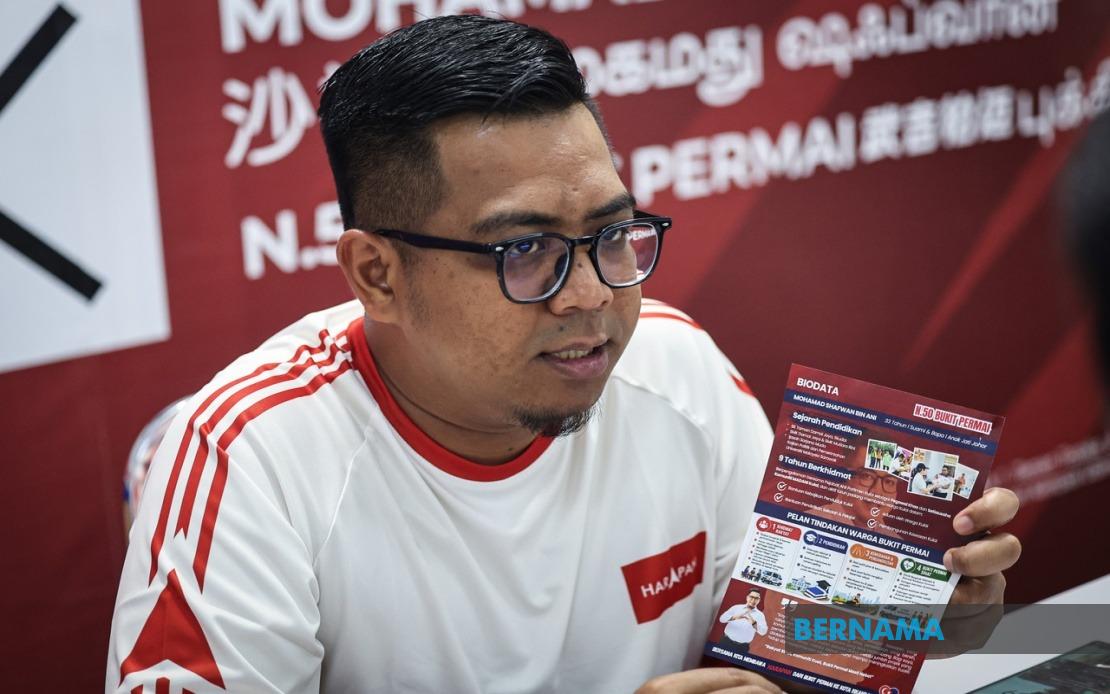
Mohamad Shafwan Ani, the Pakatan Harapan candidate for Bukit Permai in the Johor state election, is staking his electoral fortunes on a track record of sustained community engagement rather than political newcomer credentials. The 33-year-old has emphasised that his campaign represents a genuine extension of nearly a decade spent building political experience in the constituency, arguing that his presence reflects genuine commitment rather than convenience or optics. This positioning is strategically important in a crowded four-way contest where differentiation among candidates is crucial for capturing voter attention and trust.
Shafwan's professional background provides a foundation for his claims of local understanding. As a special officer at the Kulai Member of Parliament's Office since 2017, he has maintained continuous proximity to constituent grievances and the operational mechanics of addressing them. His academic background as a Universiti Malaysia Sarawak graduate in Political Studies and Government offers formal policy knowledge that complements his practical exposure. The combination of nine years' residence in the Skudai-based constituency and institutional access to parliamentary resources presents a compelling narrative for voters questioning whether candidates possess genuine familiarity with local conditions or are merely transient political operatives.
The centrepiece of his electoral platform is the Bukit Permai Action Plan, structured around four substantive pillars designed to address tangible challenges facing constituents. The Mobile State Assembly Service Centre concept recognises a structural impediment many Malaysians face: geographic and temporal barriers to accessing government services. For constituents in outlying areas or those managing precarious employment with limited flexibility, travelling to fixed administrative locations imposes significant costs. By bringing service delivery to strategic points throughout the constituency, the proposal attempts to democratise administrative access while acknowledging the financial constraints of the B40 demographic and elderly residents navigating fixed incomes amid inflation.
The Targeted Education initiative addresses equity within the constituency's educational landscape, proposing needs-based assistance rather than universal but potentially wasteful provision. This approach recognises that financial capacity varies significantly among the 44,819 registered voters in Bukit Permai, and that calibrated support maximises developmental benefit. Similarly, the Balanced Infrastructure component identifies concrete grievances—flash floods, drainage deficiencies, and inadequate road networks in village and Federal Land Development Authority settlements—that frustrate daily life and constrain economic opportunity. These issues resonate particularly among rural and semi-rural communities where infrastructure deficits compound other development challenges.
The fourth pillar, Bukit Permai Sihat, extends to preventive healthcare through free health screenings delivered at accessible locations. For elderly residents and low-income households, preventive care programmes can represent the difference between managing chronic conditions and experiencing acute medical crises that devastate family finances. The integration of this healthcare component alongside service delivery and infrastructure suggests a multidimensional understanding that constituent wellbeing emerges from intersection of administrative access, educational opportunity, physical infrastructure, and health security.
Shafwan's candidacy operates in the context of established electoral patterns. The 2022 contest saw Barisan Nasional's Datuk Mohd Jafni Md Shukor retain Bukit Permai with a 4,755-vote majority, a margin that reflects neither overwhelming incumbent strength nor irreversible opposition weakness. This mathematical reality creates strategic opportunity for a challenger who can convincingly demonstrate superior engagement and more compelling remedies for constituency challenges. Shafwan's lengthy residence and institutional experience position him to articulate the specific genealogy of local problems in ways recent arrivals cannot match.
Campaign incidents provide secondary evidence of electoral intensity. The reported vandalism of his campaign materials, while regrettable, has not deterred his organisational efforts and may subtly reinforce narratives of underdog authenticity and institutional bias. His response—framing the incident as motivation rather than discouragement and delegating investigation to authorities—projects composure and maturity. More substantively, his strategic focus on younger voters, who constitute 30 to 40 per cent of Bukit Permai's electorate, recognises demographic reality within Malaysian constituencies. Youth engagement represents both opportunity and challenge; younger voters harbour distinct policy priorities, demonstrate volatile electoral behaviour, and respond to authenticity claims with heightened scepticism.
Shafwan's rhetorical strategy explicitly rejects poster-based evaluation in favour of demonstrated commitment across time. This framing inverts typical campaign dynamics where visibility and media presence drive candidate recognition. Instead, he invites voter assessment based on consistency and persistence through actual service encounters. For constituents who have sustained interaction with his office since 2017, this appeal carries evidential weight; they possess direct knowledge of his responsiveness or inattention, competence or incompetence. For newer residents, claims require verification through community networks and reputation channels that operate below mainstream campaign visibility.
The volunteer mobilisation Shafwan acknowledges reflects broader Pakatan Harapan organisational patterns in this cycle, where grass-roots energy has rebounded from previous troughs. Volunteer commitment often indicates perception of campaign viability and candidate credibility, serving as informal endorsements that ripple through social networks more persuasively than candidate rhetoric. The maintenance of volunteer enthusiasm across a two-week campaign window, particularly amid opposition targeting and resource constraints, provides operational validation of his campaign's internal momentum.
Johor's broader electoral context shapes individual seat dynamics. With 172 candidates contesting 56 state seats, the election represents a significant political event in Malaysia's most prosperous state economically. Johor's politics have traditionally oscillated between Barisan Nasional dominance and emerging Pakatan strength, with outcomes hinging on whether opposition coalitions can consolidate voter support across urban and rural constituencies. Individual contests like Bukit Permai aggregate into broader patterns that determine whether the current state government retains power or faces replacement.
From a regional perspective, Johor state elections signal broader East Coast and Southern peninsula political trajectories that influence federal policy calculations. A strong Pakatan showing in Johor would suggest growing urban coalition strength extending beyond traditional opposition heartlands in Klang Valley and Penang. Conversely, sustained Barisan performance would confirm that conservative electoral preferences remain formidable in ethnically mixed constituencies where economic anxiety and cultural concerns intersect. Shafwan's candidacy, while individually focused, participates in these larger structural questions about Malaysia's political equilibrium.
The timing of the 2023 Johor election occurs amid economic pressures affecting Malaysian households, particularly rising living costs that feature prominently in Shafwan's campaign messaging. Constituency-level responses to inflationary pressures, whether through price controls, targeted assistance, or infrastructure investment, determine electoral performance. Shafwan's emphasis on reducing burden through service accessibility and health provision directly engages these economic anxieties, proposing mechanisms beyond wage increases or direct cash transfers that constituents perceive as impossible within state government competence.
Ultimately, Shafwan's campaign reflects a particular understanding of electoral legitimacy: that demonstrated service, institutional knowledge, and sustained presence should matter more than external endorsements or resource advantages. Whether this framing resonates sufficiently to overcome the incumbent's 4,755-vote cushion depends on whether Bukit Permai voters prioritise stability and incumbent performance or seek change through an alternative with local credibility. The contest thus becomes a referendum on what constituencies value in representation itself.

