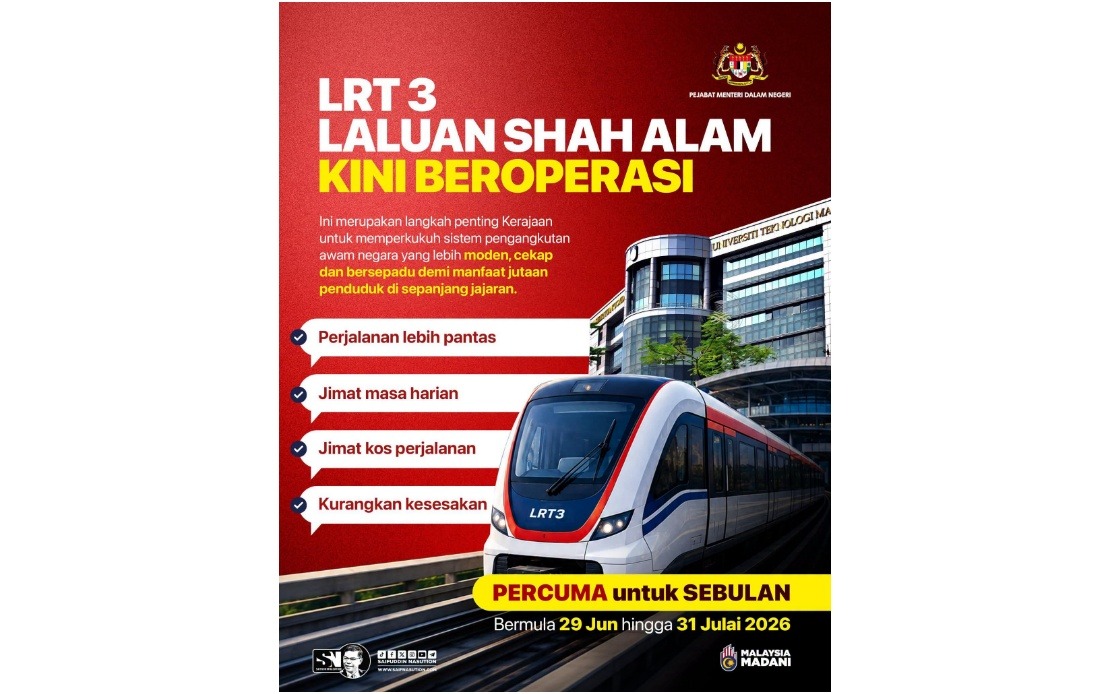
Malaysia's newest rail corridor represents a watershed moment for urban mobility in Southeast Asia's most congested metropolitan region. The Shah Alam Line LRT3, which began operations in late June, signals the MADANI Government's determination to reshape how millions of commuters navigate the sprawling Klang Valley, according to Home Minister Datuk Seri Saifuddin Nasution Ismail. Speaking from Shah Alam, the minister framed the new infrastructure as more than mere engineering achievement—it is a policy statement about prioritising accessible, affordable transport for ordinary Malaysians struggling with daily commute burdens.
The strategic rationale underlying this expansion cuts to the heart of Malaysia's urban development challenges. For decades, the Klang Valley has suffered from transportation bottlenecks that compound daily frustration and economic inefficiency. The corridor served by Shah Alam LRT3 ranks among the country's most congested transport arteries, with hundreds of thousands of workers, students and service users competing for limited capacity. By introducing an additional rapid transit option, authorities aim to divert meaningful volumes from clogged highways, creating space for remaining motorists while offering non-drivers a viable commuting alternative. This dual benefit—reducing congestion whilst expanding access—reflects orthodox transport planning wisdom increasingly adopted across Southeast Asia's major cities.
Beyond congestion relief, the practical benefits extend across multiple dimensions of urban life. Commuters who switch from personal vehicles to rail transport can redirect savings from fuel and vehicle maintenance toward household essentials or education. Travel times predictability improves, as rail services operate on fixed schedules independent of traffic conditions. Workers enjoy flexibility to use commute periods productively—reading, studying, or conducting business—rather than concentrating on navigation. These seemingly modest advantages compound across millions of journeys annually, ultimately reshaping labour market participation and quality of life metrics for Klang Valley residents. The government recognises that modern public transport functions as fundamental infrastructure underpinning economic competitiveness and social equity.
Prime Minister Datuk Seri Anwar Ibrahim's decision to introduce zero-fare operations through July represents a calculated promotional strategy with deeper implications. By eliminating price barriers during the critical early operational phase, the government removes the most obvious deterrent for cautious first-time users. Residents accustomed to car dependency face psychological resistance alongside practical concerns about transit reliability and convenience. A free trial period allows potential passengers to experience the system's actual performance without financial penalty, converting scepticism into informed decision-making. This approach proves particularly effective for lower-income households, where fare costs genuinely constrain mobility choices. When suddenly rendered costless, previously inaccessible transport options may trigger behavioural shifts that persist even after commercialisation resumes.
The complementary role of feeder bus services deserves particular emphasis in understanding LRT3's integrated design philosophy. A rail corridor succeeds only insofar as residents can economically and conveniently reach stations. Prasarana Malaysia Bhd's expanded feeder bus network along the alignment directly addresses this critical last-mile challenge. Without such integration, the corridor becomes useful primarily for passengers already located within walking distance of stations, excluding dispersed suburban communities. By bundling free bus services with free rail fares throughout the promotional period, authorities demonstrate that modern public transport requires systems thinking—optimising the complete passenger journey rather than isolated modal segments.
Geographically, Shah Alam and surrounding municipalities occupy strategic positions within Malaysia's economic geography. These areas host substantial residential populations, manufacturing facilities, educational institutions and government offices. Shah Alam itself functions as Selangor's state capital, while Klang remains a critical port city and industrial hub. Subang hosts Malaysia's oldest airport and surrounding commercial zones. The alignment connecting these nodes taps genuine travel demand from established origins and destinations. Unlike speculative infrastructure, LRT3 addresses real commuting patterns and journey purposes, enhancing its prospects for sustainable ridership development. Southeast Asian cities increasingly recognise that successful public transport demands careful alignment with settlement patterns and employment geography.
Saifuddin Nasution's invocation of MADANI principles explicitly links this infrastructure project to the government's broader policy framework. MADANI governance emphasises inclusive prosperity and enhanced living standards through strategic public investment. Framing public transport improvements within this ideological context positions the government as actively delivering on promises to ordinary citizens experiencing tangible hardship. Transportation challenges transcend class boundaries—wealthy professionals commute alongside blue-collar workers—yet disproportionately burden lower-income groups lacking private vehicle access. Politically, investment in mass transit appeals to aspirational narratives of progressive governance while addressing widespread frustrations that government programmes often benefit elites. The LRT3 initiative thus functions simultaneously as practical infrastructure and political messaging.
The free-fare promotion carries particular relevance for educational institutions clustered throughout the corridor. Students represent a demographic segment most receptive to transit adoption, with lifestyles requiring frequent, affordable mobility. Universities and secondary schools in Shah Alam, Subang and surrounding areas contain substantial populations whose transportation needs have traditionally imposed significant burdens on family budgets. Free transit access during the promotional period may convert student commuters into permanent rail users, establishing transit-oriented behaviours extending far into future decades. This generational dimension of transport policy often receives insufficient analytical attention; choices made during formative years powerfully influence lifetime mobility preferences and car ownership patterns.
Regional context amplifies the significance of Malaysia's expanding rail infrastructure. Across Southeast Asia, rapid urbanisation has overwhelmed road-based transport systems, creating public health crises from air pollution whilst strangling economic productivity through congestion costs. Thailand, Indonesia and the Philippines all struggle with transport gridlock constraining city growth. Singapore's famously comprehensive transit system evolved from decades of deliberate government policy prioritising public over private transport. Malaysia's sequential expansion of LRT networks—now encompassing multiple lines across the Klang Valley—suggests gradual movement toward transport systems more resembling developed city-state models. The Shah Alam Line represents incremental progress within this broader trajectory of sectoral reform.
Implementation timelines and cost considerations warrant closer examination. Major infrastructure projects frequently encounter delays and cost overruns that derail political narratives about government competence. That LRT3 reached operational launch on or near schedule, with the government immediately introducing promotional incentives, suggests effective project management and policy preparation. Sustainability concerns focus on whether free-fare periods successfully convert trial users into permanent customers willing to pay commercial tariffs. Transport economics indicates that fare revenues alone rarely cover rail infrastructure costs; systems depend on integration with urban development patterns, land value capture mechanisms, and cross-subsidisation from profitable peak services. Malaysia's evolving approach to financing public transport thus merits monitoring for indicators of long-term sector health.
Looking forward, the Shah Alam Line expansion establishes foundation for progressive system development. Additional planned extensions, integration with other modal networks, and supporting land use policies will collectively determine whether LRT3 realises its transformative potential or remains an isolated initiative. Neighbouring communities must balance development intensification near stations against affordability concerns ensuring benefits accrue to existing residents rather than purely speculative investors. Pricing structures for post-promotional operations require calibration reflecting equity concerns and ridership targets. Malaysian planners and policymakers now possess real operational data from this corridor—passenger volumes, origin-destination patterns, service utilisation metrics—enabling evidence-based refinements. The MADANI Government's challenge lies not merely in building infrastructure but ensuring it genuinely improves lives across income and geographical spectra.

