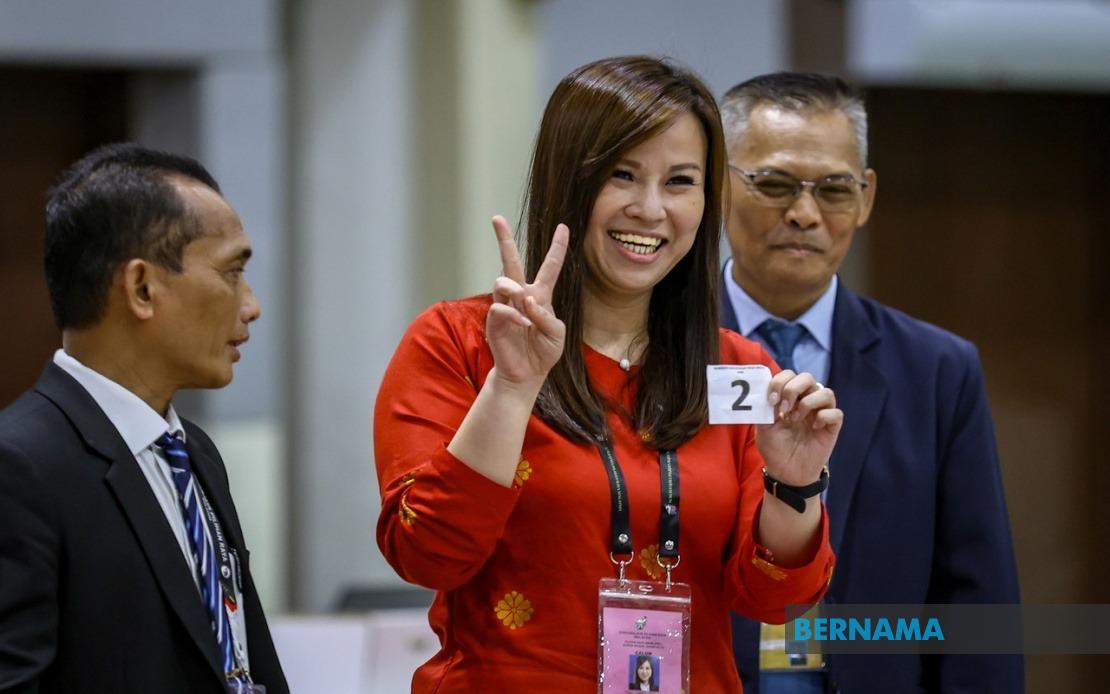
Sharon Teo, the Pakatan Harapan candidate for Permas, has anchored her campaign on addressing two persistent concerns facing the constituency: deteriorating road conditions and gaps in public welfare provision. Speaking after the nomination process at Dewan Muafakat in Johor Bahru, the Johor Amanah Women's Youth chief emphasised that these issues have emerged repeatedly during her constituency visits, reflecting the lived experiences of ordinary residents navigating daily challenges in the area. Her emphasis on infrastructure quality signals an attempt to tap into grassroots frustration with maintenance standards and safety hazards that affect commuters and businesses alike.
Teo brings relevant parliamentary experience to her candidacy, having previously worked as an aide within the Pulai parliamentary constituency under the late Amanah deputy president Salahuddin Ayub. This background provides her with institutional knowledge of how to navigate the Malaysian political system and advocate for constituent interests within larger political structures. However, she remains a relative newcomer to state-level politics, competing against an incumbent with established ground presence and administrative track record. Her campaign strategy appears focused on translating her youth and fresh perspective into an asset, though she has yet to unveil the comprehensive manifesto detailing specific policy proposals for Permas voters.
The road infrastructure angle deserves particular attention given Permas's geographic location and demographic profile. Situated within the Pasir Gudang parliamentary constituency in the southern Johor region, the area has experienced rapid urbanisation and population growth. With 113,963 eligible voters registered for this state election, the constituency encompasses both established residential neighbourhoods and newer developments, all of which place significant demand on local transport networks. Deteriorating road conditions not only compromise public safety but also affect business operations and property values—concerns that resonate across socioeconomic divides.
Incumbent Baharudin Mohamed Taib, who secured the Permas seat in the 2022 Johor election, has acknowledged the competitive landscape ahead of the July 11 polling date. His candid assessment that each of his opponents possesses distinct strengths reflects the fragmented political environment in contemporary Johor state politics. Rather than launching a personal manifesto, Baharudin has indicated his intention to operate within the broader Barisan Nasional framework, suggesting reliance on the coalition's established governance record and institutional machinery rather than distinctive individual policy proposals. This approach prioritises coalition loyalty but potentially limits his ability to articulate a distinctive vision for Permas beyond the broader BN platform.
The Permas contest has evolved into a four-way contest reflecting the current fractionalisation of Malaysian state politics. Beyond Teo and Baharudin, Perikatan Nasional fields T. Vela, while Parti Bersama Malaysia, a relatively newer political entrant, has fielded Dr Zamil Najwah. This four-cornered configuration means that victory could theoretically be achieved with a significantly reduced vote share compared to traditional two-way or three-way contests. Such fragmentation typically rewards candidates with strong ground organisation and consolidated voter bases, creating strategic pressure on each campaign to mobilise their core supporters effectively.
The timing of this contest carries broader implications for Johor's political trajectory and federal dynamics. The 16th Johor state election represents a significant test of voter sentiment across the southern peninsula following the 2022 federal election cycle. Results here will provide crucial signals about the durability of political alignments in Malaysia's most economically significant state outside the federal territories. A strong PH performance would reinvigorate coalition hopes in a state where BN has maintained traditional dominance, while BN consolidation would suggest sustained voter confidence in its governance approach despite recent national political turbulence.
The voter base of over 113,000 registered electors comprises diverse constituencies: established working-class communities, emerging middle-class residential areas, small traders dependent on road networks, and service sector workers. These groups have varying priorities, though infrastructure quality and social support mechanisms affect them universally. Teo's emphasis on welfare provisions alongside road improvements suggests an attempt to address both material infrastructure concerns and social safety net issues, potentially appealing to households experiencing economic pressures while also satisfying business concerns about transportation networks.
Barisan Nasional's governance record in Johor provides substantial material for incumbent messaging. The coalition controls the state government and has channelled developmental resources into the region, delivering various infrastructure projects and service expansions. Baharudin can point to concrete deliverables within his tenure as the seat holder, a tangible advantage against a challenger without comparative track record at the state level. However, voter expectations regarding development have typically escalated over successive election cycles, meaning past achievements may not fully satisfy demands for continued progress.
The electoral calendar matters significantly here. With early voting scheduled for July 7 and main polling on July 11, campaigns have a compressed timeframe to solidify messaging and mobilise supporters. This timeline favours well-organised operations with established ground networks, potentially advantaging the incumbent and BN's traditional machinery. Conversely, Teo's campaign must generate sufficient momentum to overcome the structural advantages of incumbency, requiring exceptional grassroots engagement and compelling messaging around her chosen priorities.
Social welfare considerations warrant deeper examination given Malaysia's evolving discourse around social protection. As the cost of living rises and economic inequality widens, voter receptiveness to substantive welfare proposals has increased markedly. Teo's emphasis on public welfare taps into this sentiment, though specificity regarding proposed interventions remains unclear pending her manifesto release. Permas voters will ultimately judge whether her welfare-focused messaging translates into credible, implementable policy or constitutes aspirational rhetoric.
The Permas election encapsulates contemporary Malaysian state politics in microcosm: fragmented opposition forces attempting to dislodge established incumbents, questions about governance delivery and constituent satisfaction, and tensions between administrative experience and fresh alternatives. How voters resolve these competing considerations will illuminate broader patterns across the peninsula and potentially reshape calculations within all major political coalitions ahead of subsequent electoral contests.

