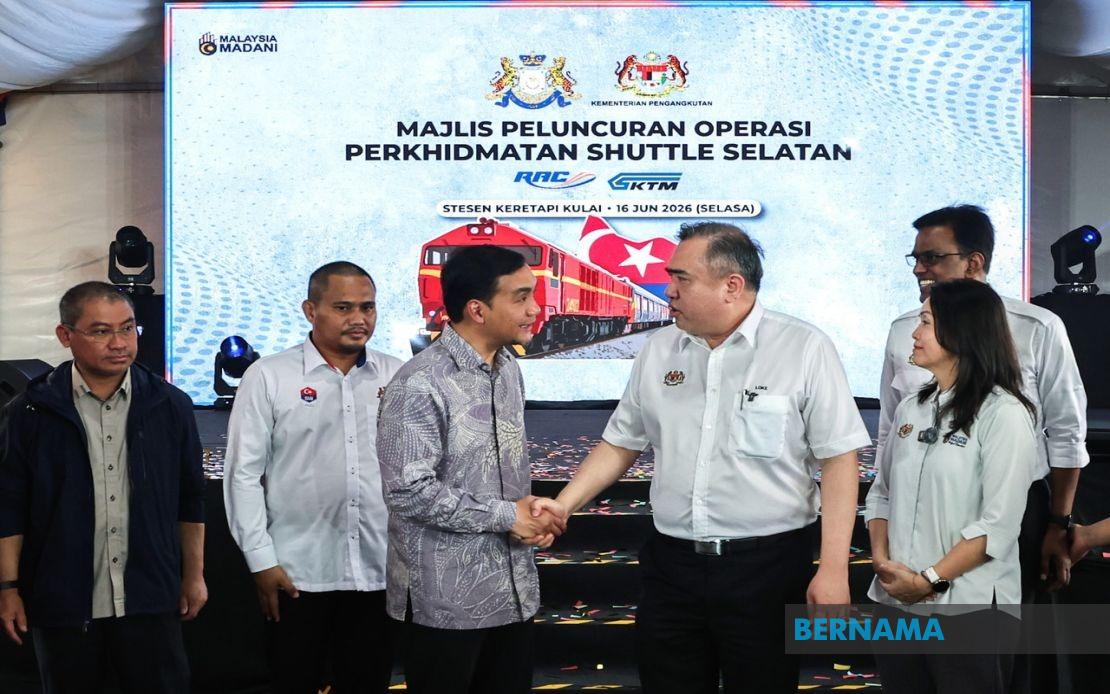
Johor has taken a significant step forward in modernising its public transport infrastructure with the inauguration of the Shuttle Selatan service, a new rail-based shuttle connecting three major population and commercial centres in the state. The service, officially launched on June 16 at Kulai KTM station, links Kulai, JB Sentral and Pasir Gudang—three areas collectively home to more than two million people. Transport Minister Anthony Loke flagged the launch as part of a broader strategic effort to position Johor's transport network in line with the state's accelerating economic development across multiple sectors.
The initial operations of Shuttle Selatan will run on two primary routes designed to maximise accessibility across residential and industrial zones. The first route operates between Kulai and JB Sentral, with journey times of approximately 40 minutes, while the second connects Kempas Baru and Pasir Gudang, taking between 40 and 45 minutes. This configuration allows commuters to move efficiently between the state capital's central hub and key industrial and residential clusters, addressing a longstanding connectivity gap in the region. The relatively quick transit times represent a competitive advantage over road-based alternatives, particularly during peak traffic periods.
Future expansion plans underscore the government's commitment to deepening rail coverage across southern Johor. Transport authorities have earmarked an extension that would stretch the network from Paloh through to Kulai, incorporating intermediate stations at Kluang, Renggam and Layang-Layang. Beyond route extensions, three additional stations—Taman Daya, Bandar Baru Sri Alam and Pasir Putih—are in the pipeline, each strategically positioned to serve burgeoning residential developments and commercial precincts. This phased expansion approach allows the service to mature operationally while new infrastructure is built out systematically.
Minister Loke emphasised that the launch reflects Johor's transformation into one of Malaysia's most dynamic economic zones. The state's industrial sector, logistics operations, port facilities and educational institutions are expanding rapidly, creating demand for transport solutions that can reliably move workers, students and goods. Shuttle Selatan directly addresses this need by establishing dedicated rail connectivity between residential dormitories, commercial and administrative hubs, and manufacturing and logistics nodes. For a state competing to attract investment and talent, efficient public transport has become a critical competitive factor.
Recognising that rail stations alone cannot solve mobility challenges, the government has embedded comprehensive first- and last-mile solutions into the Shuttle Selatan ecosystem. Feeder bus services operated by the state transport authority will connect users from residential areas to shuttle stations, while Bas.My routing has been coordinated to avoid duplication and optimise network efficiency. A dedicated shuttle service operates from Kempas Baru station, a critical interchange hub, and park-and-ride facilities at AEON Bandar Dato' Onn enable drivers to leave private vehicles and transition to rail for their journey into the city. These complementary services transform the shuttle from an isolated rail line into an integrated mobility network.
To overcome behavioural barriers to public transport adoption, the government has introduced an innovative incentive programme centred on the Commuter MADANI Shuttle Selatan Card. Initially, 3,000 cards have been distributed free to eligible residents across Johor, offering unlimited travel for a specified period at a flat RM50 cost. Behind this soft-launch strategy lies a broader messaging effort: the Railway Assets Corporation has underwritten incentives exceeding RM150,000 to seed the transition from private vehicles to rail-based commuting. This subsidy strategy mirrors global practice in cities attempting to shift travel behaviour during the critical early operating months when network perception is formed.
The institutional architecture supporting Shuttle Selatan reflects deep coordination between federal and state transport authorities. The Ministry of Transport, Keretapi Tanah Melayu Berhad (KTMB) and the Railway Assets Corporation have collaboratively designed and deployed the service, representing a harmonisation of federal rail operators and state-level asset management that has historically proved challenging in Malaysian public transport. This collaboration model, if sustained, could serve as a template for similar initiatives across other states grappling with urban sprawl and congestion.
For Malaysian commuters and business observers, Shuttle Selatan carries broader implications. The service signals that Malaysia's transport investment strategy is gradually shifting from highway-centric approaches toward rail-based solutions, a necessary transition for sustainable urban mobility. Johor's rapid urbanisation and industrial growth have strained road networks, making rail expansion economically and environmentally imperative. The shuttle service also demonstrates that medium-capacity rail solutions—distinct from heavy metro systems or light rail networks—can serve smaller metropolitan areas effectively.
The launch also reflects evolving federal transport policy under Minister Loke's stewardship. Previous administrations had deferred or delayed provincial rail initiatives, but recent pronouncements and implementation actions suggest renewed priority for intra-state connectivity. Shuttle Selatan may thus represent a pilot that, if successful, encourages similar services in Selangor, Perak or other states with comparable urbanisation patterns. Success metrics will likely centre on daily ridership, modal shift percentages and cost recovery ratios—figures that will ultimately determine whether the model scales.
Operationally, the shuttle service must navigate persistent challenges facing Malaysian public transport adoption. Private vehicle ownership remains culturally entrenched, parking infrastructure at many workplaces discourages transit use, and fare structures must remain affordable for lower-income workers who constitute a large portion of Johor's commuting population. The RM50 subsidised card addresses affordability temporarily, but the service's long-term viability depends on maintaining affordable tariffs post-incentive period and delivering reliable, frequent service that genuinely saves commuters time and money compared to driving.
For Johor specifically, Shuttle Selatan's success could catalyse additional transport investments and urban planning priorities that privilege transit-oriented development. Land near stations could be rezoned for higher-density housing and mixed-use development, creating urban nodes that generate sufficient ridership to sustain frequent service. Employers near shuttle stations might benefit from reduced parking pressures and improved employee recruitment, as reliable transit expands the geographic pool of potential workers. These secondary effects, though harder to quantify immediately, often determine whether transport infrastructure becomes a genuine transformative asset or remains a symbolic but underutilised amenity.
The service launch also occurs within Johor's broader positioning as an alternative growth engine to the congested Klang Valley. As companies and professionals increasingly seek alternatives to Selangor's saturated markets, Johor's appeal depends partly on quality-of-life factors including commute times and traffic congestion. Shuttle Selatan, modest as it appears compared to major metro systems elsewhere in the region, contributes to this narrative by demonstrating state-level commitment to livability and convenience. In competitive economic development, such signals matter significantly to both investors and talent acquisition.