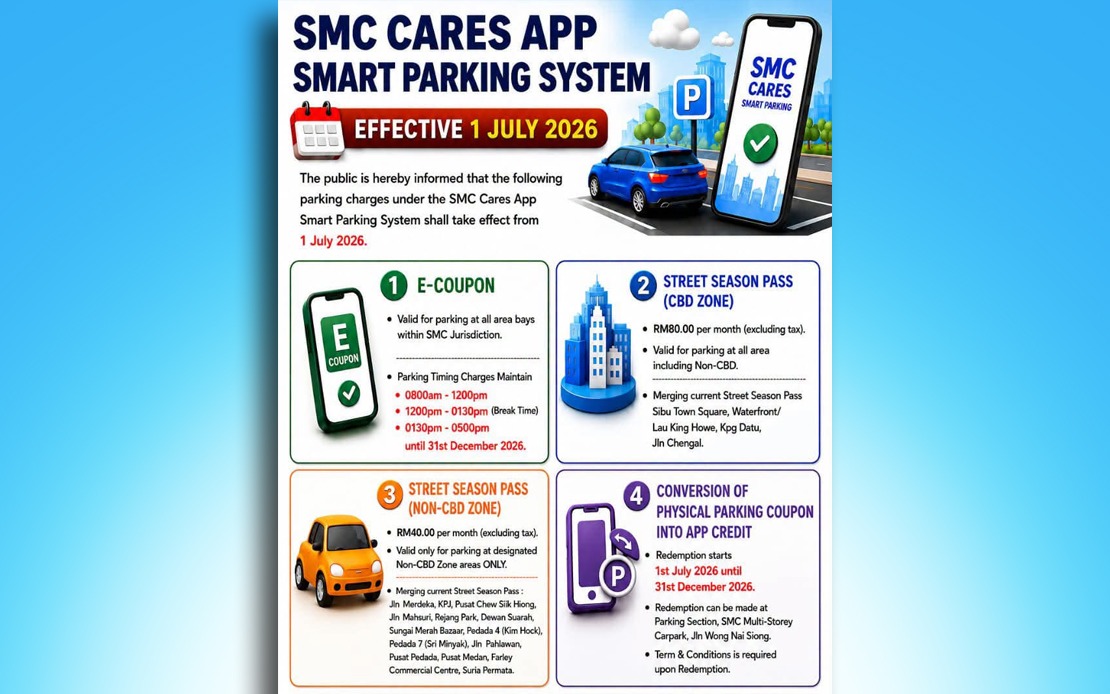
The Sibu Municipal Council has moved to ease tensions surrounding its recently implemented smart parking system by introducing operational refinements designed to address mounting public complaints. Following waves of criticism on social media since the SMC Cares Smart Parking system's full rollout earlier this month, council chairman Clarence Ting Ing Horh announced that motorists will receive a grace window of between five and 10 minutes before an Over Parking Notice is issued, giving users adequate time to activate their parking through the mobile application.
The council's decision reflects acknowledgment that the transition to digital parking enforcement has created genuine friction among users unfamiliar with the technology. Rather than defending the system's rigid initial implementation, Ting framed the adjustment as an effort to prioritise user-friendliness over penalty collection, explicitly stating that the council does not intend to punish the public through overzealous enforcement. The system provider, Primal Solution Sdn Bhd, has been instructed to study and implement these grace period parameters, suggesting the technical infrastructure for such adjustments exists but was not activated during the initial launch phase.
Beyond the grace period, the council will introduce a Senior Citizen Parking Pass programme from August targeting motorists aged 60 and above, though specific details remain forthcoming. This move directly addresses one of the most sympathetic complaint categories: elderly users struggling with app registration and activation. The initiative acknowledges that smart parking systems, while modernising municipal infrastructure, can disadvantage demographics less comfortable with mobile technology. For Malaysia's rapidly ageing population, such targeted concessions signal important recognition that digital convenience must remain accessible across all age groups.
The council has also responded to criticism regarding enforcement consistency by clarifying the roles and limitations of parking wardens employed by the contractor. These wardens are authorised only to enforce parking-related offences such as unpaid charges, expired parking duration, and overstaying. Illegal parking enforcement, including traffic obstruction cases, remains under SMC's own enforcement division and police jurisdiction. This delineation suggests that some social media complaints stemmed from confusion about enforcement authority, though it also raises questions about coordination between private contractor staff and municipal enforcement bodies.
Operationally, SMC has instructed the contractor to enhance customer-facing service standards. Parking wardens must be approachable and available to assist members of the public unfamiliar with the application, and they have been directed to avoid wearing face coverings except for legitimate medical reasons, facilitating public identification and building trust. These measures represent relatively low-cost adjustments that address the human dimension of system adoption—recognising that technology implementation requires adequate support infrastructure.
For users experiencing disputes, the council has established a formal appeals mechanism. Motorists who believe an Over Parking Notice has been wrongly issued, whether due to registration number errors or other legitimate grounds, can submit appeals for council review. Ting emphasised that each penalty is supported by photographic evidence stored within the system, suggesting that documentation standards exist to support fair adjudication. However, the effectiveness of such appeals processes often depends on response times and accessibility, details not yet publicly clarified.
In response to allegations that Sibu charges the state's highest parking fees, Ting asserted that comparative analysis with other Sarawak local authorities demonstrates SMC's rates remain competitive. This deflection addresses a concern that extends beyond user experience to affordability. Malaysian urban centres increasingly rely on smart parking revenue, and parking cost escalation can create genuine hardship for regular commuters. The council's position that rates are competitive rather than exceptional may have limited persuasiveness for users experiencing monthly parking bills that substantially exceed previous charges under manual systems.
The council has also clarified the financial arrangement surrounding the system. All parking revenue collected through SMC Cares is paid directly to the municipal council, while the contractor—Primal Solution Sdn Bhd—receives separate remuneration through a service contract. This structure theoretically insulates the contractor from perverse incentives to maximise penalties rather than facilitate legitimate parking, though it also means the council itself has financial motivation to enforce actively, a factor worth monitoring in coming months.
Adoption metrics indicate that the system has attracted over 93,000 registered users since introduction, with council projections suggesting the target of 100,000 registrations will be exceeded by year-end. These figures demonstrate significant user engagement despite operational friction, though they reveal little about active daily usage or user satisfaction. High registration numbers may reflect either genuine acceptance or simply the requirement that app registration has become necessary to park, rather than reflecting voluntary enthusiasm.
The council has established a dedicated SMC Cares counter at the Sibu Public Library to provide hands-on guidance for users struggling with registration and application navigation. This walk-in support infrastructure represents a tangible commitment to easing adoption barriers, particularly for seniors and less technologically literate users. However, the effectiveness of such support depends on adequate staffing, convenient operating hours, and the extent to which in-person guidance actually resolves systemic usability problems within the application itself.
Publicised complaints have revealed specific technical deficiencies including complicated registration procedures, unfriendly user interface design, sluggish system performance, unexpected automatic logouts, delayed payment processing, and critically, penalties being issued before users could complete parking payments. These operational issues suggest that the system was launched with insufficient user testing or capacity planning. SMC's appeal for users to submit feedback directly to the council rather than relying on social media signals an effort to regain narrative control, though the council would be better served by proactively addressing the documented technical failures that generated the complaints.
For Malaysian readers and other Southeast Asian municipalities considering smart parking implementation, the Sibu experience illustrates both the promise and pitfalls of rapid digital deployment. Smart parking systems offer genuine benefits including reduced time spent searching for spaces and improved municipal revenue management. However, as Sibu demonstrates, successful implementation requires sufficient user testing, accessible support infrastructure, transparent enforcement procedures, and genuine responsiveness to feedback. The council's willingness to introduce grace periods and targeted exemptions suggests institutional flexibility, though observers might note that these adjustments should have preceded full system launch rather than following public pressure.

