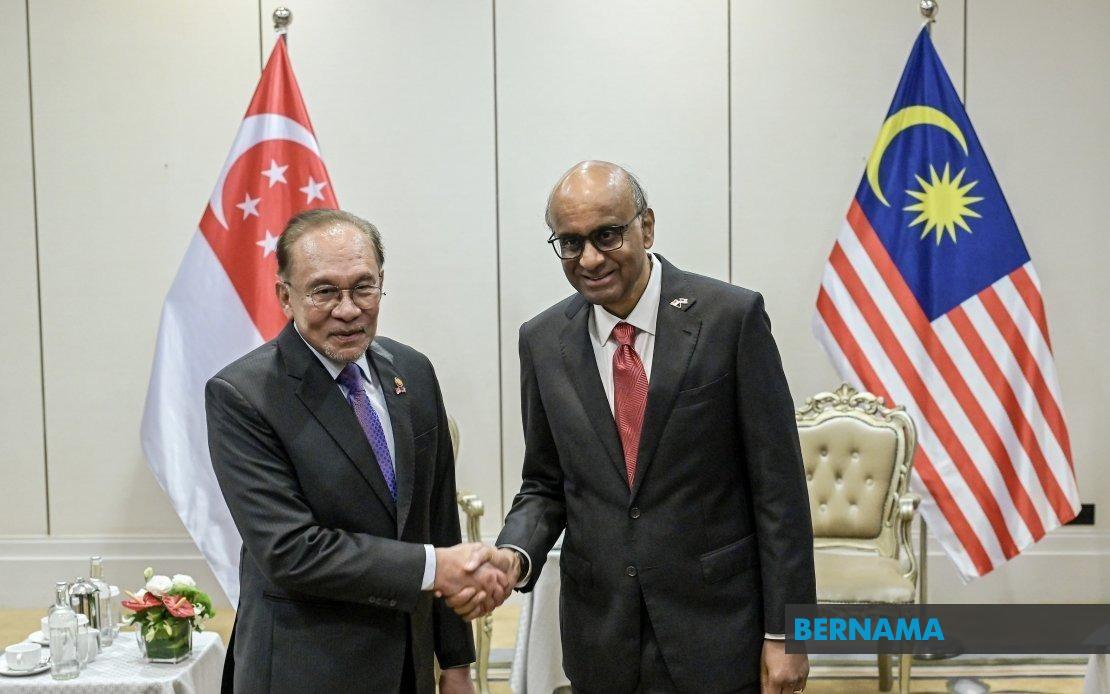
Singapore and Malaysia have committed to broadening their partnership across critical sectors, with both nations identifying food security and energy as priority areas requiring intensified collaboration. The pledge emerged during President Tharman Shanmugaratnam's historic inaugural state visit to Malaysia, which began on July 12 and runs through July 15. The commitment reflects a mutual recognition that the two neighbouring economies face overlapping challenges that demand coordinated regional responses, particularly in ensuring stable supplies of essential resources amid evolving global supply chain uncertainties.
During his courtesy call on Prime Minister Datuk Seri Anwar Ibrahim on Monday, President Tharman articulated Singapore's desire to deepen engagement with Malaysia across multiple dimensions of bilateral cooperation. The Singapore Foreign Ministry statement, released on Tuesday, underscored that both leaders acknowledged the necessity of sustained dialogue and coordinated action on matters affecting regional prosperity and stability. This emphasis on food security carries particular resonance for both nations, as both depend heavily on imported agricultural products and processed foods, making them vulnerable to international market fluctuations and supply disruptions.
The energy dimension of their cooperation agenda reflects broader regional trends toward sustainable development and energy transition. As Southeast Asian economies grapple with climate commitments while maintaining growth momentum, collaborative approaches to energy security, renewable technology deployment, and grid stability have become increasingly important. Singapore's position as a regional energy trading hub and Malaysia's substantial energy resources create natural synergies for deepened partnership, particularly as both nations pursue their respective net-zero ambitions within the framework of regional climate initiatives.
Beyond economic priorities, the two leaders devoted considerable attention to geopolitical developments reshaping the regional landscape. Tharman and Anwar exchanged perspectives on the deteriorating situation in West Asia, a region whose stability has profound implications for Southeast Asian trade routes, security, and economic interests. The Middle East tensions affect shipping lanes crucial to Malaysia and Singapore, both major maritime trading nations, and could influence global energy prices and supply chains that both economies depend upon. This dialogue underscores how regional leaders increasingly recognize that seemingly distant international crises can rapidly cascade into Southeast Asian economic and security challenges.
Central to their discussions was reaffirmation of commitment to international maritime law and the preservation of freedom of navigation across key sea routes. Both leaders emphasized the enduring importance of the United Nations Convention on the Law of the Sea (UNCLOS), the framework that governs maritime disputes and commercial shipping worldwide. This explicit endorsement carries significance given regional tensions over maritime boundaries and resource claims, signalling that Singapore and Malaysia stand together in defending rules-based order and peaceful resolution mechanisms. For Malaysian and Singaporean trading communities that depend on unobstructed shipping through waters like the Malacca Strait, such reassurances carry tangible economic weight.
President Tharman's state visit has afforded him the opportunity to engage Malaysia's leadership at multiple levels, extending beyond federal government circles. On Monday, he and his wife Jane Ittogi Shanmugaratnam received a formal state welcoming ceremony at Istana Negara, where they were received by His Majesty Sultan Ibrahim, King of Malaysia, and Her Majesty Raja Zarith Sofiah, Queen of Malaysia. This protocol reflected the elevated stature accorded to Singapore's head of state, underscoring the diplomatic importance both nations attach to bilateral relations. The ceremonial dimension of the visit creates symbolic weight that reinforces substantive cooperation commitments.
Tuesday's engagements expanded the visit's reach to state-level governance structures, demonstrating that cooperation frameworks encompass subnational actors. President Tharman met with the Sultan of Selangor, Sultan Sharafuddin Idris Shah, and held discussions with Selangor Menteri Besar, Datuk Seri Amirudin Shari. These Selangor-centric conversations proved particularly fruitful, generating discussion of technical and vocational education collaboration, climate adaptation strategies, flood mitigation programmes, and support for start-up ecosystems. The emphasis on vocational training reflects recognition that both economies must develop skilled workforces capable of competing in knowledge-intensive sectors while supporting workers displaced by economic transition.
The climate adaptation and flood mitigation agenda reflects shared vulnerability to environmental challenges affecting both nations. Malaysia's exposure to seasonal flooding and Singapore's low-lying geography create mutual interest in developing and sharing adaptive technologies and practices. Collaborative research and capacity-building on flood management systems, early warning frameworks, and infrastructure resilience can yield benefits extending beyond bilateral relations, potentially informing broader Southeast Asian adaptation strategies. President Tharman's explicit welcome for expanded Singapore-Selangor exchanges signals intention to institutionalize such collaboration beyond one-off engagements.
The start-up ecosystem discussion reveals both nations' commitment to fostering innovation-driven growth and technological entrepreneurship. Singapore and Malaysia increasingly recognize that regional competitiveness depends on nurturing environments where innovative companies can scale across borders, leveraging complementary strengths and talent pools. Closer collaboration on regulatory frameworks, venture capital access, and technology transfer can accelerate development of competitive regional champions capable of competing internationally. This focus on the innovation economy signals how both nations are positioning themselves within global technological shifts driven by artificial intelligence, digital transformation, and green technology deployment.
President Tharman's inaugural state visit marks a symbolic moment in bilateral relations, offering occasion to recalibrate partnership frameworks and articulate shared aspirations. The breadth of issues addressed—ranging from food and energy security through maritime law to climate adaptation and innovation—demonstrates the comprehensive nature of modern bilateral relations between neighbouring city-states and regional economies. For Malaysia and Singapore, deepening cooperation serves not merely bilateral interests but contributes to broader Southeast Asian stability and prosperity, positioning both nations as responsible architects of regional order amid turbulent global circumstances.

