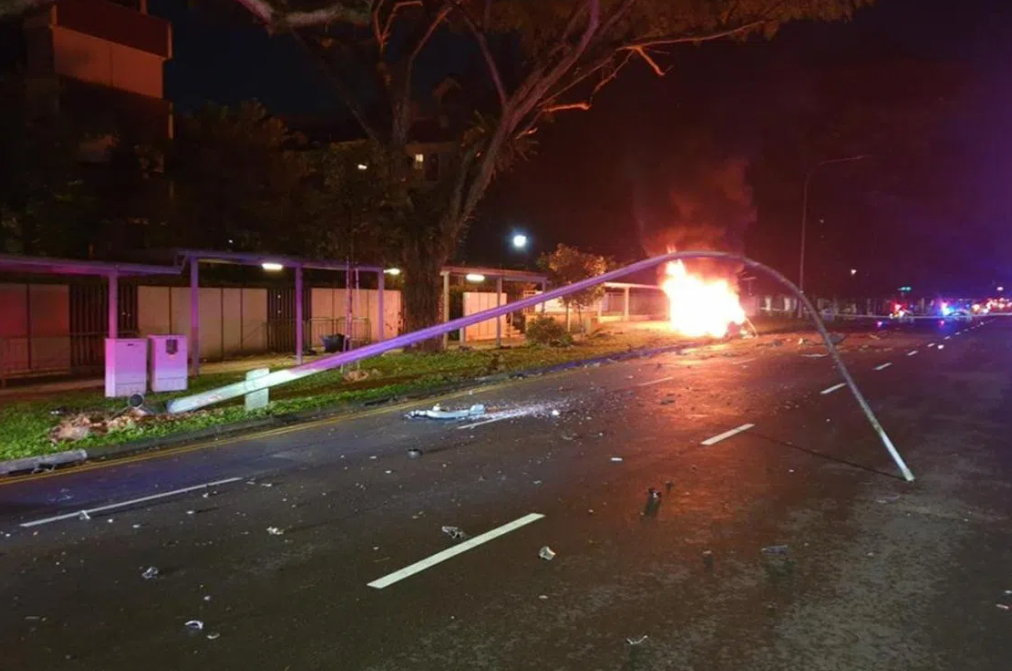
A high-speed rampage through Singapore's early-morning traffic has culminated in serious charges against a repeat drink driver whose actions endangered dozens of commuters and left two young schoolchildren requiring hospital treatment. Aaron Tan Yao Cong, 29, is now facing five charges stemming from the March 6, 2024 incident, which unfolded across multiple locations in the western part of the island and ended with his vehicle engulfed in flames.
The sequence of events, documented in court papers, reveals a dangerous journey that began shortly before dawn. At 5.50am on Cavenagh Road near Bukit Timah Road, Tan disregarded a traffic sign mandating a straight path and instead veered left into the opposing lane. His vehicle came to rest on the left side of the two-lane Cavenagh Road facing toward Buyong Road, already driving directly into oncoming traffic. He and three passengers were able to exit the vehicle safely at this stage.
Twenty minutes later, as police officers approached the stationary car, Tan accelerated and fled the scene, triggering a pursuit that would last several critical minutes. Between 6.16am and his eventual collision, officers observed his vehicle traveling along Bukit Timah Road toward Upper Bukit Timah Road, weaving dangerously between other vehicles while maintaining an average speed of 114 kilometres per hour—well above the legal limit for urban driving in Singapore.
The sequence culminated at the junction of Sixth Avenue, where Tan failed to respect a red traffic signal and struck a private bus that was executing a U-turn. The impact sent his vehicle into a nearby lamp post with sufficient force to ignite a fire that quickly consumed the car. Tan, together with his three companions, evacuated the burning vehicle. However, the bus carried a driver and two passengers—children aged nine and ten—all of whom required hospital admission following the collision. The two young occupants sustained injuries serious enough to warrant medical evaluation and treatment.
Alcohol played a central role in this incident, and testing revealed the extent of impairment. When arrested, Tan initially refused to submit to a breathalyser examination at the scene, a refusal that itself constitutes a separate criminal offense. Subsequent testing showed his blood alcohol concentration at approximately 148 milligrams per 100 millilitres of blood, nearly twice the legal threshold of 80 milligrams per 100 millilitres. This was not Tan's first encounter with impaired driving. Court records indicate he had previously been convicted of drink driving and driving without due care and attention in 2019, making him a repeat offender and substantially increasing the severity of potential penalties.
The charges filed on Thursday, June 18, reflect the gravity of his actions and include drink driving as a repeat offense, dangerous driving causing hurt, leaving a vehicle in a hazardous position, failing to cooperate with breathalyser testing, and driving against the flow of traffic. Tan has not indicated whether he intends to plead guilty to any of the charges, and his case is scheduled to return to court on July 16 for further proceedings.
The sentencing framework for these offenses underscores Singapore's rigorous approach to dangerous driving. For drink driving as a repeat offense, Tan faces imprisonment of up to two years and a fine reaching $20,000. The dangerous driving causing hurt charge carries a maximum two-year sentence and $10,000 fine, with repeat offenders subject to enhanced penalties of up to $20,000 and two years' jail. The offense of leaving a vehicle in a dangerous position carries three months' imprisonment and $1,000 in fines, while failing to provide a breath specimen can result in six months' jail and $5,000 in fines for repeat offenders, with possible enhancement to one year and $10,000.
This case carries particular resonance in Southeast Asia, where drink-driving remains a persistent public safety challenge across the region. Singapore's strict enforcement regime and substantial penalties reflect the island nation's zero-tolerance stance toward impaired driving, yet incidents involving repeat offenders demonstrate the limits of punitive measures alone. The involvement of schoolchildren amplifies concerns about the vulnerability of young passengers and the unpredictable consequences of reckless driving on public roads during commuting hours.
For Malaysian readers, the incident offers instructive parallels to domestic road safety challenges. While Malaysia has established its own drink-driving legislation and penalties, enforcement inconsistency and the prevalence of repeat offenders remain concerns requiring sustained attention. The case illustrates how impaired driving combined with excessive speed and traffic violations creates a cascade of endangerment, affecting not only the driver but innocent bystanders, particularly children. Early-morning incidents like Tan's rampage may suggest testing periods when enforcement is less visible, potentially emboldening risky behaviour among some drivers.

