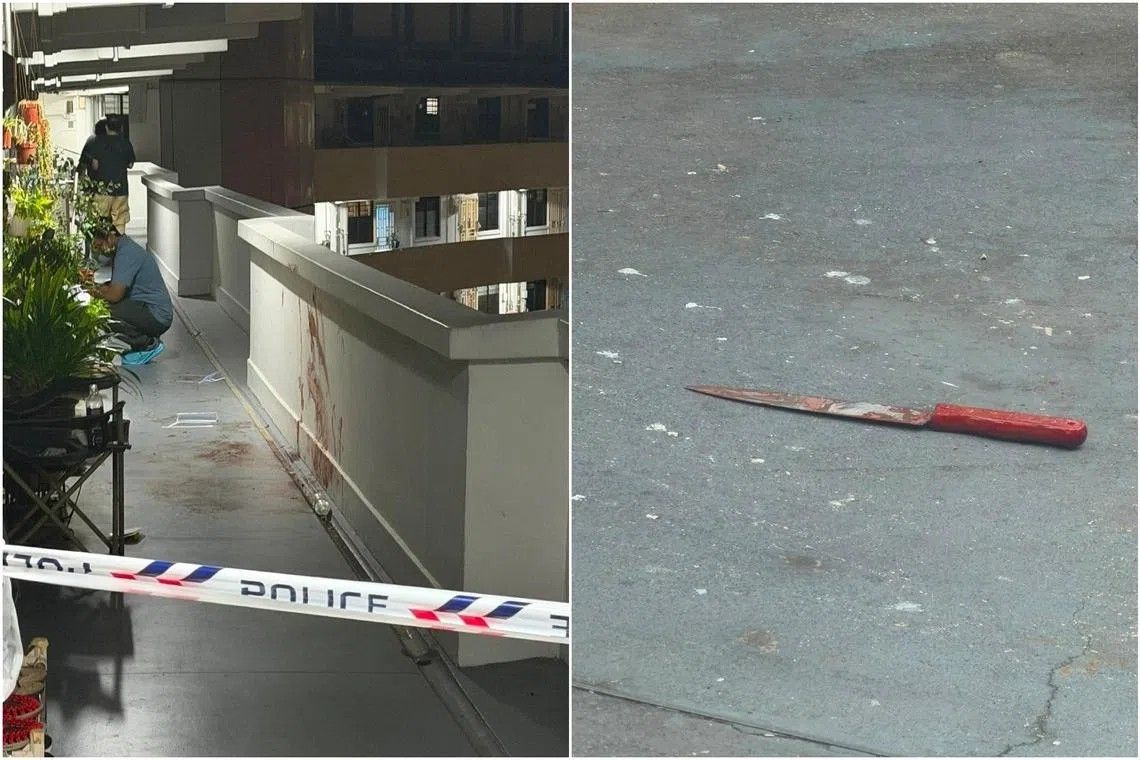
A Singapore resident has been formally charged with murder after the death of his neighbour in what authorities describe as an incident at a residential block in the Redhill area. Ng Swee Seng, 59, appeared before a district court via video link on July 22 to face an accusation that he unlawfully caused the death of Thiyagarajan Karunakaran, also 59, at Block 55 Lengkok Bahru on July 20.
The circumstances surrounding the death emerged after police received multiple emergency calls shortly before 5pm on July 20. Officers dispatched to the scene discovered Thiyagarajan motionless in the lift lobby situated on the 16th floor of the residential block. He was swiftly transported to the National University Hospital but succumbed to his injuries later that evening, according to police statements released at the time.
When journalists visited the block on July 21, visible evidence of the violent nature of the incident remained apparent. Bloodstains and a distinctive bloodied footprint were observed along the 16th-floor corridor, suggesting a struggle had taken place within the residential unit before the victim was found at the lift lobby. Such physical evidence often plays a crucial role in homicide investigations, helping establish the sequence of events and movements within the crime scene.
The two neighbours occupied separate units on the same floor, though they lived several doors apart according to a resident interviewed by The Straits Times. This detail suggests the incident may have stemmed from a domestic or neighbourhood dispute rather than a chance encounter. For many public housing residents across Southeast Asia, close quarters and shared communal spaces can occasionally become flashpoints for interpersonal conflict, though violent incidents of this severity remain comparatively rare.
The incident at Block 55 Lengkok Bahru underscores the unpredictable nature of residential violence, where apparently ordinary living arrangements can conceal underlying tensions between occupants. Proximity in housing estates—whether in Singapore's high-density Housing and Development Board blocks or similar public housing elsewhere in the region—creates unavoidable daily interactions that, while generally harmonious, occasionally deteriorate into serious conflict.
Singapore's criminal justice system treats murder charges with considerable gravity. The legal definition encompasses unlawful killing with premeditation or during the commission of another felony, and such charges typically carry severe penalties upon conviction. The appearance via video link on July 22 represents an early stage in the judicial process, with further proceedings likely to follow as investigations continue.
The Redhill area, where Lengkok Bahru is located, comprises established residential neighbourhoods within central Singapore. Violent crime remains statistically uncommon in Singapore compared to many other urban centres globally, with stringent law enforcement and community policing contributing to public safety perceptions. However, incidents such as this remind residents that social tensions can occasionally manifest in tragic ways regardless of broader crime statistics or general safety records.
For Malaysian observers and those throughout Southeast Asia, such incidents serve as reminders of the importance of community vigilance and conflict resolution mechanisms within residential environments. Many housing estates across the region have implemented neighbourhood watch schemes, community mediation services, and resident liaison committees designed to address tensions before they escalate into violence. These preventive approaches prove more effective than reactive law enforcement interventions following serious incidents.
The investigation into the circumstances leading to Thiyagarajan's death will likely examine the relationship between the two men, any prior disputes, potential motives, and the specific sequence of events on July 20. Homicide investigations typically involve forensic analysis of physical evidence, witness statements from other residents in the block, and examination of any prior police interactions involving either party.
As the case proceeds through Singapore's courts, it will inevitably attract attention across the region given the serious nature of the allegations and the fact that such violent incidents among neighbours remain comparatively exceptional occurrences in Singapore's residential precincts. The broader implications for housing estate management, conflict prevention, and community intervention services will likely inform discussions among housing authorities and social agencies throughout Southeast Asia regarding best practices in maintaining safe residential environments.

