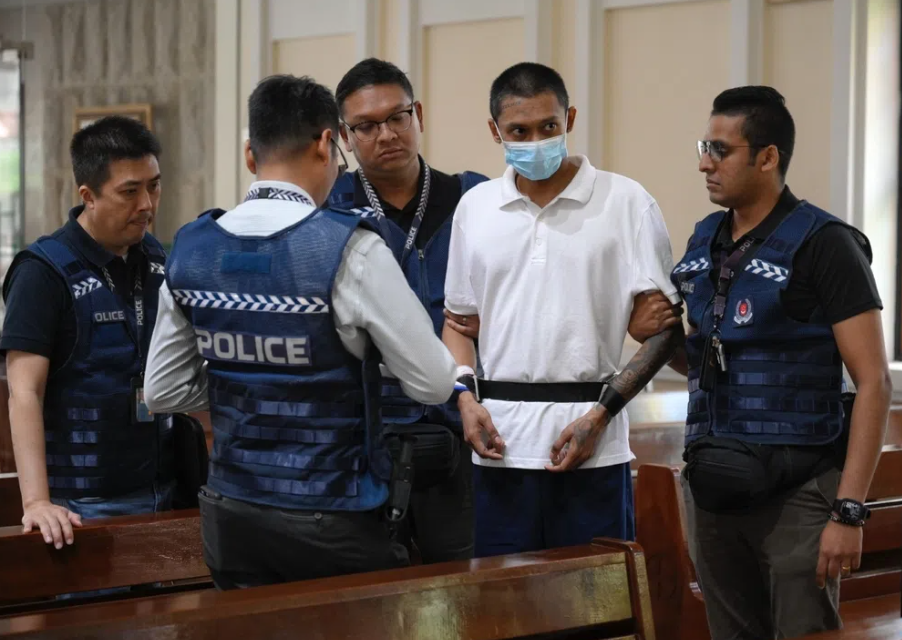
A 38-year-old man in Singapore has received a sentence of four years and three months' imprisonment along with nine strokes of the cane for a violent assault on a Catholic priest during a religious service. Basnayake Keith Spencer pleaded guilty on Friday, August 21, to charges of voluntarily causing grievous hurt using a dangerous weapon and illegal possession of a blade. The sentencing concludes a shocking incident that unfolded at St Joseph's Church during a children's mass attended by approximately 900 worshippers.
The attack occurred on the evening of November 9, 2024, when Basnayake arrived at the church around 5.30pm and took a seat in the middle of the church hall. As the mass progressed towards communion, he ingested five pills in total—two initially to maintain focus, then three more immediately before the communion ritual began. Court documents indicate he took the additional sedatives after realizing the service was designated for children. When communion commenced around 6.15pm, Basnayake positioned himself in a queue behind Father Christopher Lee, then 57 years old, rather than approaching the other priest who was also administering the sacrament.
Without warning or apparent provocation, Basnayake withdrew a 23-centimetre foldable knife featuring a 10-centimetre blade and thrust it directly into the priest's mouth. The weapon penetrated deeply, causing a severe laceration measuring 8 centimetres on Father Lee's tongue, a 3-centimetre cut on his upper left lip, and a 4-centimetre wound at the corner of his mouth. Blood pooled significantly in the cleric's mouth as he stumbled backward from the unexpected violence. Demonstrating remarkable presence of mind despite his injuries, Father Lee immediately grabbed the rear pocket of Basnayake's jeans to prevent further attacks on other parishioners in the congregation.
The situation quickly descended into chaos as church members, including an off-duty police officer among the congregation, physically restrained Basnayake and summoned emergency services. Officers arrested him at the scene without further incident. When authorities searched Basnayake following his apprehension, they discovered he carried multiple weapons: a 14.5-centimetre penknife, a flip knife, and a fishing gaff—a pole equipped with a sharp hook—suggesting premeditated intent or a disturbing pattern of carrying implements of violence.
Father Lee's injuries necessitated immediate hospitalization, where he remained for six days before discharge on November 15, 2024. Beyond the acute physical trauma, the priest required 40 days of hospitalization leave and underwent months of speech therapy to address complications from his tongue laceration. The psychological toll of sustaining such an assault during a sacred moment in a place of worship remains unquantified but undoubtedly significant. The attack's timing—during the most solemn part of Catholic mass—amplified its transgressive nature and potential for triggering mass panic among the large congregation, particularly the children present.
Barring from bail in December 2024, Basnayake has spent more than one year and nine months in remand custody pending trial. Prosecutors described him as presenting an exceptionally high danger to the public with a substantial likelihood of reoffending. This assessment drew weight from his criminal history: in 2019, Basnayake had been convicted of voluntarily causing hurt with a dangerous weapon and sentenced to one year's imprisonment after stabbing his then-girlfriend in the buttocks with a kitchen knife while under the influence of methamphetamine. The earlier offense demonstrated an established pattern of weapon-related violence, particularly when his judgment was impaired by controlled substances.
During sentencing proceedings, Deputy Public Prosecutor Xu Sijia acknowledged that Basnayake was intoxicated and experiencing a drug-induced psychotic episode at the time of the church assault, yet argued this did not eliminate his culpability. The prosecution contended that despite his altered mental state, he maintained sufficient awareness when committing the attack. Prosecutors urged the court to impose between four years three months and four years eleven months imprisonment, coupled with nine strokes of the cane. Basnayake's defence lawyer, Ashwin Ganapathy of the Public Defender's Office, countered by seeking a sentence below four years' imprisonment with caning, emphasizing his client's remorse and requesting proportionate punishment.
District Judge Shaiffudin Saruwan, in pronouncing sentence, emphasized the gravity of unprovoked violence directed at a defenceless individual administering a sacred religious ritual. The judge specifically highlighted the assault's occurrence during a pivotal moment in Catholic worship, underscoring both the real danger to congregants and the breach of sanctuary that such violence represents. The timing and location of the attack—designed to maximize shock and potential for widespread injury among worshippers—factored prominently in the sentencing calculus. The judge noted that the assault created genuine potential for mass panic and additional casualties had other parishioners intervened or if Basnayake had retained his weapon.
Under Singapore law, the offence of voluntarily causing grievous hurt with a dangerous weapon carries severe penalties including life imprisonment, sentences up to 15 years, substantial fines, and caning. The sentence imposed—while substantial—fell toward the lower end of the possible range, reflecting both Basnayake's guilty plea and arguably, some judicial consideration of his compromised mental state. Nevertheless, the nine strokes of the cane represent the maximum typically administered in Singapore courts, signalling the bench's view that severity was warranted despite mitigating factors.
The incident raises troubling questions about mental health support, substance abuse intervention, and public safety in religious spaces across Singapore and the broader Southeast Asian region. That an individual with documented violent tendencies and prior weapons convictions could carry multiple bladed implements into a crowded place of worship points to potential gaps in monitoring and prevention systems. The case underscores tensions between compassion toward individuals experiencing psychotic episodes and protecting vulnerable populations, particularly in settings of spiritual gathering where security is traditionally minimal. For Singapore's religious communities, the attack represents a violation of sanctuary principles and has prompted ongoing discussions about balancing accessibility with protective measures.

