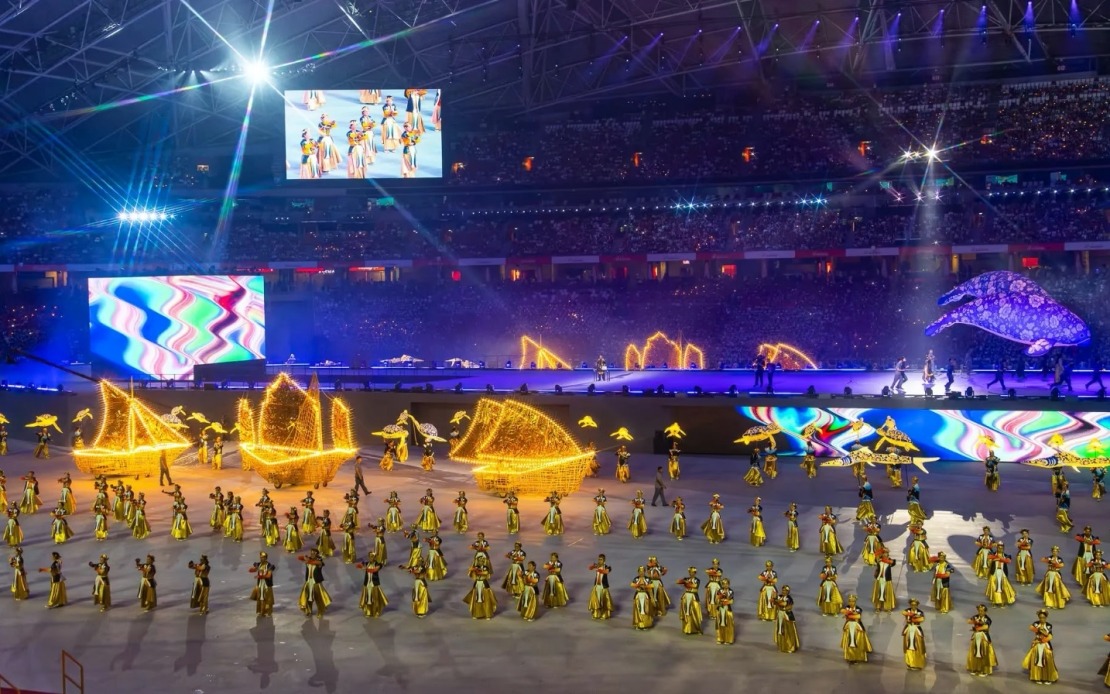
Singapore's 61st National Day celebrations on Sunday marked a significant milestone with the restoration of the National Day Parade at the National Stadium, a venue that had been absent from the nation's flagship civic ceremony for over ten years. The event, themed "Majulah Singapura, Go Beyond!", brought together the republic's political leadership and tens of thousands of citizens in a display of national unity and forward-looking optimism. President Tharman Shanmugaratnam and Prime Minister Lawrence Wong presided over proceedings alongside the full Cabinet and parliamentary representatives, setting the formal tone for a day designed to celebrate Singapore's achievements and chart its future direction.
The scale of public participation underscored the continued resonance of National Day observances in Singapore's civic calendar. Approximately 42,000 members of the public filled the National Stadium, a venue chosen deliberately to symbolise a return to traditional gathering spaces after years of modified arrangements. The sea of red and white clothing worn by attendees created a visually striking demonstration of national identity and collective pride. This number represented not merely spectators but active participants in a shared ritual of citizenship, reflecting how deeply the National Day ceremony remains embedded in Singaporean society's cultural fabric.
A particularly innovative element of this year's celebrations was the geographical expansion of ceremonial activities beyond the stadium's physical confines. For the first time in Singapore's six-decade history as an independent nation, both the Presidential Gun Salute and State Flag Flypast were relocated to Kallang Basin, a decision that fundamentally altered how the ceremonies were experienced across the broader precinct. This geographical expansion was not merely logistical but conceptually significant, suggesting how public ceremonials can evolve to reach wider audiences while maintaining their symbolic power and traditional dignity.
The execution of the gun salute itself demonstrated Singapore's continued investment in military pageantry and ceremonial excellence. Four 25-pounder Howitzer guns, mounted on Mobility 3rd Generation rafts, traversed Kallang Basin in a configuration that brought the spectacle within visual and auditory range of thousands more citizens gathered throughout the surrounding area. The 151-member artillery and combat engineer contingent orchestrated a 21-gun salute, transforming what is typically an enclosed stadium event into an expanded public experience. This innovation allowed communities positioned throughout Kallang to participate in the celebration without requiring entry to the main venue, effectively democratising access to one of the republic's most significant civic ceremonies.
The parade proper commenced in early evening with the "Go Beyond Self" segment, a thematic framing that suggested introspective as well as outward-looking perspectives on national progress. The segment mobilised 32 distinct contingents drawing from across Singapore's institutional landscape, with participation exceeding 2,000 individuals. The structural composition of these contingents revealed the breadth of Singapore's organised society: six Guard of Honour contingents representing the republic's security apparatus, ten contingents from uniformed youth organisations that cultivate civic responsibility among younger generations, and sixteen supporting contingents that amplified the processional grandeur. The Singapore Armed Forces Colours Party provided ceremonial focus, escorted by representatives from the Singapore Army, Navy, Air Force, the newer Digital and Intelligence Service, Police Force, and Civil Defence Force—an enumeration that itself mapped Singapore's evolving security architecture.
Beyond the formal parade structure, the evening's performance segment synthesised entertainment, narrative, and technological innovation into a cohesive statement about Singaporean identity and capability. The show segment engaged 36 professional artistes and more than 2,600 performers in a production centred on the overarching "Go Beyond!" theme. The breadth of this creative mobilisation suggested that National Day celebrations in Singapore represent not merely governmental occasions but genuinely inclusive national projects that draw from the full spectrum of the republic's cultural and artistic communities. The production narrative explicitly focused on "authentic stories" and "innovative technology", positioning Singapore simultaneously as a keeper of cultural memory and an agent of technological transformation.
A particularly significant dimension of this year's celebration was its explicit commitment to inclusive representation and accessibility. Seven dancers from varied demographic and physical backgrounds participated in the performance segment, including dancers with autism and Down syndrome. This deliberate programming choice represented more than symbolic gesture; it embodied a substantive message about participation and contribution in Singapore's future development. The inclusion of performers with disabilities in a nationally televised ceremony on the republic's most important civic date communicates powerful messaging about inclusion and the recognition that national progress depends on utilising the talents and energies of all citizens, regardless of background, ability, or origin. This approach reflects contemporary understanding that genuine national unity requires acknowledging and celebrating diversity rather than emphasising homogeneity.
For Malaysian observers and regional audiences, Singapore's National Day evolution offers instructive lessons about how city-state societies manage civic rituals and national identity formation. The deliberate restoration of the National Stadium venue after a decade's absence signals confidence in traditional institutional spaces while the simultaneous innovation of expanding ceremonies to new locations demonstrates adaptive governance. The thematic emphasis on "going beyond"—both as individual self-transcendence and collective national progress—resonates across Southeast Asia's development contexts. Singapore's approach to integrating disabled performers into its highest-profile civic ceremony also presents a progressive model worthy of regional consideration, particularly as Southeast Asian nations increasingly recognise inclusive development as central to national competitiveness.
The 2026 celebration also reflects Singapore's evolving relationship with public gatherings and ceremonial display following pandemic-related disruptions. The decision to restore the National Stadium parade venue after years of alternative arrangements suggests that Singapore's leadership views large-scale public assemblies as essential to national identity reproduction and civic bonding. This represents a calculated choice to prioritise the cohesive and morale-building functions of mass ceremonial over caution regarding crowd concentrations. The innovation of incorporating water-based ceremonial elements alongside traditional stadium-centred activities suggests institutional creativity in expanding the geographic and experiential reach of national occasions—an approach that balances the symbolic power of traditional venues with the participatory benefits of distributed ceremonies.
The participation rates and organisational scale of Singapore's National Day celebrations—involving tens of thousands of civilians and hundreds of uniformed and civilian personnel—underscores how thoroughly the occasion integrates across governmental, military, cultural, and voluntary sectors. Such comprehensive mobilisation requires sustained institutional coordination and planning, reflecting the level of social organisation that Singapore has achieved. For observers across the region, the execution of events at this scale and sophistication level demonstrates capabilities that remain aspirational for many Southeast Asian democracies still developing their institutional infrastructure for large-scale public coordination.
Looking forward, Singapore's National Day commemoration patterns suggest that the republic will likely continue expanding the experiential and geographic scope of its civic ceremonies while maintaining traditional elements that anchor national memory. The conscious integration of technological innovation, inclusive representation, and expanded public participation indicates a society consciously crafting civic rituals that speak to contemporary values while honouring historical continuities. For the broader Southeast Asian region, Singapore's approach offers a model of how established nations can continuously refresh their national identity narratives while maintaining the ceremonial dignity and collective solidarity that such occasions require. The return to the National Stadium venue, enhanced by innovation and inclusive programming, signals confidence in Singapore's capacity to evolve as a nation while preserving the institutional and symbolic resources that bind citizens together across generational and demographic lines.

