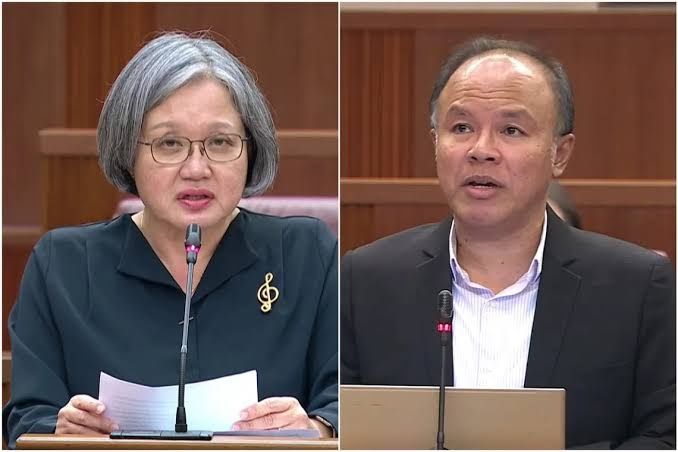
Singapore's Parliament has formally closed a protracted chapter in its political history, announcing that no further action can be taken against Workers' Party leaders Sylvia Lim and Faisal Manap over their involvement in a parliamentary lying scandal. The decision stems not from innocence but from the expiry of statutory time limits that govern when Parliament may impose disciplinary measures, according to Leader of the House Indranee Rajah, who delivered the ministerial statement on July 7.
The episode that consumed Parliament's attention originated in 2021 when then-Sengkang MP Raeesah Khan fabricated an anecdote about police conduct during a parliamentary speech. Khan's deception triggered an investigation by Parliament's Committee of Privileges, which subsequently found that three Workers' Party figures—Pritam Singh, Sylvia Lim, and Faisal Manap—had made false statements to the committee while it examined the original falsehood. The investigation exposed what appeared to be a coordinated effort to contain the damage, with Pritam Singh allegedly directing Khan to conceal the lie permanently.
What distinguishes the cases is the severity of involvement attributed to each party. Pritam Singh bore primary responsibility for orchestrating the cover-up, while Lim and Faisal were found to have played subordinate roles in denying that Khan's fabrication had been discussed during a critical August 2021 meeting. Despite their lesser culpability, the committee determined that both had fundamentally breached parliamentary standards through deliberate dishonesty. The two MPs subsequently denied having opportunities to defend themselves in court proceedings, as they were neither charged nor called as witnesses in Pritam's criminal trial.
The procedural complexity that ultimately saved Lim and Faisal from parliamentary sanction lies in Singapore's Parliament (Privileges, Immunities and Powers) Act, which contains strict temporal constraints on enforcement. Under Section 22 of this legislation, Parliament retains power to punish parliamentary contempt only if committed during the immediately preceding session or the final session of the prior parliamentary term. With the 14th Parliament dissolved following the 2025 general election and the 15th Parliament commencing in September 2025, the statutory window for action definitively closed. The infractions occurred during the first session of the 14th Parliament, rendering them beyond the enforcement scope of the new Parliament.
Indranee acknowledged that circumstances conspired against timely resolution. Parliament originally could have acted on the Committee of Privileges' 2021 findings immediately but chose to extend leniency pending the completion of Pritam Singh's legal proceedings. This decision prioritised fairness, allowing Lim and Faisal to benefit from the court's definitive judgment in Pritam's case before determining their own punishment. However, the criminal justice system's protracted timeline—with Pritam convicted by District Court in February 2025, appealing, and ultimately having his conviction upheld by the High Court in December 2025—meant that parliamentary action could not commence until after the legal landscape had fundamentally shifted through general elections.
For Malaysian observers, this outcome illustrates the tension inherent in parliamentary privilege procedures when they intersect with criminal justice timelines and electoral cycles. The case demonstrates how statutory time bars, while designed to create finality and closure, can occasionally produce outcomes that appear disconnected from substantive accountability. Indranee herself noted that under ordinary circumstances, she would have initiated disciplinary proceedings against individuals found to have engaged in such "dishonourable conduct and serious contempt of Parliament." The minister suggested that had timelines aligned differently, a substantially different outcome would have been pursued.
The Workers' Party had already navigated its own reckoning with these events. During internal elections on June 28, party cadres voted to retain Pritam Singh as leader despite his criminal conviction, signalling that the party's grassroots membership rejected calls for his resignation. This decision preceded Parliament's formal closure of the matter, effectively placing the onus for accountability entirely within the party structure rather than parliamentary discipline. The Workers' Party essentially decided that Pritam retained sufficient legitimacy to lead the opposition, independent of Parliament's inability to formally punish his conduct through legislative mechanisms.
Parliament retained one symbolic recourse despite statutory constraints: the ability to pass a motion expressing institutional disapproval of Lim and Faisal's conduct. Indranee indicated, however, that such a gesture would be redundant. In January 2025, Parliament had already declared Pritam Singh unsuitable to serve as Leader of the Opposition through a formal motion, a statement that implicitly encompassed condemnation of the broader pattern of misleading Parliament that ensnared all three individuals. The legislative body thus found opportunity to signal its collective standards through another parliamentary mechanism, even as traditional disciplinary powers remained unavailable.
Sylvia Lim's brief parliamentary intervention underscored a persistent grievance: she maintained that references to her conduct in Pritam Singh's appeal judgment relied entirely on prosecution evidence, and she had never been afforded courtroom opportunity to present her account, having never been charged or called as witness. This structural asymmetry—where parliamentary findings about her conduct were effectively confirmed through another person's criminal trial without her participation—highlights potential fairness gaps in how parliamentary accountability intersects with criminal procedure. Her clarification that she harboured no objection to closure suggested weary acceptance rather than full satisfaction with the process.
The closure of this matter carries implications extending beyond personalities or immediate Singapore politics. For parliamentary democracies across Southeast Asia, including Malaysia, the case illustrates how legislative privilege frameworks must balance institutional integrity against individual fairness, and how statutory time limits can create unanticipated consequences. The principle that Parliament must scrupulously observe its own legal constraints, even when doing so prevents accountability for confirmed dishonesty, reinforces rule-of-law principles while simultaneously raising questions about whether procedural perfection necessarily produces substantive justice. Indranee's closing statement—that "the law, in this case the time bar provisions of PPIPA, must be observed"—encapsulates this tension, acknowledging that legal necessity sometimes demands accepting outcomes that institutional preference would reject.

