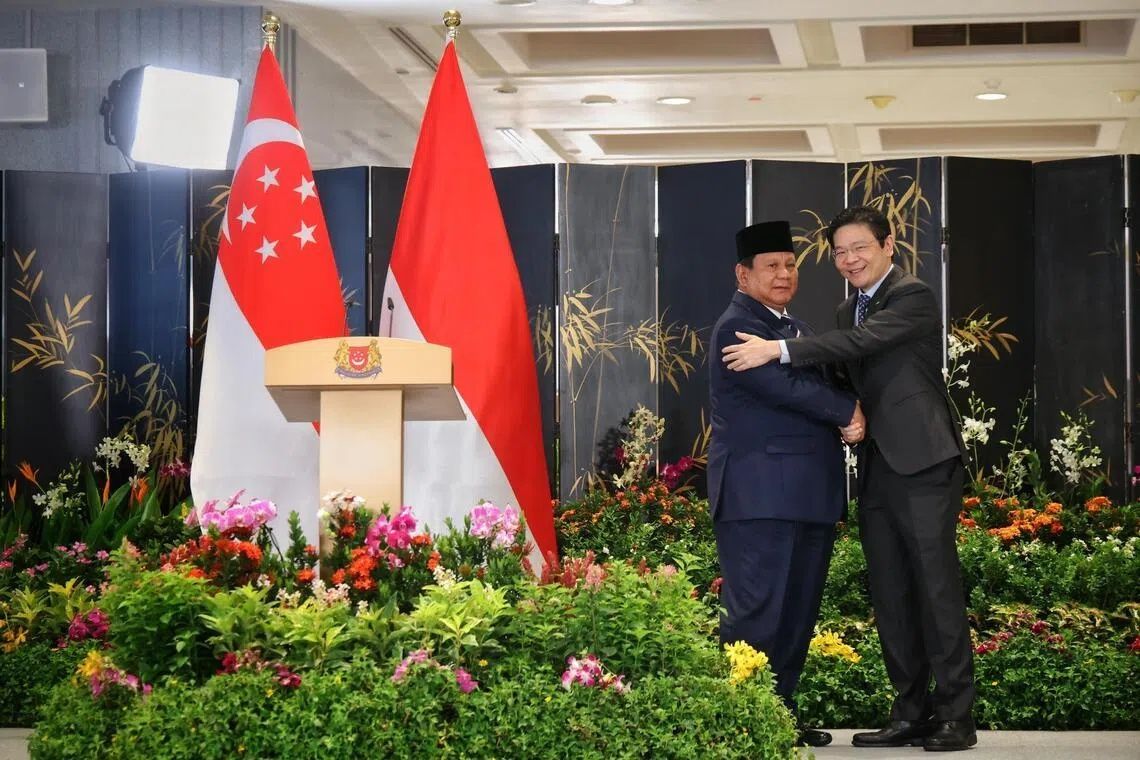
Prime Minister Lawrence Wong is heading to Jakarta on Monday, July 6, for the Singapore-Indonesia Leaders' Retreat, where he and President Prabowo Subianto will review the trajectory of bilateral relations and chart the course for future engagement. The retreat represents the highest-level diplomatic platform between the two neighbours and signals the continued centrality of the Singapore-Indonesia relationship in both nations' foreign policy architectures.
This will be the second formal leaders' retreat under the current administrations, with the first having taken place in Singapore in June 2025. The event, to be hosted by President Prabowo at the presidential palace in Jakarta, follows an established pattern of annual engagement that has become institutionalised as the primary mechanism for strategic dialogue between the two governments. The Prime Minister's Office confirmed the visit and outlined the key objectives of the meeting, emphasising the desire to reaffirm the deep historical and contemporary bonds that connect Singapore and Indonesia.
The bilateral relationship between Singapore and Indonesia carries particular significance for Southeast Asia. The two nations share maritime boundaries, economic interdependencies, and overlapping strategic interests in maintaining regional stability and prosperity. For Singapore, Indonesia represents both a critical economic partner and a neighbouring state whose cooperation is essential for security and connectivity. For Indonesia, Singapore serves as a vital financial hub and a gateway to global markets, while also representing a model of development and governance that carries influence across the region.
At the forthcoming retreat, the two leaders will conduct a comprehensive review of cooperation across multiple sectors. Both governments intend to receive detailed updates on bilateral projects initiated since the previous retreat, allowing them to assess progress and identify areas requiring acceleration or adjustment. This systematic approach to bilateral management reflects the maturity and institutional depth of the Singapore-Indonesia relationship, which extends far beyond ceremonial exchanges to encompass substantive policy coordination.
The scope of bilateral cooperation has undergone significant expansion in recent years, extending into domains that reflect contemporary global priorities and technological change. While traditional pillars of the relationship—including trade, investment, and defence cooperation—remain foundational, both nations are now actively exploring collaboration in the green economy, cross-border electricity trade, carbon capture and storage technologies, artificial intelligence, and digital connectivity. This broadening reflects both countries' recognition that economic and security challenges increasingly transcend traditional sectoral boundaries and require integrated policy responses.
The investment dimension of the relationship remains particularly robust. Throughout 2025, Singapore has maintained its position as Indonesia's leading source of foreign direct investment, channelling US$17.4 billion into the Indonesian economy. This figure underscores the confidence of Singapore-based and Singapore-linked investors in Indonesia's economic potential and the strength of bilateral commercial ties. Such investment flows generate employment, facilitate technology transfer, and deepen economic interdependence, creating constituencies within both nations that have a vested interest in maintaining harmonious bilateral relations.
During their discussions, PM Wong and President Prabowo are anticipated to exchange perspectives on broader regional and global developments. This component of the retreat is particularly significant for Malaysia and other Southeast Asian nations, as it offers insight into how Singapore and Indonesia—the two largest economies in ASEAN—are assessing the regional geopolitical landscape. Their views on issues ranging from maritime security to great power competition to climate action often set the tone for wider ASEAN positions and initiatives.
The composition of PM Wong's delegation reflects the cross-sectoral nature of modern bilateral engagement. Accompanying him will be Deputy Prime Minister and Minister for Trade and Industry Gan Kim Yong, whose presence underscores the economic focus of the retreat; Coordinating Minister for Public Services and Minister for Defence Chan Chun Sing, representing the security dimension; Foreign Minister Vivian Balakrishnan, who leads diplomatic efforts; and ministers responsible for social development, manpower, and science and technology. This broad ministerial representation ensures that discussions can delve into technical details and that commitments emerging from the retreat can be rapidly translated into concrete action across government agencies.
The retreat also carries symbolic significance for Indonesia's new administration under President Prabowo. Since assuming office, Prabowo has sought to reaffirm Indonesia's commitment to regional stability and international partnerships while simultaneously articulating a vision of renewed national development. The engagement with Singapore, a close and successful partner, provides both nations an opportunity to demonstrate the resilience and forward momentum of their relationship despite changes in political leadership and global circumstances.
From a Malaysian perspective, the Singapore-Indonesia Leaders' Retreat warrants careful attention. As ASEAN's second-largest economy and a nation deeply involved in regional architecture, Malaysia's interests are frequently affected by decisions and understandings reached between Singapore and Indonesia. Developments in cross-border electricity trade, digital connectivity initiatives, and approaches to regional security all have potential implications for Malaysia's own strategic position and economic interests. The expanded cooperation in green economy and carbon capture technologies could influence the region's approach to climate action and clean energy transitions, areas where Malaysia seeks to maintain relevance and assert leadership.
During PM Wong's absence from Singapore, Coordinating Minister for National Security and Minister for Home Affairs K. Shanmugam will assume the role of acting prime minister, ensuring continuity of governance in Singapore. This arrangement reflects standard practice and the institutional robustness of Singapore's administrative systems, which allow for seamless transitions when senior leadership is abroad on official business.
The Leaders' Retreat exemplifies how mature bilateral relationships in Southeast Asia operate at the highest levels while maintaining focus on practical outcomes and strategic coordination. For observers across the region, including Malaysian policymakers and analysts, these bilateral engagements provide crucial windows into how major regional actors are recalibrating their partnerships and priorities in response to evolving regional and global circumstances.

