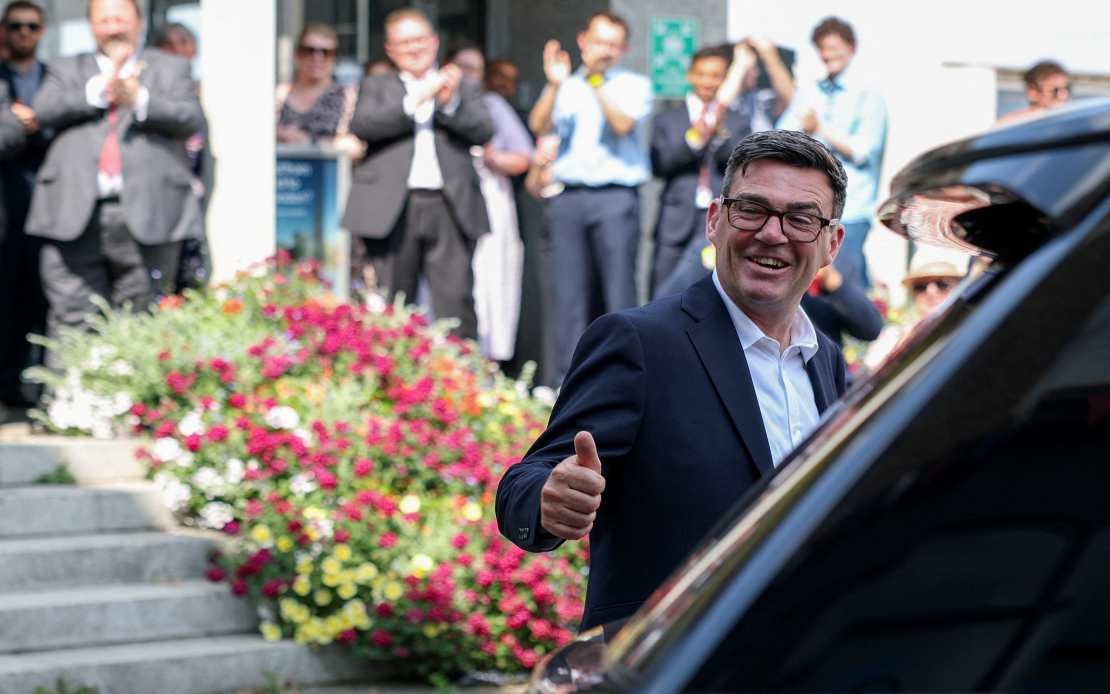
Singapore's Prime Minister Lawrence Wong has extended formal congratulations to Andy Burnham following his assumption of office as the United Kingdom's new prime minister on Monday. The move underscores the Lion City's diplomatic engagement with its traditional Western allies at a moment of significant geopolitical flux in both Europe and the Asia-Pacific region. Buckingham Palace had earlier confirmed that Burnham, leader of the Labour Party, met with King Charles III and was formally invited to establish a government, cementing his transition from regional Northern English politics to the highest office in Westminster.
In his congratulatory correspondence, Wong expressed optimism about the partnership ahead while anchoring his message in established diplomatic reality. He conveyed wishes for Burnham's success in steering the UK through what Wong characterised as a period of deep geopolitical and economic transformation. The phrasing reflects Singapore's recognition that the new British administration inherits a complex landscape marked by post-Brexit recalibration, European security concerns related to Russia, and the need to recalibrate Britain's global economic positioning. For Malaysian observers, Singapore's swift and formal response demonstrates how carefully the city-state manages relationships with major Western powers, a diplomatic balancing act Southeast Asia watches closely.
The core of Wong's message emphasises the historical depth and contemporary relevance of the Singapore-UK relationship. By invoking the Strategic Partnership framework and referencing trust accumulated across decades, Wong positions the bilateral relationship as institutionally resilient and ideologically aligned. This language serves multiple audiences: domestically, it reassures Singaporeans that key security partnerships remain stable; internationally, it signals to Burnham that Britain has committed regional partners ready to work collaboratively. For the broader Southeast Asian context, Singapore's emphasis on established partnerships with Western democracies reflects the region's enduring interest in maintaining a balance between rising Asian powers and traditional Western engagement.
Wong explicitly identified several domains for continued cooperation, with particular emphasis on innovation, science and technology, and defence. These sectors represent contemporary pillars of the Singapore-UK relationship that extend well beyond historical colonial legacies. The technology cooperation dimension is especially significant given Britain's aspirations in artificial intelligence and semiconductor research, areas where Singapore has positioned itself as a regional hub. Defence cooperation carries equally strategic weight, particularly given Britain's renewed interest in Indo-Pacific security architecture and Singapore's role as a crucial logistics node for international naval operations in Southeast Asian waters. Malaysian policymakers observe such partnerships closely, understanding that defence arrangements between external powers and Singapore influence the broader regional security environment.
A particularly noteworthy element of Wong's message was his emphasis on the principle that trusted partners achieve more through cooperation, especially during periods of global instability. This formulation speaks directly to contemporary challenges affecting both Britain and the Asia-Pacific region: economic fragmentation, rising protectionism, and questions about the sustainability of established international order. By framing partnership as a practical necessity rather than merely an ideological preference, Wong appeals to Burnham's pragmatic instincts while positioning Singapore as a reliable counterweight to destabilising forces. This message resonates throughout Southeast Asia, where nations are increasingly emphasising practical multilateralism over rhetoric.
Wong's reference to Singapore's valuation of Britain's continued regional presence carries diplomatic weight extending beyond ceremonial language. By highlighting the UK's status as an ASEAN Dialogue Partner and its participation in the Five Power Defence Arrangements, Wong acknowledges Britain's institutional embedding in regional affairs. The Five Power Defence Arrangements, involving Britain, Singapore, Malaysia, Australia, and New Zealand, represent one of the region's oldest security mechanisms. This reference subtly reminds the new British prime minister of existing commitments and suggests that Singapore expects continuity in Britain's regional military and diplomatic presence. For Malaysia, which is itself party to these arrangements, such affirmations of British commitment provide reassurance about the stability of regional security frameworks.
Looking forward, Wong invoked a significant institutional opportunity arising from Singapore's assumption of the ASEAN Chairmanship coinciding with Britain's expected G20 Presidency in 2027. This convergence of responsibilities creates a unique window for coordinated diplomatic action on global governance questions. Wong explicitly flagged this as an occasion for intensified cooperation on multilateral challenges affecting both regions. For Malaysia and other ASEAN members, this statement indicates Singapore's intention to leverage its temporary ASEAN leadership role to strengthen external partnerships, a strategy that will shape the bloc's diplomatic trajectory over the coming years. The emphasis on addressing shared global and regional challenges suggests a focus on trade governance, climate action, and security architecture questions that preoccupy both Asian and European policymakers.
The broader context of Burnham's ascension reflects Labour Party victory in recent British elections, marking a significant shift from Conservative governance. This transition carries implications for Britain's foreign policy orientation, including its approach to Indo-Pacific engagement. Labour governments have historically emphasised multilateral institutions and development cooperation, dimensions that Singapore clearly hopes to leverage. The party's traditional focus on social cohesion and economic fairness may also influence how Britain approaches trade relationships with Southeast Asian partners, potentially affecting Malaysian interests in sectors ranging from palm oil to financial services.
For Southeast Asian readers, Wong's calibrated response demonstrates the careful diplomacy required when engaging with major Western powers experiencing internal political transitions. Singapore's immediate and substantive engagement with the new British leadership signals that the city-state views the UK-Singapore relationship as sufficiently robust to weather political changes in London. This approach contrasts with more cautious positions some regional governments might adopt, reflecting Singapore's confidence in the institutional depth of bilateral ties. Malaysian observers might note how Singapore's proactive diplomacy with emerging British leadership creates platforms for enhanced regional influence, a lesson relevant to how ASEAN more broadly should engage with transitional governments in major powers.

