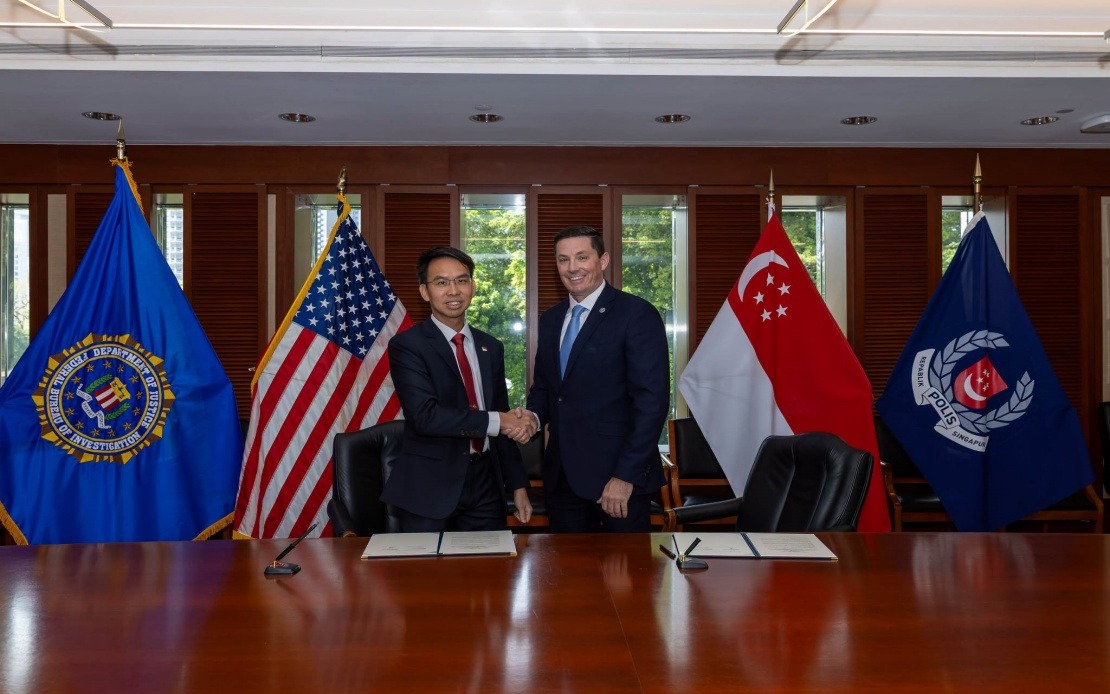
Singapore's law enforcement agency and the United States Federal Bureau of Investigation have formalized their commitment to disrupting criminal networks engaged in digital fraud and money laundering across international borders. The memorandum of understanding, signed on Friday, represents a significant milestone in institutionalizing cooperation between the Singapore Police Force and the FBI, two of the region's most influential investigative bodies.
The agreement underscores a shared recognition between both agencies that online scams and cyber-enabled fraud have evolved into genuinely transnational threats. Neither nation can effectively combat these crimes in isolation. By establishing formal protocols for collaboration, the two forces aim to create a more integrated enforcement framework that closes the gaps criminals exploit when operating across jurisdictions. This partnership carries particular significance for Southeast Asia, where digital fraud has grown exponentially as internet penetration and financial digitalization have expanded rapidly across the region.
Operational cooperation forms the backbone of this arrangement. The SPF and FBI have committed to conducting joint operations, exchanging intelligence in real time, providing reciprocal training opportunities, and building each other's institutional capacity to identify and prosecute complex financial crimes. The formal nature of the agreement ensures that both agencies operate under clear protocols rather than relying on ad hoc arrangements. This matters because transnational criminals deliberately exploit jurisdictional gaps and inconsistent enforcement responses.
A recent joint operation provides concrete evidence of how this partnership functions in practice. In July 2026, the SPF Cyber Command and FBI teams collaborated on an investigation targeting sophisticated cryptocurrency scams that victimized people across both nations. By pooling blockchain intelligence and cross-border investigative resources, the two agencies identified 54 victims and potential victims while helping prevent losses totaling US$2.7 million in the United States and S$388,000 in Singapore. This single operation demonstrates that coordinated enforcement can recover resources and dismantle operations before they inflict maximum damage.
The cryptocurrency dimension of this partnership deserves particular attention for Malaysian observers. Digital asset fraud has become increasingly prevalent throughout Southeast Asia, with scammers using blockchain's pseudonymous features and cross-border transfer capabilities to obscure their activities. Many victims in Malaysia have fallen prey to similar schemes, making Singapore's experience and the FBI's technical expertise directly relevant to the region's security landscape. As Malaysia continues developing its own digital economy and fintech sector, understanding how sophisticated cryptocurrency fraudsters operate becomes essential for policymakers and enforcement agencies.
Money laundering represents another critical focus area of the accord. Criminal networks use online fraud proceeds to purchase legitimacy by routing stolen funds through multiple jurisdictions and financial instruments. By enhancing information sharing about suspicious financial flows, the SPF and FBI can more effectively detect laundering schemes before they successfully integrate illicit proceeds into the formal economy. This has implications for regional financial stability and the integrity of banking systems throughout Southeast Asia.
The foundation for this deepened partnership rests upon prior collaborative history. The two agencies have accumulated years of experience working together on various initiatives, allowing them both to understand each other's operational procedures, legal frameworks, and investigative standards. This pre-existing relationship accelerates implementation of the memorandum and reduces friction that might otherwise impede joint investigations. Trust between institutions develops incrementally, and both the SPF and FBI have demonstrated sufficient confidence to formalize their arrangement.
For Malaysia specifically, this Singapore-US partnership creates both opportunities and challenges. On the positive side, Malaysian law enforcement might benefit from accessing the collective intelligence and expertise that this partnership generates. Criminal networks operating in Malaysia often have connections to Singapore or the United States, and improved information flow could help Malaysian authorities disrupt operations. However, Malaysia's own law enforcement capacity building and bilateral relationships with both Singapore and the United States will determine whether these benefits materialize.
The broader context involves an acceleration of international law enforcement cooperation across Southeast Asia and beyond. As digital crime becomes increasingly borderless and sophisticated, individual nations recognize that unilateral enforcement approaches produce diminishing returns. The SPF-FBI agreement reflects a global trend toward multilateral frameworks that enable faster intelligence sharing and coordinated action. This signals to criminal organizations that they cannot rely on jurisdictional complexity to evade detection indefinitely.
The memorandum also highlights how cybercrime and financial crime investigations now demand specialized technical expertise. Both the SPF and FBI maintain sophisticated cyber commands and financial forensics units. By formalizing their partnership, they enable knowledge transfer about emerging fraud methodologies, evolving technical tools, and novel criminal tactics. This institutional learning benefits both agencies and, by extension, the broader international law enforcement community that monitors and adapts to these developments.
Implementation challenges nonetheless exist. Differing legal standards, data protection requirements, and operational protocols between nations sometimes complicate joint investigations. The agreement presumably establishes mechanisms to navigate these complications, though specific procedures remain unpublished. Malaysian stakeholders should monitor how effectively the two agencies overcome these practical obstacles, as successful models could inform future regional partnerships.
Looking forward, this formalized cooperation between Singapore and the United States sends a clear message to transnational criminal networks: investigative boundaries have blurred. Scammers cannot confidently assume that physical distance or jurisdictional separation guarantees impunity. As law enforcement agencies worldwide develop similar partnerships, the operating environment for digital fraudsters grows progressively riskier, potentially encouraging some to abandon their criminal enterprises or making success rates and profit margins unsustainable.

