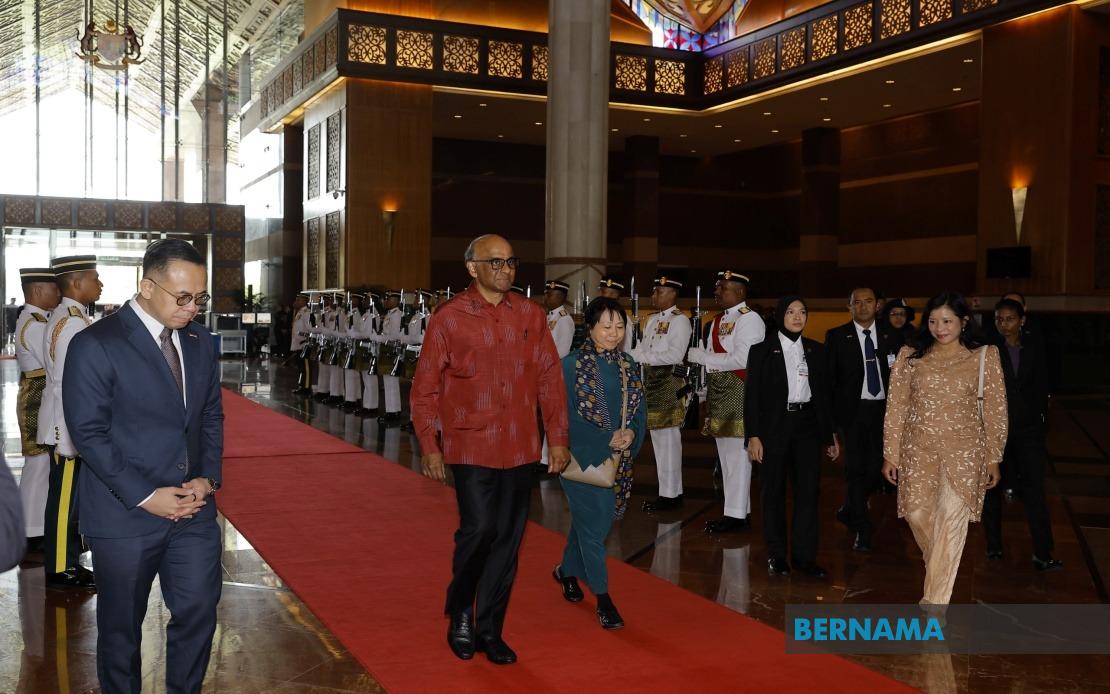
Singapore President Tharman Shanmugaratnam departed Malaysia on Monday afternoon, bringing to a close a significant three-day state visit that underscored the enduring diplomatic bonds between the two neighbouring nations. The President, accompanied by his spouse Jane Ittogi and official delegation, boarded a commercial flight from Kuala Lumpur International Airport Terminal 1 at 2.20 pm, marking the conclusion of a carefully structured diplomatic engagement that carried considerable symbolism for both governments.
The farewell ceremony at KLIA reflected the formal protocols typically reserved for state visits of this calibre. Upon arrival at the Bunga Raya Complex at 1.45 pm, Tharman was presented with a static Guard of Honour comprising two officers and 26 personnel from the First Battalion of the Royal Ranger Regiment, commanded by Captain Muhammad Hanafi Ja'afar. This ceremonial send-off mirrored the grandeur of his reception and demonstrated Malaysia's commitment to honouring the high-ranking visitor. Minister of Entrepreneur and Cooperatives Development Steven Sim attended the departure to offer official farewells on behalf of the Malaysian government, underscoring the diplomatic importance assigned to the occasion.
Tharman's visit commenced on Sunday at the formal invitation of His Majesty Sultan Ibrahim, King of Malaysia, representing the first state visit by the Singapore President since his inauguration as the ninth President of Singapore on September 14, 2023. This timing was deliberate, as the visit functioned as a reciprocal gesture following Sultan Ibrahim's state visit to Singapore on May 6 and 7, 2024. Such exchanges form a critical component of contemporary bilateral diplomacy between Malaysia and Singapore, allowing senior leaders to engage in substantive discussions while reinforcing shared interests and resolving potential areas of friction.
The substantive engagements during Tharman's stay demonstrated the multifaceted nature of Malaysia-Singapore relations. On Monday, the President received a full state welcoming ceremony followed by a formal audience with Sultan Ibrahim at Istana Negara, the seat of Malaysia's constitutional monarchy. These ceremonial elements, whilst symbolic, serve to validate the importance of bilateral relations at the highest institutional levels. The audience provided an opportunity for the two leaders to discuss matters of mutual concern and to reaffirm their nations' commitment to collaborative governance in the region.
Beyond the ceremonial dimensions, Tharman held substantive meetings with Malaysia's executive leadership that reflected the breadth of bilateral engagement. Prime Minister Datuk Seri Anwar Ibrahim received the Singapore President, with the consultation attended by a notably senior roster of Malaysian ministers. Foreign Minister Datuk Seri Mohamad Hasan, Investment, Trade and Industry Minister Datuk Seri Johari Abdul Ghani, and Minister Steven Sim all participated in the courtesy call, indicating that discussions likely encompassed trade, security, infrastructure, and regional cooperation frameworks. Such high-level attendance signals that Malaysia views the bilateral relationship as sufficiently important to warrant input from multiple portfolio holders.
The visit also incorporated engagements with Malaysia's state-level leadership, reflecting the federal structure of Malaysian governance and the importance of subnational players in bilateral affairs. The Sultan of Selangor, Sultan Sharafuddin Idris Shah, granted an audience to Tharman at Istana Alam Shah, demonstrating that Singapore's relationship with Malaysia extends beyond federal government interactions to encompass state-level diplomacy. This multi-layered approach to state visits acknowledges the complexity of Malaysian federalism and ensures that regional interests are acknowledged within the broader bilateral framework.
The diplomatic rhythm of reciprocal visits between Singapore and Malaysia reflects a deliberate pattern of engagement designed to maintain relationship continuity and demonstrate mutual respect. President Tharman's visit arrived approximately nine months after Sultan Ibrahim's trip to Singapore, a timeframe that allows for substantive follow-up discussions on matters raised during the previous interaction. This cadence of high-level visits represents one of the mechanisms through which Singapore and Malaysia manage their intricate relationship, which encompasses shared maritime boundaries, significant economic interdependencies, and complex historical legacies that require ongoing diplomatic attention.
For Malaysian observers, Tharman's presidency represents a notable development in Singapore's domestic politics, given his background as an economic policymaker during Singapore's transformation into a financial hub. His elevation to the presidency, whilst largely ceremonial in Singapore's parliamentary system, nonetheless signals continuity in Singapore's development philosophy. For Malaysia, engaging with Singapore's leadership at this level contributes to regional stability and reinforces collaborative mechanisms on issues ranging from maritime security to economic cooperation within frameworks like the ASEAN Economic Community.
The three-day format of state visits serves practical purposes beyond ceremonial requirement. It permits sufficient time for bilateral discussions at multiple governmental levels, allows for cultural exchanges and public diplomacy activities, and provides space for addressing both headline issues and technical matters that require sustained attention. The structure of Tharman's visit—encompassing federal and state-level engagements—reflects this multidimensional approach to contemporary diplomacy in Southeast Asia, where relationship-building occurs across multiple institutional channels.
Looking forward, visits of this nature establish the diplomatic foundation for addressing emerging challenges within the Malaysia-Singapore relationship. These challenges range from long-standing maritime demarcation issues to contemporary concerns regarding security cooperation, economic complementarities, and shared interests in regional stability. By maintaining robust high-level dialogue through structured state visits, both nations signal their commitment to resolving differences through established diplomatic channels rather than allowing tensions to escalate.
The conclusion of Tharman's visit marks a significant moment in Malaysia-Singapore relations, demonstrating the continuity and resilience of bilateral engagement despite periodic tensions that periodically surface. The careful choreography of state visits, with their ceremonial elements and substantive discussions, represents the machinery through which two neighbouring nations with complex histories maintain constructive relationships. As both countries navigate regional geopolitical shifts and economic transitions, such diplomatic engagement remains essential for sustaining the cooperation frameworks that have underpinned Southeast Asian stability for decades.

