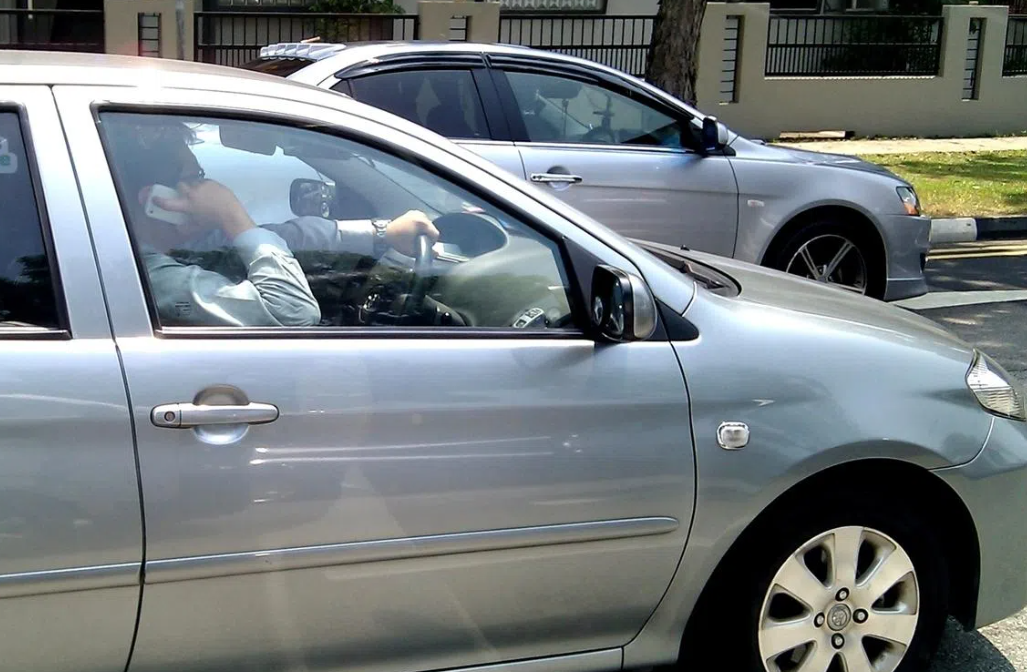
Singapore is cracking down on dangerous driving behaviour with sweeping amendments to its road traffic laws that would penalise drivers merely for holding a smartphone while the vehicle is in motion, even if they are not actively using the device. The Ministry of Home Affairs (MHA) tabled the Road Traffic (Miscellaneous Amendments) Bill on Tuesday, July 7, representing a significant shift in enforcement strategy driven by alarming road safety statistics. The legislation targets three key areas: distracted driving through phone handling, purposeful vehicle-based endangerment, and drug driving offences, all reflecting growing concern about safety on Singapore's roads.
The urgency behind these changes becomes clear when examining the data. Between 2021 and 2025, traffic fatality rates surged by approximately 24 per cent while traffic violations climbed by about 38 per cent. Most troublingly, traffic deaths reached a 10-year peak of 149 in 2025, compared with 141 in 2016, though this represents a modest decline from 142 deaths recorded in 2024. Injuries on Singapore's roads have also worsened, rising from 9,342 cases in 2024 to 9,955 in 2025. These figures underscore the escalating crisis that has prompted the MHA to declare that "to arrest this trend, we will be tightening enforcement and penalties for traffic offences."
The smartphone provisions represent a fundamental shift in how authorities address distracted driving. Currently, Singapore's traffic laws already prohibit texting or calling while holding a phone, with first-time offenders typically receiving 12 demerit points and fines ranging from $400 to $500. More serious cases proceed to court, where first-time convictions can result in up to six months imprisonment and $1,000 fines, with repeat offenders facing up to one year in jail and $2,000 fines. However, this approach has proven problematic in practice because it requires authorities to prove the device was actually being used, necessitating visual confirmation by Traffic Police officers at the moment of the infraction. Such enforcement proves difficult, time-consuming, and ultimately limited in scope.
The proposed amendment eliminates this evidentiary burden entirely. Simply holding a phone while driving will become an offence, regardless of whether the driver was actively using it. The MHA's rationale rests on a straightforward safety argument: any driver holding a phone is inherently distracted and less likely to maintain full focus on the road ahead. This lowered threshold for prosecution serves a practical enforcement purpose as well, permitting the Traffic Police to identify violations through stationary camera footage, photographs, and videos submitted by members of the public. This technological approach could dramatically expand enforcement capacity across Singapore's road network. Notably, the legislation carves out a critical exception: drivers may continue to hold phones and other mounted devices while their vehicles are stationary, maintaining reasonable flexibility for essential communications during traffic stops.
Beyond smartphone use, the Bill addresses a second category of dangerous behaviour: drivers who deliberately use their vehicles as weapons against other road users. The MHA has identified a troubling gap in existing criminal law, noting that when drivers deliberately endanger others and cause death, current legislation often proves inadequate to reflect the severity of their culpability. Present law limits most such cases to dangerous driving causing death charges, which carry maximum sentences of eight years imprisonment. The case of Jarrett Tee Lee Kiat exemplifies this concern. Tee, who demonstrated no remorse after causing the death of an 18-year-old during an expressway race, received a sentence of five years and eight months for dangerous driving—a term the MHA considers insufficient given the premeditated nature of his conduct.
To address this sentencing gap, the Bill introduces a new offence of "purposeful endangerment using a vehicle causing death or grievous hurt." Offenders convicted under this provision face substantially more severe consequences: imprisonment for up to 15 years, fines, caning, and disqualification from driving either for life or for a minimum of 10 years if special circumstances apply. This enhancement reflects judicial concern about maximum sentence adequacy. In a significant 2025 case, the High Court increased Yoong Kok Kai's sentence from three-and-a-half years to five years for a drunk-driving accident that left an auxiliary police officer in a vegetative state. The presiding judge remarked that "there was no excuse for those who chose to drink large amounts of alcohol and yet drive," while questioning whether existing maximum sentences adequately addressed the worst categories of traffic crimes.
Parallel amendments increase penalties for dangerous driving causing grievous hurt. For first-time offenders, the maximum jail term rises from five to seven years; for repeat offenders, it climbs from 10 to 13 years. Additional enhancements apply when aggravating factors exist, such as when the offence occurs while the driver is under the influence of alcohol or drugs. Currently, such aggravating circumstances justify an additional year of imprisonment; the Bill raises this to 18 months. These escalations recognise that impaired driving represents a particularly reckless form of road conduct, combining deliberate disregard for others' safety with impaired judgment and reduced vehicle control. Notably, the legislation makes no changes to maximum sentences for careless driving causing grievous hurt, suggesting that the MHA views such offences as distinct from the more culpable forms of dangerous driving.
The expansion of drug-driving offences represents the third pillar of this legislative package, though specific details regarding this component remain underdeveloped in the presented material. Nevertheless, this addition signals growing recognition across the region that substance-impaired driving poses mounting risks alongside alcohol-related offences. For Malaysian readers and observers across Southeast Asia, Singapore's approach offers instructive lessons about enforcement innovation and penalty calibration. The smartphone-holding offence, in particular, demonstrates how simplifying the legal test for harmful behaviour—shifting from requiring proof of active device use to prohibiting mere possession—can enhance enforcement feasibility when coupled with modern surveillance technology.
These amendments also carry implications for Singapore's standing as a regional transport hub and financial centre. Stricter road safety measures support the island-state's broader agenda of maintaining public confidence in urban infrastructure and protecting its labour force. For businesses operating vehicles in Singapore, the new penalties will necessitate clearer driver behaviour policies and potentially increased driver training expenditure. The regulations also send a clear message to all road users: Singapore intends to significantly raise the cost of dangerous driving behaviour through both criminal penalties and disqualification from driving. This approach differs from some regional jurisdictions that continue to rely primarily on fines and demerit systems.
Implementation will prove critical to the Bill's effectiveness. The MHA's reliance on public video submissions and fixed camera footage presumes robust coordination between the Traffic Police, municipal authorities, and digital evidence management systems. Singapore's well-established infrastructure and technological sophistication suggest such coordination is achievable, yet any transition inevitably involves teething problems. The prohibition on phone holding while driving will require clear public education campaigns to ensure drivers understand that even brief moments of hand-holding constitute violations. Courts will likely receive increased caseloads as enforcement ramps up, particularly in the early post-implementation phase.
The legislation reflects a deliberate policy choice to prioritise prevention and deterrence through severe penalties over rehabilitation and graduated enforcement. By making phone-holding inherently illegal regardless of actual use, Singapore accepts false positives—drivers holding phones for valid reasons unrelated to distracted driving—in exchange for capturing all instances of phone-based distraction. This utilitarian calculus trades individual fairness for collective safety, a trade-off that resonates with Singapore's broader approach to public regulation but that other jurisdictions, particularly those with stronger civil liberties frameworks, might find excessive. For neighbouring countries considering similar reforms, Singapore's approach offers both a template and a cautionary case study regarding the balance between effectiveness and proportionality in traffic law.

