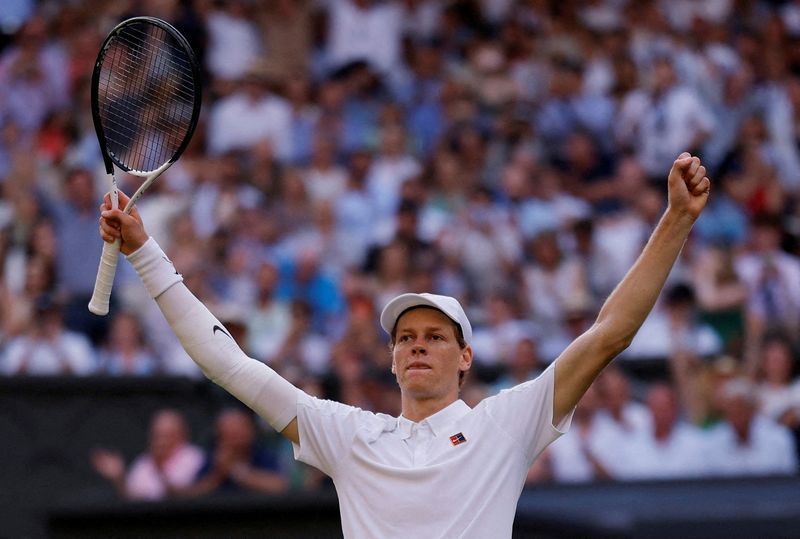
Jannik Sinner's journey to Wimbledon carries the weight of recovered authority and lingering uncertainty. The world number one and defending champion prepares for the grass-court fortnight at the All England Club beginning Monday, yet the invincibility that characterised his early 2024 campaign has fractured under pressure. His second-round exit from the French Open last month shattered a remarkable 30-match winning streak dating to February, prompting searching questions about whether the Italian can maintain elite performance when Grand Slam significance reaches its peak.
The defending champion's stumble on clay emerged from accumulated fatigue rather than sudden loss of talent. Sinner contested numerous tournaments across two months leading into Roland Garros with minimal downtime and insufficient training recovery, leaving him depleted precisely when he needed maximum reserves. Former Grand Slam champion Mats Wilander identified this scheduling vulnerability as the root cause, describing it as a manageable physical issue rather than fundamental weakness. Yet the setback carries psychological consequence beyond mere physical exhaustion. His decision to bypass traditional grass-court warm-up events before Wimbledon raises eyebrows among observers searching for evidence of proper preparation and recovery.
Wilander offered cautious optimism about Sinner's prospects on the grass, noting the restorative period should restore him to peak condition. However, the Swedish legend inserted a crucial qualifier: grass-court tennis presents unique variables that differ markedly from clay's predictability. The surface's reduced friction favours different tactical approaches, rewards aggressive serving and volleying, and punishes hesitation more severely than Roland Garros ever could. For a player accustomed to dictating rallies from the baseline through overwhelming consistency, Wimbledon demands stylistic adaptation.
No player threatens Sinner's throne more formidably than Novak Djokovic, whose exceptional grass-court credentials and unmatched return-of-serve capability position him as the primary challenger. The Serbian veteran approaches the fortnight pursuing dual objectives that carry profound career significance. His eighth Wimbledon title would match Roger Federer's record, cementing his legacy as perhaps history's greatest grass-court exponent. More pressingly, at age 39, Djokovic hunts an elusive 25th Grand Slam title—a standalone record that remains tantalizingly close yet increasingly distant as his career enters its twilight phase.
Djokovic's French Open early departure might appear disqualifying to casual observers, yet tournament history suggests otherwise. The five-time Wimbledon champion last claimed the title four years ago and retains grass-court mastery that transcends recent form. American analyst Andy Roddick articulated this precisely on his podcast, arguing that Djokovic possesses sufficient self-awareness and competitive fire to recognise Wimbledon as his realistic final opportunity to capture both historic records. Roddick contended that for Team Djokovic, the narrative practically constructs itself: with Sinner diminished and Alcaraz injured, perhaps the Serbian legend remains equipped for one final grand statement.
Alexander Zverev arrives at Wimbledon with momentum rarely seen in the modern men's tour. The German's maiden Grand Slam triumph at the French Open represents far more than breaking a personal drought—it signals the emergence of another elite contender precisely when vacancies exist in tennis's hierarchy. Boris Becker, himself a six-times Grand Slam champion, nominated Zverev as favourite for the Wimbledon crown, citing the absence of Alcaraz combined with uncertainty surrounding Sinner. Becker emphasised that Zverev's explosive serve and attacking capability naturally translate to grass-court success, requiring only tactical adjustment rather than fundamental skill enhancement.
For Malaysian and Southeast Asian tennis enthusiasts, the absence of Alcaraz represents a seismic shift in competitive landscape. The Spaniard's grass-court dominance during consecutive 2023 and 2024 Wimbledon triumphs shaped regional viewing expectations. His injury opens the draw substantially, eliminating the player most capable of suffocating opposition through relentless baseline excellence combined with grass-court adaptability. This void cascades through the draw, elevating players previously overshadowed by Alcaraz's presence and creating multiple plausible pathways to unexpected deep runs.
The secondary tier of contenders suddenly possesses genuine prospects for meaningful impact. American talents Ben Shelton, Taylor Fritz, and Frances Tiafoe each command serving power and aggressive shot-making that translates effectively to grass. Italian challenger Flavio Cobolli, having reached the French Open final and demonstrated rapid improvement, headlines an emerging generation anxious to announce itself at the Grand Slam stage. These players benefit immeasurably from the injuries and uncertainties afflicting the establishment's hierarchy.
Sinner's psychological resilience will prove as consequential as his physical preparation during this fortnight. Defending Grand Slam titles presents inherent difficulty; doing so after recent collapse intensifies the pressure substantially. The Italian must navigate not only his own elevated expectations but also the scent of blood emanating from predatory rivals recognising vulnerability. His Wimbledon reset represents more than a fresh tournament beginning—it constitutes a referendum on whether he possesses the mental fortitude to recover from significant setback and restore dominance at sport's most prestigious stages.
The grass-court draw lacks clarity previously guaranteed by Alcaraz's predictable superiority or even Sinner's early-season dominance. Multiple legitimate contenders possess sufficient weapons and current form to justify realistic title claims. Wimbledon's traditional competitive openness—a quality distinguishing the grass-court Grand Slam from its cousins—appears amplified this year by circumstance and injury. For regional audiences, this uncertainty enhances viewing appeal considerably, as familiar hierarchies dissolve and unexpected narratives emerge from the All England Club's storied turf.

