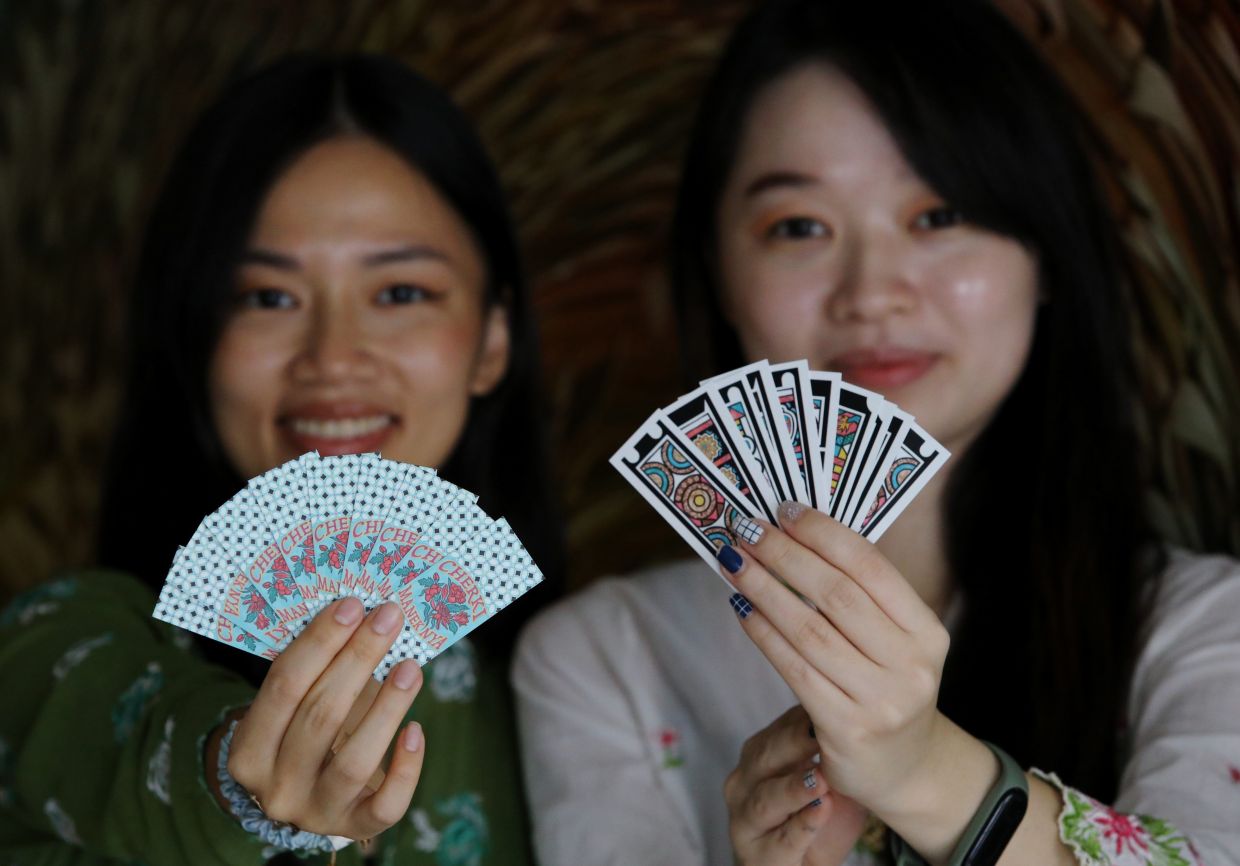
Sisters Lee Swee Lin and Lee Swee May, both from Melaka, are breathing new life into Cherki, a centuries-old Peranakan card game that has nearly faded from living memory. The 32 and 31-year-old entrepreneurs, who already operate a Kuala Lumpur-based business focused on Peranakan beaded footwear and decorative items, have redesigned the traditionally monochrome cards with vibrant colours and contemporary illustrations while maintaining the game's authentic cultural motifs and structural integrity. Their initiative addresses a growing concern within the Peranakan community: younger generations are losing connection with ancestral traditions as opportunities to learn from elders diminish and competing modern entertainment options dominate leisure time.
The genesis of their Cherki revival project traces back to their late paternal grandmother, Deo Yeok Kim, who served as custodian of family traditions and cultural knowledge. Growing up in her Melaka household, the sisters absorbed not merely the mechanics of traditional practices but the deeper significance embedded within Peranakan rituals, cuisine, language and material culture. Lee Swee Lin explains that their grandmother's recent passing crystallised their realisation of how much inherited wisdom comes through intergenerational living arrangements—knowledge that cannot be easily replaced once those connections are severed. The sisters' previous experience learning beading techniques from their mother and grandmother naturally positioned them to undertake this cultural preservation project, though the scope extended beyond their existing expertise.
Cherki itself represents a fascinating intersection of global trade and local adaptation in Southeast Asian history. Scholars believe card games originated in Tang Dynasty China during the 9th century, with contemporary records describing a "leaf game" that eventually spread westward via established trading routes, reaching Europe by the 14th century. The game travelled southward as well, becoming embedded in Peranakan households across Singapore, Malaysia, Indonesia and Thailand, where it was commonly called Ceki, Chi Kee or Koa. The Peranakan terminology—daun ceki, literally "leaf cards"—reflects this linguistic synthesis that characterises the entire Peranakan cultural identity.
Traditionally, Cherki decks consisted of two sets of 60 cards featuring 30 distinct patterns, divided into three suits representing coins, strings and myriads, with values ranging from one to nine plus three special cards: white flower, red flower and old thousand. The gameplay mechanics share structural similarities with mahjong, making it a natural fit for communities already familiar with that game. However, the plain black-and-white aesthetic of historical cards combined with increasingly obscure rules have rendered Cherki largely inaccessible to contemporary players. The sisters encountered this very challenge when researching the game's fundamentals during 2024—much knowledge existed but remained scattered and difficult for newcomers to grasp.
The redesigned Cherki deck represents approximately eighteen months of collaborative work between the sisters and a small design team utilising digital tools including Procreate and Adobe Illustrator. Rather than merely applying cosmetic changes, they fundamentally reimagined the visual language while preserving game mechanics. The new iteration features 30 patterns repeated four times rather than twice, maintaining the three-suit structure but introducing Peranakan cultural symbols throughout. Individual value cards now incorporate imagery referencing the kantan (a fragrant flower central to Nyonya cuisine), chupu (traditional porcelain serving vessels), kerongsang (decorative brooches fastening kebaya garments) and gelang (bracelets worn by Nyonya women). The special cards transform from generic flowers into butterfly, dragon and phoenix—symbols rich with cultural significance and visual appeal.
Lee Swee May articulates the design philosophy underlying their approach: creating a game that feels immediately relevant to contemporary players rather than resembling a museum artifact. By introducing colour, modern illustration techniques and enhanced instructional clarity, they positioned Cherki as an accessible entry point for younger Peranakans to engage with their heritage. Simultaneously, maintaining traditional pattern vocabulary and structural authenticity ensures that players connect with something their grandparents genuinely played, creating a temporal bridge across generations. This balancing act reflects broader challenges facing heritage preservation in globalised Southeast Asia, where cultural forms must evolve to remain meaningful without losing authenticating elements that distinguish them from generic entertainment.
The urgency of such preservation efforts becomes evident when examining demographic trends within the Peranakan community. A 2022 comparative study titled "Comparative of Cultural Material Study Between Baba Nyonya Original Descendants and Baba Nyonya New Descendants in Malacca" documented how younger descendants increasingly prioritise global pop culture over traditional practices, a pattern accelerated by exposure to digital entertainment and social media platforms that compete aggressively for attention. Lee Yuen Thien, deputy president of Persatuan Peranakan Baba Nyonya Malaysia (PPBNM) and manager of the Baba & Nyonya Heritage Museum Melaka, estimates the nationwide Peranakan population at 10,000 to 15,000 individuals, with the association itself maintaining 3,000 members. He observes that career pressures, urban mobility and changing family structures—particularly migration away from traditional Peranakan centres like Melaka and Penang—have fundamentally altered how younger community members experience cultural transmission.
Mixed marriages and diaspora patterns have further complicated heritage maintenance. Families dispersed across Malaysia, the broader region and international locations cannot rely on daily observance and intergenerational cohabitation to convey cultural knowledge. Traditional practices increasingly require deliberate, formalised educational efforts rather than osmotic absorption through household immersion. Lee notes that many younger Peranakans lack sufficient exposure to cultural activities within their immediate family circles, making external initiatives like the Cherki revival particularly vital. Without conscious intervention, practices like Cherki could disappear entirely within two to three decades as knowledge holders pass without transmitting expertise.
Swee Lin frames heritage preservation as fundamentally addressing questions of identity and continuity. Reviving Cherki transcends merely salvaging a historical game—the initiative preserves a tangible vessel carrying Peranakan stories, traditions and cultural distinctiveness. A world where this game becomes completely forgotten represents not merely entertainment loss but erasure of a particular way of understanding Southeast Asian identity and cross-cultural synthesis. She believes that creating awareness about ancestral heritage can spark interest among younger generations, offering them tools to develop meaningful connections with their background rather than viewing it as irrelevant to modern existence.
Lee Yuen Thien endorses this approach while emphasising that culture necessarily evolves as societies transform. Rather than attempting to preserve Peranakan practices in amber-like stasis, he advocates creating contemporary expressions that maintain essential authenticity while remaining accessible. Awareness campaigns, museum exhibitions, educational programmes and commercial products like the redesigned Cherki deck all serve complementary functions in this broader revitalisation effort. When younger Peranakans encounter their heritage through formats they actively choose to engage with—whether playing an aesthetically appealing card game with friends or exploring museum collections—the probability increases that they internalise cultural appreciation rather than treating tradition as obligatory parental expectation.
The sisters' initiative also carries commercial dimensions that may expand its reach beyond heritage communities. The visual appeal of the redesigned cards—combining contemporary design sensibilities with culturally specific symbolism—could attract players outside Peranakan circles, much as global interest in Asian games has expanded mahjong's audience. Marketing Cherki through digital platforms, international game retailers and cultural tourism channels creates multiple pathways for discovery. Parents seeking to teach children about Asian heritage, cultural enthusiasts and casual game players might all become vectors for transmitting Peranakan cultural knowledge. This broader market potential provides financial sustainability for heritage projects that purely educational or communal efforts might struggle to maintain.
The Cherki revival ultimately reflects broader Southeast Asian challenges regarding cultural preservation in accelerating modern contexts. Malaysia's remarkable multicultural society encompasses numerous communities—Peranakan, Orang Asli, Eurasian, and others—each facing pressures to maintain distinctive traditions amid globalisation, urbanisation and digital saturation. Successful models like the Lee sisters' approach, which combine aesthetic innovation with respectful authenticity, offer templates applicable across communities. Heritage preservation need not choose between frozen antiquarianism and complete assimilation; instead, thoughtful engagement can create living traditions that remain meaningful to successive generations. Whether Cherki ultimately experiences genuine revival or represents a poignant but ultimately unsuccessful attempt at heritage resurrection will depend partly on how extensively younger Peranakans adopt the redesigned game and partly on how broader community institutions support such initiatives.

