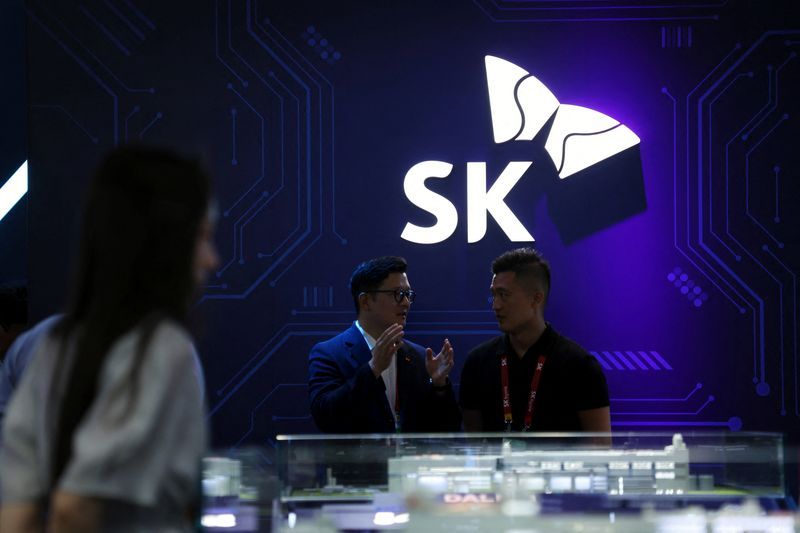
SK Hynix, South Korea's leading memory chipmaker, announced plans on Wednesday to raise up to 45.45 trillion won ($29.43 billion) through a listing of American Depositary Receipts, signalling an aggressive expansion strategy amid unprecedented global demand for artificial intelligence chips. The potential capital raise represents a watershed moment for the company, which has rapidly ascended to become the nation's most valuable corporation following the surge in AI-related semiconductor procurement worldwide.
The secondary offering will involve the issuance of 17.79 million new shares to support the ADR listing scheduled for July 10 on the Nasdaq exchange. SK Hynix specified that ten ADRs will be equivalent to one common share, a structure designed to facilitate international investment participation. The company indicated that the final fundraising amount could fluctuate following the bookbuilding process, during which institutional investors signal their demand and pricing preferences. This flexibility is standard practice for major capital markets transactions but underscores the company's confidence in investor appetite for its securities.
Proceeds from the offering will be strategically deployed across several critical infrastructure initiatives. The company plans to construct a new semiconductor fabrication facility in Yongin, establish an advanced packaging factory in Cheongju, and acquire essential chipmaking equipment including Extreme Ultraviolet Scanners. These cutting-edge lithography systems represent the frontier of semiconductor manufacturing technology and are essential for producing the most advanced chips demanded by technology giants worldwide. The capital investment reflects SK Hynix's determination to capture growing market share in high-performance memory segments.
The transaction is being orchestrated by a prestigious consortium of investment banks including BofA Securities, Citigroup Global Markets, Goldman Sachs, and JP Morgan Securities. Their involvement signals the scale and complexity of the undertaking, with these institutions leveraging their global networks to source institutional capital from across multiple continents. The choice of such heavyweight financial partners demonstrates the significance attached to this offering by both SK Hynix management and the international investment community.
If the transaction completes at the upper end of the indicated price range, SK Hynix will have orchestrated the largest American Depositary Receipt offering in history, dwarfing the $21.8 billion raised by Chinese e-commerce giant Alibaba during its landmark 2014 New York debut. This achievement would underscore the shifting dynamics of global capital markets, where semiconductor manufacturers increasingly command the attention and capital of international investors seeking exposure to transformative technological trends.
SK Hynix has emerged as one of the primary beneficiaries of the global artificial intelligence explosion, commanding a dominant position in the supply of high-bandwidth memory chips essential to AI computing infrastructure. The company counts technology titans such as Nvidia and Google, through its Alphabet parent, among its most significant customers. This positioning has proven extraordinarily profitable as enterprises worldwide rush to deploy AI capabilities across their operations, generating insatiable demand for specialized semiconductor components.
The timing of this capital raise reflects market dynamics that have fundamentally shifted in SK Hynix's favour. The company achieved a historic milestone on Monday when it surpassed Samsung Electronics in market capitalisation to become South Korea's most valuable enterprise. This remarkable development illustrates how technological disruption and evolving industrial structures can rapidly redistribute economic value within established corporate hierarchies. Samsung, long the nation's flagship conglomerate, has found its valuation eclipsed by SK Hynix's superior positioning in the AI semiconductor value chain.
For Malaysian and Southeast Asian investors and policymakers, this development carries significant implications. The region hosts substantial semiconductor manufacturing capacity and assembly operations, making regional stakeholders keenly interested in the fortunes of major chipmakers. SK Hynix's expansion plans could influence supply chain dynamics, equipment procurement patterns, and competitive pressures within the broader Asian semiconductor ecosystem. The company's success in raising capital at favourable terms may also trigger competitive responses from other regional players seeking similar international investment.
The ADR listing mechanism itself merits attention, as it allows non-U.S. companies to access American capital markets while maintaining their primary listings in domestic exchanges. This approach has proven particularly effective for large-capitalisation Asian companies seeking to broaden their shareholder base beyond home markets. For SK Hynix, the ADR structure provides access to the world's largest pool of institutional capital while maintaining operational headquarters and governance frameworks in Seoul.
The company's confidence in issuing new equity at this juncture reflects management's optimistic assessment of long-term artificial intelligence adoption trends. Rather than leveraging increased debt or restraining expansion through retained earnings alone, SK Hynix has chosen to strengthen its balance sheet through equity financing. This conservative financial approach provides flexibility to navigate potential cyclical downturns while maintaining capacity to pursue strategic investments during periods of strong demand.
The semiconductor industry remains subject to cyclical pressures and technological disruption, factors that necessitate continuous capital investment to maintain competitive positioning. SK Hynix's substantial fundraising effort acknowledges these realities while betting decisively on sustained AI-driven demand. The company's ability to access international capital markets on favourable terms validates its strategic positioning and technological capabilities in an intensely competitive global industry dominated by a handful of major manufacturers competing for dominance.

