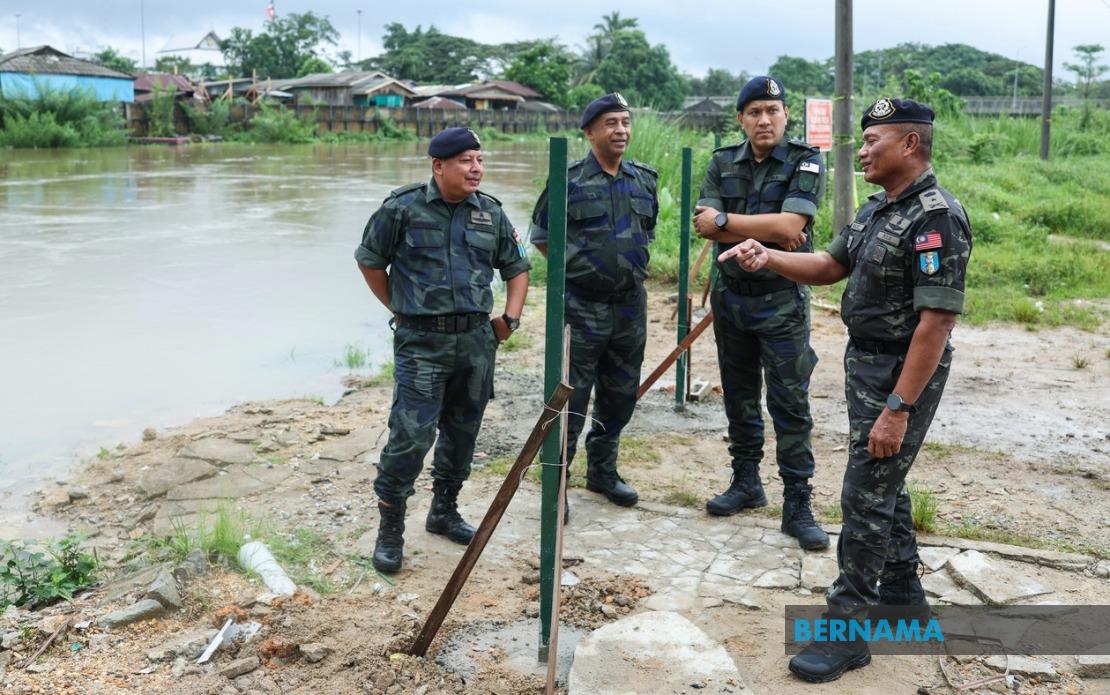
The General Operations Force has uncovered a significant shift in smuggling tactics along Malaysia's northern border, revealing how criminal networks are adapting their methods to circumvent increasingly vigilant security checks. During an operation in Kelantan's Pasir Mas district, authorities arrested 13 undocumented Myanmar nationals and dismantled a scheme that deliberately fragmented migrant movements into smaller contingents—a stark departure from the larger convoy transports that characterised previous attempts. This evolution in criminal methodology underscores the cat-and-mouse dynamic between enforcement agencies and organised smuggling rings determined to maintain profitable operations despite heightened border surveillance.
The breakthrough came through Operasi Taring Wawasan Kelantan, which the GOF's 8th Battalion executed in coordination with the Criminal Investigation Division from Pasir Mas district police headquarters. According to Southeast Brigade GOF commander SAC Ahmad Radzi Hussain, the operation commenced in the pre-dawn hours when officers acting on intelligence observed a Proton Exora exhibiting suspicious behaviour near Kampung Banggol Kemian. When the vehicle's driver detected the approaching security personnel, he abandoned the car and fled into adjacent forest, successfully evading immediate capture. The subsequent search yielded four Myanmar males from the vehicle itself, all lacking legitimate travel credentials. A more extensive sweep of the surrounding woodland approximately one hour later resulted in the apprehension of nine additional Myanmar nationals, apparently recent arrivals through unauthorised river crossings.
The arrested individuals, ranging in age from twenty to thirty-seven years, provided crucial intelligence about their journey and the syndicate's operational blueprint. They recounted being transported across the Golok River from Thailand by two unidentified handlers, who then deliberately staggered their delivery into Malaysia across multiple drop-off points within forested terrain. This deliberate compartmentalisation—releasing migrants in stages rather than moving them collectively—represents a calculated response to security force deployment patterns. The individuals interviewed indicated their intended destination was the Kuala Lumpur metropolitan area, suggesting the syndicate operates an internal distribution network moving arrivals from the border region toward urban employment opportunities. Such spatial separation reduces the visibility profile of any single transportation movement, making detection exponentially more difficult for patrols covering vast border areas with limited resources.
This tactical innovation reflects broader intelligence understood by law enforcement across the region. Smuggling organisations accumulate operational experience through successive interceptions, analysing which methods prove vulnerable to particular enforcement strategies. The shift toward disaggregated transport represents a response to Malaysia's historical success in intercepting large migrant convoys along established trafficking corridors. By fragmenting groups into units of four to nine individuals, smugglers reduce the likelihood that any single breach will result in the apprehension of entire networks. Concurrently, smaller groups attract less attention from local communities and informal informant networks that often alert authorities to suspicious activity in border villages. The forest staging methodology employed here also exploits Malaysia's challenging topography, where dense vegetation and multiple infiltration points create enforcement gaps impossible to seal completely with existing personnel levels.
The Pasir Mas operation yielded additional material evidence of the syndicate's operational capacity. Authorities seized the Proton Exora valued at approximately RM30,000, itself likely a testament to the venture's profitability. The vehicle's employment for migrant transport represents an investment suggesting the smugglers operate with sufficient capital reserves to absorb occasional losses through vehicle confiscation. The relatively modest value of the seized automobile also indicates these operators may maintain a fleet rotating vehicles through routes, limiting individual asset exposure. Such logistical sophistication points toward established criminal enterprises rather than opportunistic smugglers, organisations with sustained institutional knowledge and financial reserves enabling adaptation to enforcement pressures.
The Myanmar origin of all arrested individuals aligns with documented displacement pressures within Myanmar itself. The country's political instability, military conflict in border regions, and economic deterioration have generated sustained outward migration, with Thailand and Malaysia functioning as primary labour destination countries. Myanmar nationals represent the largest undocumented migrant population within Malaysia's irregular workforce, concentrated in construction, manufacturing, agriculture, and domestic service sectors. The stated intention of these individuals to seek employment in Kuala Lumpur reflects rational economic calculation—the capital offers significantly higher wage prospects than provincial areas or Thailand itself, compensating smuggling fees typically ranging from 8,000 to 12,000 baht per person.
The enforcement response deployed in this operation illustrates Malaysia's multi-agency coordination approach to border security. The General Operations Force, primarily tasked with paramilitary operations and border patrol, collaborated with the Criminal Investigation Division to ensure proper evidentiary gathering and legal procedures. All thirteen arrestees were transferred to Pasir Mas CID for processing under Section 6(1)(c) of the Immigration Act 1959/63, which criminalises harbouring undocumented migrants and their smuggling. This legislative framework enables prosecution of both migrants and transporters, though enforcement practice frequently focuses on migrants due to their visibility and accessibility versus the operational distance maintained by smuggling network organisers.
For Malaysian policymakers, this tactical evolution presents a recalibrated enforcement challenge. Previous detection strategies optimised for identifying large-scale movements may prove inadequate against dispersed networks coordinating smaller contingents. The successful interception required sophisticated intelligence—the initial spotting of a single suspicious vehicle—combined with rapid ground response and follow-up sweep operations. Replicating this success across the entire 506-kilometre Thailand-Malaysia border would require substantially enhanced intelligence-gathering capacity, technological surveillance infrastructure, and personnel deployment during vulnerable nocturnal hours when most infiltration attempts occur. The forest-based staging methodology also poses logistical barriers to enforcement, requiring trained personnel comfortable pursuing operations through difficult terrain.
Regionally, this development carries implications extending beyond Malaysia's immediate borders. Thailand faces comparable smuggling pressures as a transit country for Myanmar and Lao nationals, while Singapore contends with maritime smuggling variant operations. The adaptive behaviour identified in Kelantan demonstrates how criminal enterprises share methodological innovations across borders, with techniques developed in response to one country's enforcement measures potentially migrating to other jurisdictions. Intelligence sharing among ASEAN member states through established law enforcement cooperation mechanisms thus becomes increasingly critical for maintaining effectiveness.
The broader context of Malaysia's labour market dynamics merits consideration alongside enforcement operations. Malaysia's substantial dependence on undocumented migrant labour—estimated at over 2 million irregular workers despite ongoing regularisation programmes—creates persistent demand-side incentives for smuggling operations. Employers in labour-intensive sectors frequently prefer undocumented workers due to lower wage expectations and reduced regulatory compliance costs. Until Malaysia fundamentally restructures labour market incentives through rigorous enforcement of minimum wage standards, workplace safety regulations, and employer liability for undocumented hiring, smuggling syndicates will maintain robust profit margins justifying continued operational adaptation and innovation.
Looking forward, authorities acknowledge that singular successful operations, while tactically significant, represent limited victories against systematically entrenched migration networks. The captured vehicles and arrested individuals represent replaceable operational assets to smuggling organisations with demonstrated capital and institutional capacity. The real enforcement challenge lies in identifying and prosecuting the syndicate's coordinators—the individuals operating from secure locations, managing finances, cultivating intelligence networks, and directing operations. Until prosecution efforts extend to this organisational apex, rather than concentrating exclusively on transporters and migrants, smuggling networks will continue adapting tactics while maintaining operational continuity. The Pasir Mas operation thus illustrates both the competence of Malaysia's security forces and the fundamental limitations of arrest-based enforcement strategies against demand-driven transnational criminal enterprises.

