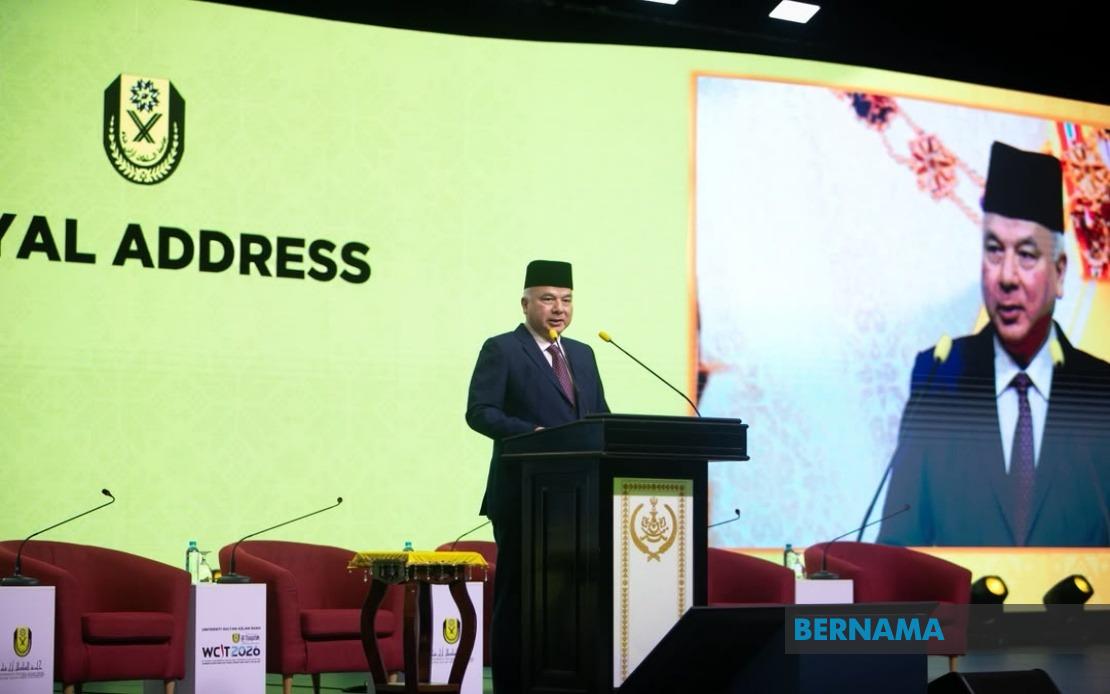
The Sultan of Perak, Sultan Nazrin Shah, has articulated a vision of national security that extends far beyond conventional military and cybersecurity frameworks, positioning social cohesion as the bedrock of a nation's resilience. During his keynote address at the 8th World Conference on Islamic Thought and Civilisation in Ipoh on July 21, he presented a nuanced argument that while border defence and protection against digital and ideological threats remain necessary, they pale in comparison to the cohesive bonds that bind citizens together.
Critically, Sultan Nazrin highlighted a growing menace facing Malaysia and the broader Islamic world: the weaponisation of religious identity for narrow political objectives. He warned specifically against the distortion of faith as a tool to fracture rather than unite communities, describing such manipulation as a corrosive force that undermines the very principles of inclusion that modern societies must champion. This observation resonates deeply within Malaysia's multicultural context, where communal harmony has historically been fragile and occasionally tested by those seeking to exploit sectarian divisions for electoral or ideological advantage.
The Sultan's framing of national integrity offers a sophisticated counterpoint to security paradigms that prioritise hardware over human connection. His reasoning proceeds from a straightforward but profound premise: a state fortified against external invasion but internally ravaged by corruption, inequality, and injustice has achieved only a temporary reprieve, not genuine security. This distinction carries particular weight in Southeast Asia, where several nations have invested heavily in military capabilities whilst simultaneously grappling with institutional decay and social fracture.
Crucially, Sultan Nazrin rejected the notion that unity must be imposed through conformity or the suppression of dissent. Instead, he posited that authentic national belonging emerges when all communities perceive themselves equitably represented within the nation's legal structures, economic opportunities, educational institutions, and corridors of power. This framework suggests that security built on coerced consensus is inherently fragile, vulnerable to collapse when external circumstances shift, whereas security rooted in genuine shared stake demonstrates the resilience necessary to weather systemic shocks.
The Sultan's treatment of education as foundational to long-term national security underscores a forward-looking preoccupation with human capital development in an era of technological disruption. He advocated for investment spanning not merely the quantitative expansion of schools and universities, but qualitative strengthening across science and mathematics disciplines whilst simultaneously preserving humanities and arts education. This holistic approach acknowledges that in a knowledge-driven economy, technical proficiency divorced from ethical reasoning and cultural literacy produces incomplete citizens.
Particularly prescient was his observation regarding the obsolescence of pedagogical methods suited to the industrial age. Rote memorisation and standardised testing, once adequate for an economy where information scarcity created value, have become counterproductive in an environment where data retrieval is instantaneous and nearly costless. Instead, Sultan Nazrin advocated cultivating distinctly human cognitive capacities: critical analysis, ethical deliberation, imaginative problem-solving, and adaptive flexibility—precisely those intellectual domains that artificial intelligence cannot yet replicate.
Sultan Nazrin positioned Islamic education as uniquely capable of nurturing this synthesis of revealed wisdom and rational inquiry, suggesting that properly conceived religious pedagogy naturally develops the very competencies now essential for thriving in the twenty-first century. This framing potentially bridges a longstanding tension between secular and religious educational models, proposing instead that rigorous Islamic learning traditions inherently promote the intellectual versatility required in an AI-inflected future.
His remarks on technical and vocational education as deserving equivalent status and investment to university pathways address a persistent hierarchical bias within Malaysian education policy. By advocating that skilled tradespeople merit the same societal esteem as physicians and engineers, Sultan Nazrin articulated a democratic vision of human dignity and national contribution that challenges lingering class assumptions about knowledge work versus manual expertise.
The Sultan's address, delivered before Deputy Prime Minister Datuk Seri Fadillah Yusof and other senior government figures, carries implicit guidance for policymakers navigating the complex interplay between security imperatives and social health. His insistence that no security apparatus can substitute for genuine belonging among citizens offers a sobering corrective to technocratic approaches that emphasise surveillance and enforcement over social investment and inclusive governance.
Fundamentally, Sultan Nazrin's thesis reframes the entire security agenda for Malaysia and the region. Rather than viewing social cohesion as a soft complement to hard security measures, he positions it as the indispensable foundation upon which all other security mechanisms must rest. In doing so, he invites Malaysia's political and policy establishment to confront an uncomfortable truth: that the nation's long-term stability depends less on additional defence expenditure or cyber barriers than on whether citizens across all communities genuinely perceive the system as just, representative, and invested in their collective flourishing.

