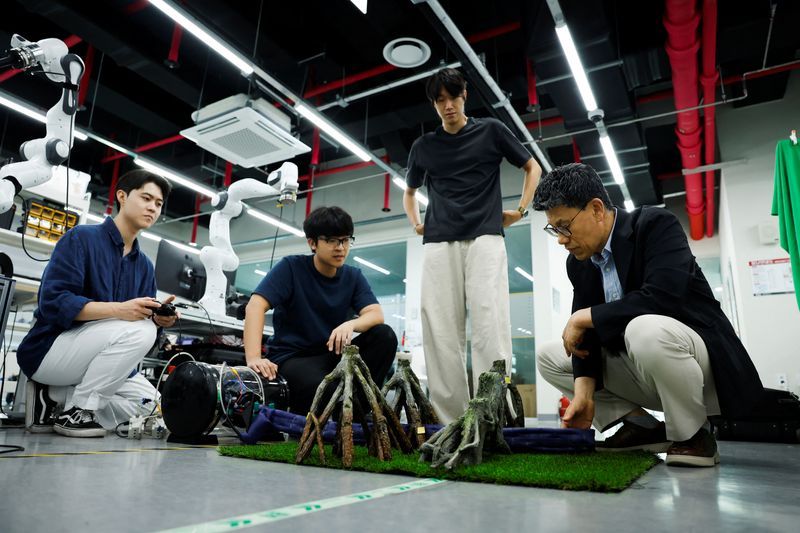
A collaborative team of engineers from KAIST in South Korea and Stanford University has developed an innovative robotic system that enables individuals to don protective or regular clothing entirely hands-free, marking a significant advancement in wearable robotics. The technology harnesses pneumatic power delivered through soft, flexible vine-like structures embedded directly into garments, which inflate and guide fabric components over the wearer's body with a climbing motion reminiscent of ivy scaling a building. The system can fully dress a person in approximately ten seconds and functions effectively even while the wearer remains in motion, eliminating the need for static positioning that has traditionally constrained robotic dressing applications.
The breakthrough emerged from an intuitive observation about everyday inconvenience. Kim Nam Gyun, the lead researcher from KAIST, recalls being caught in unexpected rainfall whilst cycling and envisioning a garment that could autonomously drape itself without interrupting his activities. This practical inspiration led to a fundamental rethinking of how robotics might address the mechanical challenge of clothing application. Rather than employing complex algorithmic controls, the researchers created a system that operates on elegantly simple principles, transforming the inside-out nature of fabric movement into an advantage rather than a limitation. The vine-like actuators grip and manipulate the textile by progressively advancing along the wearer's torso and limbs, much as a climbing plant gradually extends upward along a trellis.
The mechanical innovation draws heavily from biomimicry, specifically replicating the growth patterns of climbing vegetation. Ryu Jee-Hwan, a professor of civil and environmental engineering at KAIST, explains that the system advances by expanding at its leading tip rather than shuffling its entire mass forward, a distinction that provides remarkable stability when navigating the curved contours of a human body. This growth-based locomotion permits the vine structures to traverse narrow spaces, conform to irregular surfaces, and maintain traction across varied terrain types—whether slippery, adhesive, or inclined. The adaptability inherent in this approach eliminates the need for precise environmental mapping or complex sensor arrays that would otherwise complicate deployment.
The practical implications for emergency response and industrial settings are considerable. Semiconductor manufacturing cleanrooms represent one immediate application domain, where workers must don protective suits rapidly while maintaining absolute contamination protocols. The ability to don full protective equipment without using one's hands—keeping them available for equipment operation or safety protocols—introduces obvious efficiency gains. More broadly, emergency personnel confronting time-sensitive situations, from firefighters requiring full protective gear to medical teams donning isolation suits during infectious disease incidents, could benefit from dramatically accelerated equipment deployment. The technology addresses a persistent bottleneck in occupational safety where the time required to properly suit up can meaningfully impact response effectiveness.
Beyond emergency and industrial applications, the researchers envision significant utility for elderly populations and individuals with physical disabilities who currently depend on caretaker assistance to don and remove clothing. The hands-free functionality removes a substantial barrier to independence and dignity for people with limited mobility or dexterity. The system's tolerance for continued body movement and position variation also makes it substantially more practical than theoretical robotics that require complete physical cooperation. The ten-second dressing timeframe, whilst seemingly brief, represents a major improvement over manual assistance protocols that consume considerably more time and require both physical proximity and coordinated effort from a helper.
The underlying engineering approach reflects a philosophical distinction within robotics research itself. Ryu emphasises that as artificial intelligence and software systems command increasing scholarly and commercial attention, mechanical engineering solutions continue to offer profound potential when solving real-world problems. The vine robot exemplifies this principle—its elegance stems not from computational complexity or algorithmic sophistication but from physical ingenuity in mimicking natural systems. The pneumatic actuation system eschews elaborate control mechanisms in favour of passive mechanical properties that accomplish dressing through fundamental principles of pressure dynamics and material flexibility. This approach potentially offers greater reliability and simplicity compared to control-intensive alternatives.
For regional significance, the advancement holds particular relevance to Southeast Asian manufacturing and industrial sectors. As semiconductor production expands across Malaysia, Singapore, and Vietnam, cleanroom efficiency becomes increasingly critical for competitive positioning. Similarly, the region's rapidly ageing demographics in countries like Singapore and Thailand create mounting demand for assistive technologies that preserve elderly autonomy. The technology's development through international collaboration between Korean and American institutions also exemplifies how regional research institutions might engage with leading global centres to advance practical innovations applicable to local challenges.
The research was formally published in IEEE Robotics and Automation Letters, a peer-reviewed journal, lending credibility to the findings and subjecting the work to rigorous scientific scrutiny. This publication pathway signals that the technology has survived expert evaluation and represents a genuine advancement rather than preliminary or speculative research. The international authorship and institutional affiliation further strengthens the credibility of the findings within the global research community. As development continues, refinement of the materials, expansion of the device's adaptability to different body types and sizes, and cost reduction will likely determine whether this laboratory achievement successfully transitions to commercial and practical deployment. The fundamental concept, however, appears robust and broadly applicable across multiple sectors where rapid, autonomous dressing provides tangible value.

