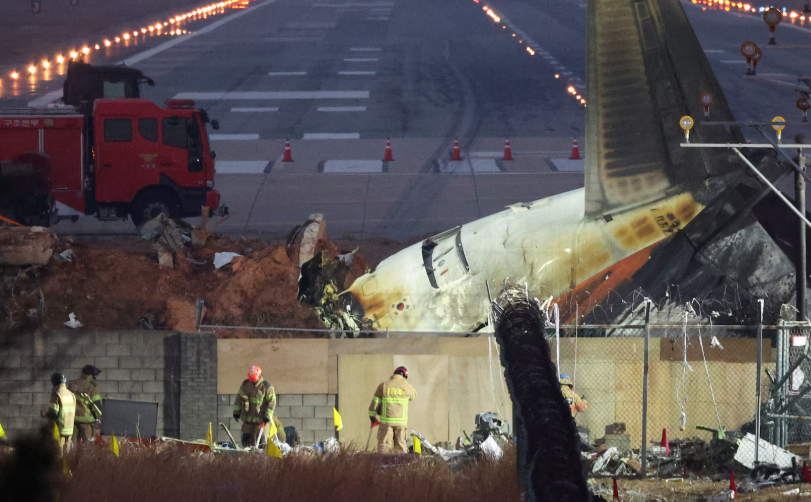
South Korean law enforcement has intensified its investigation into the Jeju Air disaster by conducting coordinated raids on multiple government agencies and aviation authorities on Tuesday, according to reports from Yonhap News Agency. The sweeping operation targeted the Korea Airports Corporation, the country's transport ministry, and the Busan Regional Office of Aviation, with investigators seeking to gather additional evidence that could strengthen their case against those allegedly responsible for the fatal incident.
The December 2024 crash at Muan International Airport claimed 179 lives in one of South Korea's deadliest aviation disasters in recent memory. The investigation, which has now expanded significantly in scope, continues to examine the circumstances leading to the accident and whether relevant authorities discharged their regulatory and operational responsibilities adequately. The raids represent a critical phase in the probe, as authorities seek to establish accountability at multiple levels of the aviation safety infrastructure.
The special investigation team has identified 74 suspects thus far, all facing potential charges of professional negligence resulting in death or injury. This legal framework allows prosecutors to pursue charges against individuals and organisations whose failures to exercise proper duty of care contributed directly to loss of life. The breadth of the suspect list indicates that investigators are examining accountability across operational, regulatory, and administrative levels rather than restricting focus to pilot or aircraft maintenance personnel alone.
Tuesday's operation marked the third instance in which investigators searched the transport ministry's offices, underscoring the complexity of establishing responsibility within government structures. The Korea Airports Corporation, which operates most of South Korea's major domestic airports with the notable exception of Incheon International Airport, has assumed particular prominence in the investigation. Authorities view the entity's operational procedures, maintenance protocols, and emergency response capabilities as central to understanding how the disaster unfolded.
Police indicated that charges of causing a serious public disaster could also be filed against suspects, a more severe legal characterisation that reflects the magnitude and scope of the incident. This additional charge carries greater significance both in terms of potential penalties and in establishing institutional rather than merely individual culpability. The combination of negligence and public disaster charges suggests prosecutors are building a layered case that addresses both specific failures and systemic shortcomings.
For Malaysian aviation observers, the South Korean investigation offers important insights into how neighbouring jurisdictions pursue accountability in major transportation disasters. The methodical approach of conducting sequential raids and expanding the suspect pool reflects the seriousness with which Seoul treats aviation safety failures. Malaysia's own regulatory framework, overseen by the Civil Aviation Authority of Malaysia and supported by established accident investigation protocols, shares similar structural characteristics with South Korea's aviation governance system.
The Jeju Air incident occurred during landing operations at Muan International Airport, a facility designed to handle regional and domestic traffic. The investigation's focus on determining the precise cause of the crash and evaluating agency response demonstrates the dual priority of modern aviation safety: preventing accidents through rigorous operational standards and ensuring rapid, effective response when incidents occur. Understanding these causative factors helps shape regulatory improvements across the entire region.
South Korea's aviation sector, like that of other developed Asian economies including Malaysia, operates within a framework of international standards established by the International Civil Aviation Organization. However, national implementation and enforcement of these standards can vary significantly. The investigation into Jeju Air suggests potential gaps existed between regulatory requirements and operational practice, a concern that resonates across Southeast Asia where aviation continues rapid expansion amid competitive pressures.
The involvement of multiple agencies in the investigative raids points to the interconnected nature of modern aviation operations. Airport authorities, transport ministries, and regional aviation offices all bear responsibility for different aspects of flight safety. By expanding the investigation across these agencies, South Korean authorities seek to identify whether failures occurred at systemic, procedural, or personnel levels, or some combination thereof.
For the families and survivors affected by the Jeju Air tragedy, the intensifying investigation signals official commitment to establishing comprehensive accountability. The scale of the inquiry, involving 74 suspects and multiple institutional searches, demonstrates that authorities view the incident as potentially reflecting widespread organisational or procedural deficiencies rather than isolated individual failures. This approach, while lengthy and complex, aims to prevent similar accidents through systemic reform.
The investigation's progression will likely influence how other countries in the region approach aviation safety oversight and accident response procedures. As air travel continues expanding throughout Southeast Asia, the lessons emerging from the Jeju Air inquiry could inform policy discussions in nations including Malaysia regarding regulatory effectiveness, inspection protocols, and the accountability mechanisms applied when disasters occur. The South Korean government's demonstrated willingness to pursue charges against institutional actors reflects broader international trends toward holding organisations responsible for safety outcomes.

