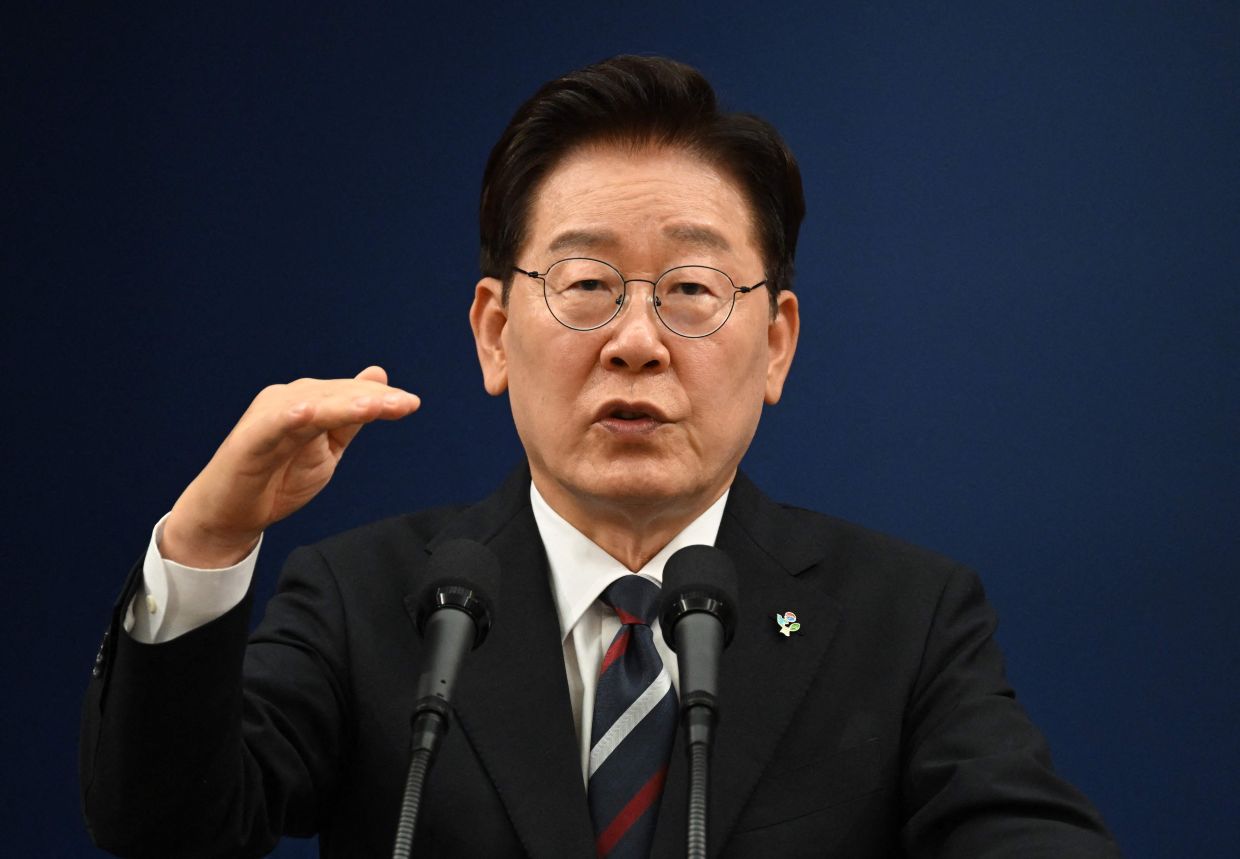
South Korean President Lee Jae Myung faces a critical moment in his nascent administration, with his approval rating plummeting to 46.7 per cent according to polling data released on June 22, marking the first occasion his performance ratings have dipped below the 50 per cent threshold since his inauguration on June 4, 2025. The Realmeter survey reveals a troubling pattern for the new leader: disapproval has climbed to 49.7 per cent, finally surpassing approval ratings and signalling a fundamental shift in public sentiment just weeks into his presidency.
The erosion of public confidence has been steep and consistent. Lee's approval trajectory shows a dramatic decline from 60.5 per cent in early May to the current 46.7 per cent, representing a loss of nearly 14 percentage points in just over a month. This fifth consecutive week of declining support indicates that the challenges facing the president are not temporary fluctuations but reflect mounting dissatisfaction with his handling of governance. While the survey's margin of error of plus or minus 2 percentage points technically places approval and disapproval within statistical range of one another, the symbolic significance of crossing below the 50 per cent mark cannot be understated in Korean politics.
The timing of Lee's approval crisis places him on a faster downward trajectory than several of his predecessors, though the pattern itself is familiar in South Korean political history. Former President Yoon Suk Yeol experienced the same crossing of disapproval over approval merely six weeks into his term in June 2022, suggesting that the first hundred days of a South Korean presidency can be treacherous. Former President Park Geun-hye took approximately 16 months to reach this inflection point, while Moon Jae-in's administration saw this shift after 19 months. Lee's rapid descent indicates vulnerabilities that demand immediate strategic response from the presidential office.
Two immediate crises have precipitated this collapse in public confidence. The June 3 local elections were marred by significant ballot shortages that undermined the credibility of the electoral process itself, creating a perception of administrative incompetence at the highest levels of government. Simultaneously, the ruling Democratic Party of Korea is convulsing with internal power struggles ahead of its August 17 convention to elect a new party chair, creating the impression of a leadership more focused on factional disputes than governing effectively. Realmeter analysts directly attributed the decline to what they termed a growing demand for accountability following what they characterised as an election management fiasco, compounded by escalating infighting within the ruling coalition.
Regional analysis of the polling data reveals concerning vulnerability in traditionally conservative strongholds that should form the bedrock of a centre-right president's support. Lee's approval rating fell most sharply in Daegu and North Gyeongsang Province—conservative bastions—dropping 9.9 percentage points to just 34.6 per cent, suggesting that even his ideological allies are losing confidence. The Greater Seoul area, encompassing Incheon, Gyeonggi Province, and Seoul itself, also shows significant erosion, with ratings falling to 44.8 per cent and 39.8 per cent respectively. This geographic fragmentation indicates that Lee's difficulties are not concentrated in opposition strongholds but are instead broadly distributed across the country.
The demographic breakdown exposes another vulnerability: support among moderate voters has crumbled to 47.5 per cent, down 4.9 percentage points. Moderates represent crucial swing voters who determine outcomes in closely contested elections and policy debates, and their defection signals that Lee has failed to consolidate the centrist coalition necessary for governing effectively. While conservative voters remain relatively supportive at 19.8 per cent approval and liberals strongly back the president at 80.4 per cent approval, the loss of moderate confidence suggests growing polarisation and suggests the president may be losing his governing coalition from the centre outward.
Interestingly, the pollster identified asset market disparities as an additional erosion factor, particularly among residents of the Greater Seoul region. Even as the Kospi index achieved a breakthrough above the 9,000-point mark—normally a positive economic indicator—ordinary South Koreans appear increasingly concerned about widening gaps in asset ownership and wealth accumulation. This disconnect between headline economic indicators and underlying economic anxiety reflects a deeper malaise about inequality and opportunity distribution that Lee's administration has not yet addressed adequately in public communication.
The presidential office's response has been measured but defensive. Cheong Wa Dae issued a statement accepting the polling results with what they termed humility, acknowledging both economic conditions and the broader conduct of state affairs as factors shaping public assessment. The statement pledges closer attention to public concerns and expectations, but offers little in terms of concrete policy responses to the dual crises of electoral administration and party dysfunction. For a presidency this young, such a passive posture risks appearing as acceptance of declining legitimacy rather than a robust action plan to reverse the trend.
Parallel polling on party support reveals a complex picture that extends beyond the president himself. Support for Lee's Democratic Party of Korea rose modestly to 40.1 per cent, while the main opposition People Power Party slipped to 42.3 per cent. However, this apparent stabilisation at the party level masks deeper fractures. The People Power Party faces mounting pressure over its role in managing the electoral crisis, with internal disputes over whether to conduct a full electoral rerun and controversies surrounding early voting arrangements. Remarkably, the Democratic Party's slight recovery appears attributable to a bipartisan agreement to launch a National Assembly investigation into election administration failures—essentially giving the ruling party credit for submitting to scrutiny rather than for successful governance.
The most alarming trend for conservative politics emerges in age-based analysis. The People Power Party's approval among voters in their twenties plummeted 10.5 percentage points to 48.6 per cent, while support among those in their thirties fell 5.1 percentage points to 47.4 per cent. This accelerating exodus of younger voters from the conservative camp threatens long-term demographic sustainability for Lee's political coalition. If these voters are becoming alienated during this early phase of his presidency, retaining their support in future elections will prove extraordinarily difficult.
For regional observers including Malaysia and other Southeast Asian nations, the South Korean political turbulence offers instructive lessons about the fragility of early presidential mandates and the high costs of administrative mismanagement. Lee's predicament demonstrates how quickly public confidence can evaporate when visible incompetence—such as ballot shortages—undermines faith in institutional capacity, regardless of a leader's prior reputation or policy intentions. The intersection of electoral dysfunction with internal party conflict creates a compounding crisis that cannot easily be resolved through rhetorical gestures or incremental policy adjustments alone.
Looking forward, Lee's administration faces a critical window to reverse this trajectory. The August party convention could either deepen internal divisions if it becomes a destabilising power struggle, or alternatively, it might provide an opportunity to demonstrate renewed unity and focus on governance. Without substantial intervention—whether through major policy announcements, personnel changes, or a comprehensive address to public concerns about electoral integrity and economic fairness—the probability of further approval deterioration appears high. For a president barely two months into his term, the political ground beneath him is already becoming unstable.

