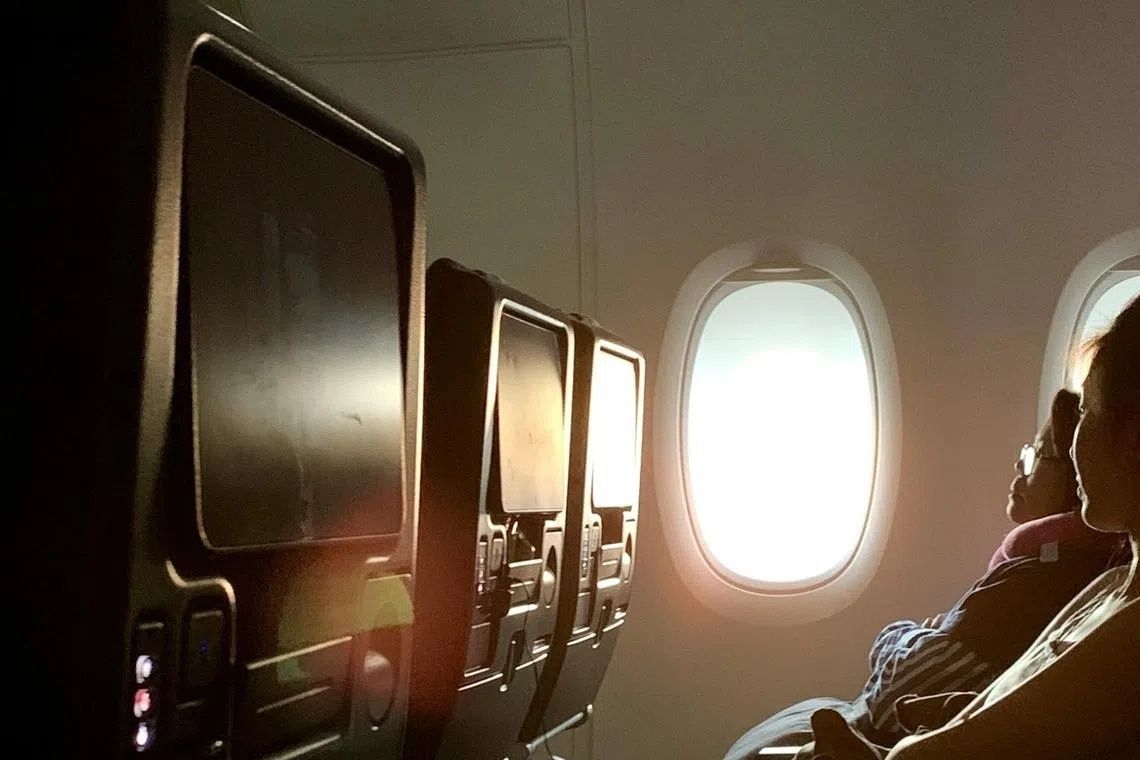
A middle school student in South Korea has escalated concerns about children's exposure to inappropriate material during flights by lodging a formal complaint with the government, highlighting a gap in protective measures aboard commercial airlines. The petitioner submitted their grievance through Petition 24, an online platform operated by the Ministry of the Interior and Safety, arguing that current airline entertainment policies fail to adequately shield young passengers from potentially harmful content.
The student described their distressing experience aboard an aircraft, explaining that despite attempting to avoid watching the screen, they found themselves unable to escape the violent and sexually suggestive imagery being broadcast. What compounds the concern is that the petitioner's younger sister, enrolled in primary school, was simultaneously exposed to the same material. This multi-generational exposure within a family unit underscores how the current system leaves vulnerable passengers with virtually no recourse or protective mechanisms once inappropriate content begins playing.
Recognising the inadequacy of existing solutions, the young petitioner has proposed implementing mandatory technological barriers to prevent unintended viewing. Their specific recommendation centres on mandatory privacy screens affixed to seat-mounted monitors, which would effectively restrict visibility of adult-rated content to viewers seated immediately in front of the display. Such a measure would create a practical physical boundary that respects both the viewing choices of adult passengers and the right of children to be protected from harmful material in a shared public space.
The petitioner's argument gains legal weight from South Korea's existing child protection framework. Both the Child Welfare Act and the Youth Protection Act explicitly require the safeguarding of children and adolescents from content deemed harmful to their development. The petition essentially argues that airlines, as commercial entities operating in domestic airspace, should fall under the scope of these legislative protections rather than operating in a regulatory vacuum.
The specific film in question remains unidentified, though the incident raises broader questions about content curation standards across South Korea's aviation sector. The two dominant carriers, Korean Air and Asiana Airlines, maintain stated policies prohibiting the broadcast of films classified for adult audiences aged nineteen and above. This threshold theoretically should filter out the most extreme content from their in-flight catalogues. However, the student's petition suggests that existing policies, while nominally protective, lack enforcement mechanisms and fail to address the particular vulnerabilities of a captive audience with minimal practical alternatives.
Both major carriers typically utilise edited versions of films in which particularly graphic violence and sexual content has been excised or substantially altered. This practice represents a middle-ground approach acknowledging that complete content exclusion would severely limit entertainment offerings, while unfiltered screening would breach protective standards. Yet the edited version approach appears insufficient in practice, as evidenced by the teenager's complaint about material that slipped through these ostensibly modified versions.
A noteworthy precedent emerged in 2020 when Korean Air and Asiana Airlines jointly decided to remove the internationally acclaimed film Parasite from their entertainment systems. Despite the film's relatively modest rating for viewers aged fifteen and above, both carriers deemed it unsuitable due to embedded scenes of violence and sexual content. This decision reflected airlines' recognition that even moderately rated films may contain discrete scenes troubling enough to warrant exclusion from the captive audience environment of commercial flights, where young children have no practical ability to leave or avoid the content.
The contrast between the Parasite decision and the current incident highlights inconsistent application of content standards. If two of Korea's premier airlines were willing to remove an acclaimed work for containing objectionable material, the question arises why other films with comparable or more severe content remain in rotation. The petitioner's complaint suggests either insufficient screening of newly acquired titles, evolving standards that have not been retroactively applied to existing playlists, or a gap between stated policies and actual implementation.
For Malaysian and wider Southeast Asian readers, this development resonates with ongoing regional debates about child safety in commercial spaces. Airlines operating throughout the region similarly grapple with balancing adult entertainment options against protecting younger passengers. The South Korean case may prompt regulatory bodies across ASEAN nations to examine whether their own carriers maintain adequate safeguards, or whether similar complaints have been inadequately addressed due to lack of formalised petition mechanisms.
The technological solution proposed—privacy screens—remains feasible and relatively inexpensive to implement, particularly for airlines seeking to demonstrate commitment to child protection without substantially limiting entertainment offerings. Such measures would align commercial aviation with standards increasingly expected in other public-facing entertainment venues, from cinemas offering matinee screenings to streaming platforms implementing parental controls.
The petition's progression through South Korea's government system may catalyse broader policy discussions about shared responsibility between airlines, regulators, and parents in shielding children from inappropriate content. While parental supervision remains important, the petitioner's argument that children in a confined aircraft environment should not bear the burden of avoiding unsolicited exposure to adult material presents a compelling case for structural, rather than merely supervisory, solutions.
Ultimately, this complaint represents an important voice advocating for the rights of young passengers to a protective environment during commercial travel, challenging the assumption that children's exposure to adult content is an acceptable cost of in-flight entertainment freedom. As South Korea's government reviews this petition, regional airlines may find themselves under increased scrutiny regarding their own content policies and the adequacy of existing safeguards.

