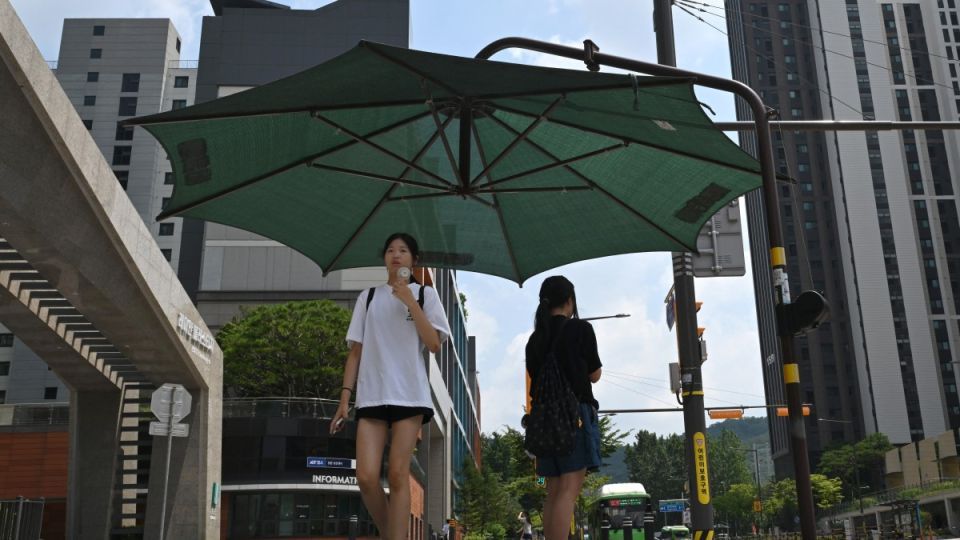
South Korea's battle against record-breaking temperatures has prompted corporate offices and industrial facilities nationwide to fundamentally reshape their working conditions, yet the response has starkly illuminated the disparities in workplace heat protection across the economy. Yangsan in South Gyeongsang Province registered a national peak of 42.5 degrees Celsius, while Seoul endured multiple days under the highest-level heatwave alert, triggering companies to overhaul daily routines with extended rest periods, staggered schedules and expanded access to cooling infrastructure. However, this corporate adaptation has created a two-tiered system of occupational safety where multinational conglomerates and large-scale employers command the resources to shield their workforce, while millions of workers at smaller enterprises and outdoor job sites remain dangerously exposed to thermal stress.
The urgency driving these workplace reforms stems from alarming statistics about heat-related occupational injuries. Data compiled by Rep. Kim Wi-sang of the ruling People Power Party reveals that between 2022 and June of this year, the Korea Workers' Compensation and Welfare Service documented 195 occupational accidents attributed to extreme heat, encompassing 20 fatalities. The situation deteriorated rapidly during the typical peak season, with 13 cases already recorded by the end of June, including four deaths, before the critical July and August months when temperatures typically reach their annual zenith. This trajectory signals a worsening trend that extends beyond mere statistical concern, representing genuine threats to livelihoods across multiple economic sectors.
Legal accountability has become an increasingly powerful motivator for corporate action. A pivotal district court decision last year convicted a construction company under the Serious Accidents Punishment Act following a heatstroke death involving a subcontractor's worker, establishing the first legal precedent specifically holding employers criminally liable for heat-related workplace fatalities. This verdict transformed workplace heat management from an optional corporate goodwill matter into a pressing legal exposure requiring substantive operational changes. The construction sector, historically accounting for a disproportionate share of industrial deaths, has consequently emerged as an industry leader in implementing comprehensive heat mitigation strategies.
Large construction firms have deployed increasingly sophisticated technologies and incentive structures to protect workers. Hyundai Engineering & Construction has implemented financial rewards for workers who utilise designated rest facilities, transforming rest-taking into a behaviorally reinforced practice. Lotte E&C operates Internet of Things-based monitoring systems across approximately 80 construction sites, continuously measuring perceived temperatures at five-minute intervals and automatically classifying heat risk levels into a five-tier classification system to trigger proportionate protective responses. Daewoo E&C has adopted a penalty-free approach permitting workers experiencing physical distress to cease work without career consequences, recognising that fear of financial repercussions often discourages workers from acknowledging genuine health risks.
Daewoo E&C has adopted a penalty-free approach permitting workers experiencing physical distress to cease work without career consequences. Meanwhile, Hyundai E&C has specifically tailored protections for migrant populations by distributing emergency reporting guides across 22 languages and providing cooling vests equipped with integrated cooling fans alongside oral rehydration solutions targeted at particularly vulnerable populations. Kumho E&C partnered with beverage manufacturer Lotte Chilsung to supply bottled water, sports drinks, cooling towels and portable shelters across its construction sites through September, recognising that hydration and shade access constitute fundamental heat safety infrastructure.
Heavy industrial operations that cannot halt production during extreme weather have implemented tightly calibrated work-rest alternation protocols. Posco, operating blast furnaces that function continuously regardless of external conditions, mandates 15-minute rest intervals following every 45 minutes of labour when perceived temperatures exceed 35 degrees Celsius, with more frequent breaks when temperatures climb further. When perceived temperatures remain between 31 and 35 degrees, Posco requires 10-minute respites after 50 minutes of work. Hyundai Steel similarly enforces minimum 10-minute hourly breaks when perceived temperatures exceed 31 degrees, increasing to 15 minutes when temperatures surpass 35 degrees. These mathematically precise schedules reflect corporate understanding that cumulative thermal exposure presents compounding physiological danger rather than instantaneous threats.
Shipbuilding conglomerates have substantially expanded their rest provisions during summer months. Hanwha Ocean has doubled its morning and afternoon breaks from 10 to 20 minutes through August's conclusion, independent of temperature considerations, while simultaneously extending lunch periods by 30 minutes when temperatures exceed 28 degrees and one full hour when temperatures climb above 31.5 degrees. HD Hyundai Heavy Industries has extended daily lunch breaks from 60 to 90 minutes through August and maintains more than 270 cooling facilities dispersed across its extensive shipyard networks, complementing these facilities with cooling vests, ice water and electrolyte supplements for workers. Samsung Heavy Industries established a dedicated task force exclusively coordinating heat-response initiatives and deploying supplemental portable cooling apparatus, while SK hynix has introduced extended rest intervals during extreme heat episodes, and Coupang has substantially upgraded ventilation, air conditioning and climate-control systems throughout its sprawling logistics infrastructure.
Yet this comprehensive corporate response obscures a deeply troubling reality regarding occupational safety distribution. Detailed analysis of the 195 documented heat-related accidents since 2022 reveals a stark concentration among vulnerable employment segments, with more than half occurring at enterprises employing fewer than 50 workers and 42 cases occurring at businesses with fewer than five employees. Labour experts and elected representatives consistently emphasise that employees at smaller enterprises typically lack access to dedicated occupational safety personnel, cooling infrastructure and adequate rest facilities, rendering them substantially more vulnerable during extreme weather episodes. The resource constraints differentiating large multinational corporations from small family-operated businesses or individual proprietors translate directly into life-threatening workplace conditions for millions of workers in lower-wage sectors.
Migrant workers engaged in agriculture and other outdoor occupations face particularly acute exposure, remaining largely absent from the corporate heat-protection measures dominating news coverage. Last month, a Thai seasonal worker died while performing agricultural labour in Haenam, South Jeolla Province, while a Vietnamese national perished while working outdoors on a farm in Goesan, North Chungcheong Province, representing only the most publicised examples of a broader pattern of preventable deaths among foreign seasonal workers. These fatalities underscore the vulnerability of temporary migrant labourers who typically lack permanent workplace safety infrastructure, reliable access to shade and hydration, and often face linguistic barriers preventing them from fully understanding heat-related health risks or communicating distress to supervisors.
Policymakers and labour advocates have begun articulating urgent calls for governmental intervention to address the yawning gap between protection levels across the economy. Rep. Kim Wi-sang has explicitly urged the government to shift focus beyond large corporate workplaces toward substantially strengthening workplace inspections and implementing practical protective measures specifically targeting seasonal migrant workers and employees at small outdoor business operations. This legislative advocacy recognises that market mechanisms and corporate responsibility initiatives, while producing measurable benefits for workers at major companies, fundamentally fail to protect the economically marginalised workers at greatest thermal risk. Without government-mandated standards, inspection regimes and enforcement mechanisms, the current heat-protection landscape will continue reinforcing existing economic inequalities while concentrating occupational safety improvements among workers already enjoying relative economic security.

