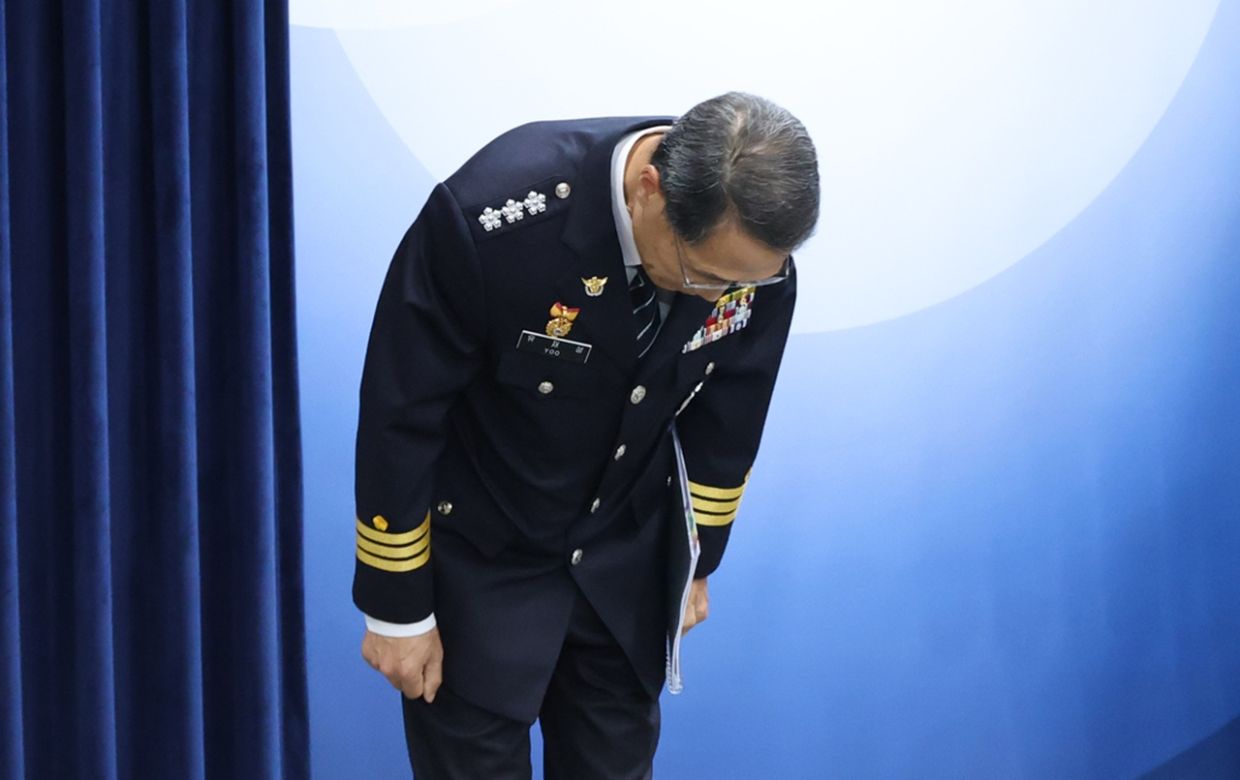
South Korea's Acting National Police Agency Commissioner General Yoo Jae-sung has committed to sweeping institutional reforms as pressure mounts on the police force over allegations of investigative misconduct and corruption within its ranks. Speaking at the Government Complex Seoul on Monday, Yoo declared that the agency would treat the mounting scandal as a catalyst for fundamental change, pledging to rebuild eroded public confidence through systematic restructuring of how investigations are conducted and officers are held accountable.
At the heart of the controversy is the case of Jang Yoon-gi, arrested in connection with the May death of a teenage girl in Gwangju. Investigations have revealed that police officers allegedly passed sensitive case information to Jang's father, a serving police officer himself, while simultaneously failing to properly secure crucial evidence. The incident has become emblematic of the risks posed by institutional networks within law enforcement and the potential for familial relationships to compromise investigative integrity—concerns that resonate throughout Southeast Asian law enforcement agencies grappling with similar transparency challenges.
Yoo's commitment to reform extends beyond symbolic gestures. The police agency has unveiled a multifaceted reform agenda that addresses investigative practices, personnel management, and external oversight. Central to this strategy is the establishment of an investigative reform task force, scheduled to commence operations by the end of July. The task force will comprise seven to ten members, with independent experts constituting over half the panel. This composition aims to inject objectivity and reduce the risk of internal resistance derailing meaningful change—a structural approach increasingly adopted by governments seeking to reform entrenched institutional cultures.
The task force's mandate encompasses significant ground. It will examine personnel reform measures designed to sever the improper institutional ties that develop between officers and their local communities—connections that the Jang case illustrated can compromise investigations. The team will also develop improved protocols for handling cases involving socially vulnerable populations, acknowledging that victims from disadvantaged backgrounds may receive inadequate investigative attention. This focus carries particular relevance for regional audiences, as marginalized groups across Southeast Asia frequently report diminished access to justice.
Complementing the task force are two new oversight bodies with distinct responsibilities. An internal affairs investigation unit operating under the National Office of Investigation will investigate serious crimes allegedly committed by police personnel, with jurisdiction extending across all ranks regardless of seniority. This structural innovation removes investigative authority from the chain of command, theoretically insulating inquiries into officer misconduct from protective hierarchical relationships. A second oversight mechanism, operating under the Korean National Police Commission, will employ approximately one hundred civilian investigators tasked with examining alleged human rights violations and investigative misconduct. Yoo emphasized that this body's effectiveness hinges on legislative authorization to issue recommendations leading to personnel transfers or disciplinary sanctions.
Implementing the civilian oversight body requires amending the Police Act, a legislative challenge that underscores the institutional barriers reformers must navigate. A related amendment has already been submitted to the National Assembly, and Yoo indicated the police agency would actively participate in the legislative process to advocate for provisions enabling meaningful enforcement mechanisms. This institutional struggle mirrors debates across the region, where law enforcement organizations often resist external oversight mechanisms that could constrain operational autonomy or reveal internal dysfunction.
Beyond investigative and oversight reforms, the government is pursuing an Interior Ministry initiative to expand police officer rotation systems across ranks. Currently, only superintendent-level and some senior inspector positions participate in mandatory nationwide rotations. The proposed expansion aims to prevent officers from developing entrenched local relationships that could compromise their professional judgment or enable personal favoritism. However, Yoo acknowledged the practical challenges inherent in such expansion. Official residences are currently provided only to superintendent-level or higher officers undergoing rotation, a subsidization model that becomes significantly more expensive if extended to lower ranks. The financial implications raise equity questions about which officers receive housing support, potentially creating resentment among personnel contributing to household costs themselves.
Yoo indicated the police would consult rank-and-file officers before proceeding with expansion, a consultative approach reflecting awareness that reform initiatives can generate frontline resistance if perceived as imposing burdens without corresponding support measures. The agency intends to implement measures capable of immediate deployment while delegating more complex policy refinements to the reform task force. This phased strategy represents pragmatic policymaking in the face of institutional inertia—introducing achievable reforms that demonstrate commitment to change while buying time to develop comprehensive solutions to more intractable problems.
The broader context reveals that institutional reform in law enforcement requires addressing not merely investigative procedures but the systemic incentive structures that enable misconduct. The Jang case exposed how familial and professional relationships within police hierarchies can override investigative standards, suggesting that structural separation of authority and oversight mechanisms represents a more durable solution than exhorting individual officers toward ethical conduct. For Southeast Asian observers, this emphasis on institutional redesign over moral exhortation offers instructive lessons as regional governments contemplate their own law enforcement modernization.
Regarding Jang's father specifically, Yoo indicated the police would defer concluding their internal investigation pending the special investigation team's final findings. This deliberate pacing reflects institutional prudence—avoiding the appearance of preferential treatment while awaiting complete factual clarity. The decision implicitly acknowledges that premature disciplinary action against a serving officer could be challenged as procedurally deficient, undermining the broader reform agenda's credibility.
Yoo's statement that he would "faithfully carry out his duties without clinging to his position" signals willingness to accept accountability should reforms prove inadequate. This rhetorical positioning attempts to project leadership confidence while acknowledging the precarious institutional environment surrounding the police agency. For governments throughout Southeast Asia wrestling with law enforcement legitimacy challenges, the Korean example demonstrates that meaningful reform requires structural innovation, external oversight, and leadership acknowledgment that institutional change sometimes demands personal sacrifice.

