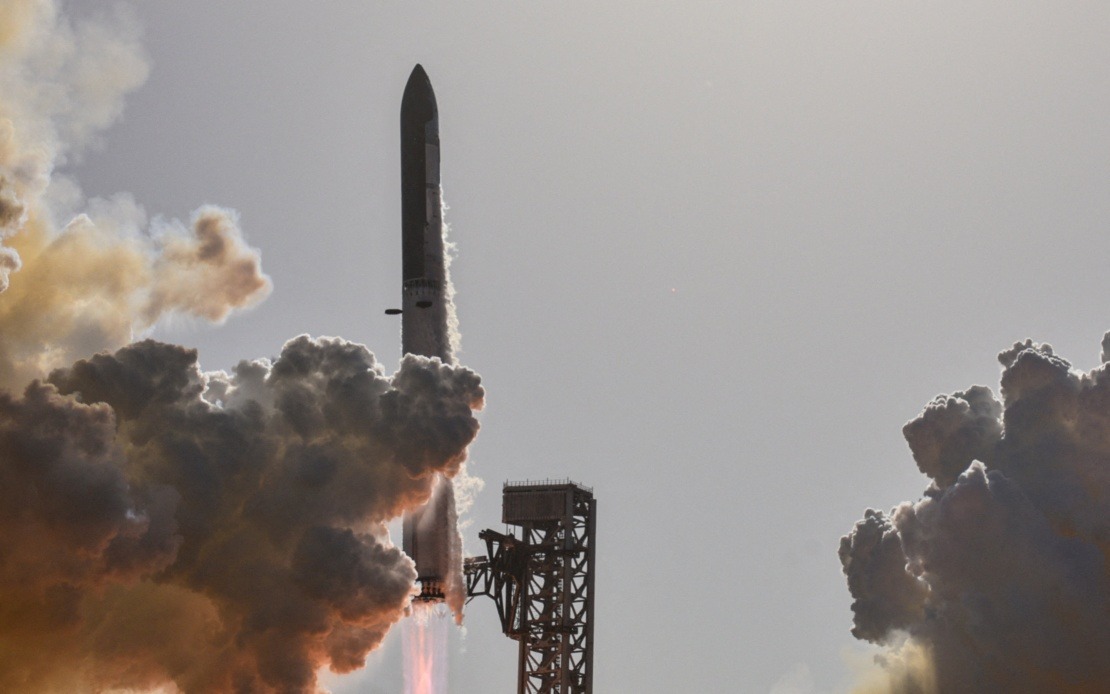
SpaceX has successfully executed its 13th test flight of the Starship super-heavy launch system, marking another step forward in the company's ambitious development programme. The rocket lifted off from the Starbase facility in Texas at 5:51 pm Central Time on July 25, shortly after 22:51 GMT, following a troubled lead-up that tested the team's patience and operational readiness.
The path to this launch proved considerably more turbulent than typical space operations. Mission planners had scheduled three separate launch attempts before finally achieving liftoff. The first attempt encountered a critical setback when the automatic countdown sequencing halted just seconds before ignition, triggered by undisclosed technical anomalies that forced a complete abort. The next two opportunities fell victim to deteriorating weather conditions across the Texas region, a common challenge for spaceport operations in the state's unpredictable summer climate. Such delays, while frustrating for teams and observers, underscore the safety-first protocols that govern modern spaceflight.
The test mission itself represented a notably ambitious agenda for the 13th iteration of this experimental programme. Among the primary objectives was the deployment of 20 Starlink V3 satellites into orbit, the highest number of this generation that Starship has attempted to carry aloft simultaneously. These satellites form part of SpaceX's broader constellation strategy aimed at expanding global broadband coverage and improving latency for terrestrial users. The V3 variant represents a technological advancement over earlier models, incorporating design refinements intended to boost data transmission speeds and overall network capacity across served regions.
Beyond straightforward satellite placement, the mission incorporated several sophisticated technical demonstrations. Once positioned in the vacuum of space, the upper stage engine team planned to execute a controlled ignition of one Raptor main engine, a critical capability that validates the spacecraft's capacity for in-space maneuvering and orbital insertion adjustments. This reignition testing feeds directly into SpaceX's long-term goals of enabling reusable spacecraft architecture for deep-space applications. The upper stage subsequently performed a controlled atmospheric reentry and achieved a soft splashdown in the Indian Ocean at 23:57 GMT Friday, demonstrating the recovery procedures essential for eventual reusability.
The satellite deployment scenario incorporated a unique experimental element designed to generate real-world performance data. The 20 Starlink V3 units were scheduled to unfold their solar panel arrays and deploy communication antenna assemblies immediately following separation from the Starship upper stage. Engineers then planned to execute laser-based inter-satellite communication tests, validating the ability of these new units to integrate seamlessly with the broader constellation network. However, the satellites would follow the same suborbital trajectory as the mothership, meaning the entire complement would experience atmospheric burn-up approximately 20 minutes after deployment, preventing any operational constellation expansion from this particular test flight.
Another layer of experimentation involved thermal protection assessment. Six of the deployed satellites had been equipped with cameras specifically tasked with imaging the Starship upper stage exterior during reentry, providing engineers with valuable visual documentation of aerodynamic heating and shielding performance. To enhance the contrast and create distinct imaging targets, technicians deliberately painted certain thermal protection tiles white against the vehicle's standard external finish, a deliberate marking strategy designed to improve tracking precision during the high-speed descent phase. These thermal imagery datasets feed directly into ongoing efforts to refine heat shield materials and deployment geometries for future iterations.
The broader significance of this mission extends beyond the immediate technical achievements. Each Starship test flight represents incremental progress toward SpaceX's goal of creating the first fully reusable super-heavy lift system capable of sustained operational flights. The company envisions this technology as foundational infrastructure for lunar transportation, Martian colonization efforts, and other deep-space activities. For Malaysian and Southeast Asian observers, the success of such advanced aerospace programmes carries implications for regional launch services, satellite communications infrastructure, and participation in emerging space economy opportunities.
The cumulative experience from thirteen test flights has allowed SpaceX engineers to identify design issues, validate structural approaches, and refine operational procedures at an unprecedented pace. This iterative testing methodology, while generating significant costs, has historically accelerated development timelines compared to traditional aerospace programmes. The relatively high cadence of Starship testing contrasts sharply with conventional space vehicle development approaches, reflecting the company's acceptance of controlled failure as a valid learning mechanism within its broader development strategy.
Looking forward, subsequent Starship missions will attempt increasingly ambitious objectives. Future tests are expected to include longer suborbital flights, orbital insertion capabilities, and ultimately booster recovery operations, each building upon the knowledge foundation established by flights such as this one. For the space industry globally and for developing nations seeking affordable launch access, the achievement of a reliable, reusable heavy-lift system could fundamentally reshape the economics of space activity, potentially unlocking new applications and commercial opportunities that currently remain prohibitively expensive through existing infrastructure.

