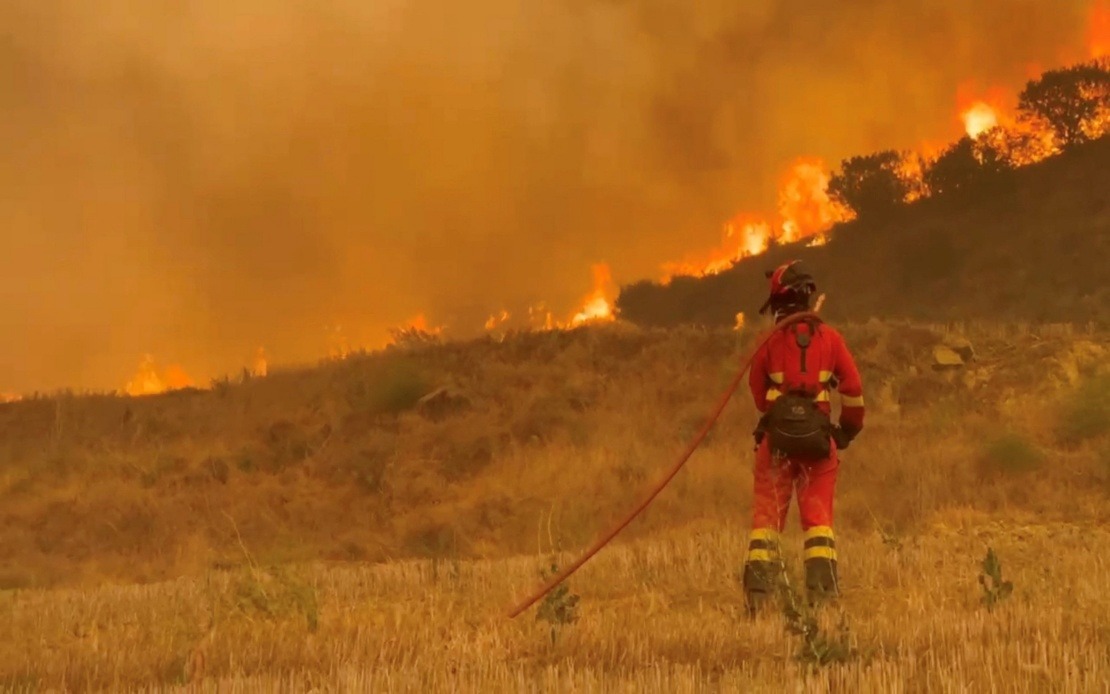
Spain is confronting an unprecedented wildfire crisis as the country's most destructive blaze of 2024 continues to devastate the northeastern province of Zaragoza, having already engulfed approximately 12,000 hectares and displacing more than 1,100 people from their homes. The fire, which ignited on Wednesday in the Cinco Villas region, has shown no signs of abating, with officials describing it as remaining "quite active" and displaying "significant" expansion overnight into Friday, transforming what began as a localized emergency into a regional catastrophe that threatens multiple communities across provincial boundaries.
The scale of the evacuation reflects the fire's alarming trajectory and the genuine peril facing residents across the affected territories. Authorities have ordered the complete evacuation of five municipalities within Zaragoza province and one additional municipality in the neighboring region of Navarre, creating a humanitarian challenge as thousands of displaced families seek shelter and information about when they can safely return. The fire's perimeter has expanded to encompass approximately 60 kilometres, with multiple road closures across the region complicating both emergency response operations and civilian movement, while simultaneously disrupting supply chains and regional commerce.
Government response has been mobilized at considerable scale, with emergency services deploying around 400 ground personnel and 19 aircraft on Thursday alone to confront the advancing flames. Throughout the night, firefighting crews concentrated their efforts on defending the municipality of Uncastillo, where residential areas faced the most immediate danger from the expanding inferno. The Spanish Military Emergency Unit was summoned to assist operations, dispatching approximately 100 personnel to reinforce stretched firefighting resources—an indication of how severely this incident has stretched Spain's emergency response capacity.
The crisis extends beyond the Zaragoza province conflagration, as Spain simultaneously battles multiple active fires across its northern and central regions. A second significant wildfire near La Mierla in Guadalajara province has already consumed around 900 hectares and continues burning, necessitating evacuations and lockdown protocols in surrounding communities. A third fire near Lozoyuela, positioned just north of Madrid, remains neither fully contained nor under control despite showing some signs of favorable progression, demonstrating that Spain is not facing a single localized emergency but rather a cascading series of fire outbreaks across diverse geographical areas.
Investigators have made an arrest in connection with the Madrid-region fire, with Civil Guard authorities apprehending a suspect on suspicion of deliberately starting the blaze. The regional government has indicated its intention to join the resulting legal proceedings as a civil party, signaling a commitment to pursuing accountability if arson is confirmed—a response that underscores official concerns about intentional fire-setting as a contributing factor to this year's catastrophic wildfire season.
The meteorological and environmental conditions converging across Spain have created an exceptionally hazardous situation for fire propagation and spread. The combination of elevated temperatures, powerful wind patterns, diminished atmospheric humidity, and abundant vegetation growth following the spring rainy season has generated circumstances where fires can advance with remarkable speed and intensity. These physical conditions, while cyclical in nature, have created a perfect storm that turns even modest ignition sources into major conflagrations capable of threatening large populations.
Beyond immediate meteorological factors, analysts point toward longer-term structural vulnerabilities within Spain's landscape that amplify wildfire vulnerability. Climate change has progressively extended the fire season and intensified peak conditions across Mediterranean regions, while the systematic depopulation and abandonment of rural areas has left vast expanses of woodland and grassland unmanaged and overgrown. This combination of climate-driven intensification and rural abandonment has transformed Spain's countryside into increasingly flammable terrain, creating conditions where even well-resourced emergency services struggle to contain rapidly advancing blazes.
For Malaysian and Southeast Asian observers, Spain's wildfire crisis offers instructive parallels to the regional challenges posed by uncontrolled fire seasons, particularly the transboundary haze episodes that periodically devastate air quality across Malaysia, Singapore, and Indonesia. The Spanish experience demonstrates how climate change, combined with land-use changes and inadequate vegetation management, can overwhelm even developed nations' emergency response capacities. Just as Southeast Asia has learned through painful experience with annual peat fires and agricultural burning, effective wildfire management requires sustained investment in prevention, early detection systems, and landscape restoration rather than reactive emergency response alone.
The immediate humanitarian and infrastructure toll continues mounting as the Zaragoza fire and its companion blazes consume territory. While authorities have successfully restored electricity to all affected towns—a logistical achievement that should not be understated—the broader disruption to regional life remains substantial. Road closures continue affecting commerce and connectivity, while the psychological impact on displaced families and the strain on regional resources supporting evacuees will persist long after the flames are extinguished, adding a social cost dimension to the already-substantial economic losses from destroyed vegetation and infrastructure.
Authorities have implemented partial lockdown measures across portions of the Cinco Villas region and maintained multiple road closures, restrictions that reflect both the ongoing danger from active flames and the need to preserve clear pathways for emergency vehicles. These restrictions, intended to protect civilians from immediate hazard, simultaneously underscore the profound disruption that major wildfire events impose on regional society. The interplay between emergency containment operations and civilian life demonstrates the severe costs that uncontrolled fire seasons extract from affected populations and economies.
Looking ahead, Spain's authorities face the dual challenge of bringing these immediate fires under control while simultaneously addressing the systemic factors—climate change, rural abandonment, vegetation management deficits—that have created conditions for this unprecedented 2024 wildfire season. The magnitude of the response already mobilized, involving hundreds of personnel and dozens of aircraft, indicates that Spanish officials recognize the severity of the threat. However, the convergence of multiple active fires across different provinces simultaneously suggests that even maximal resource deployment may struggle to contain all blazes before they consume substantially more territory and potentially claim lives.

