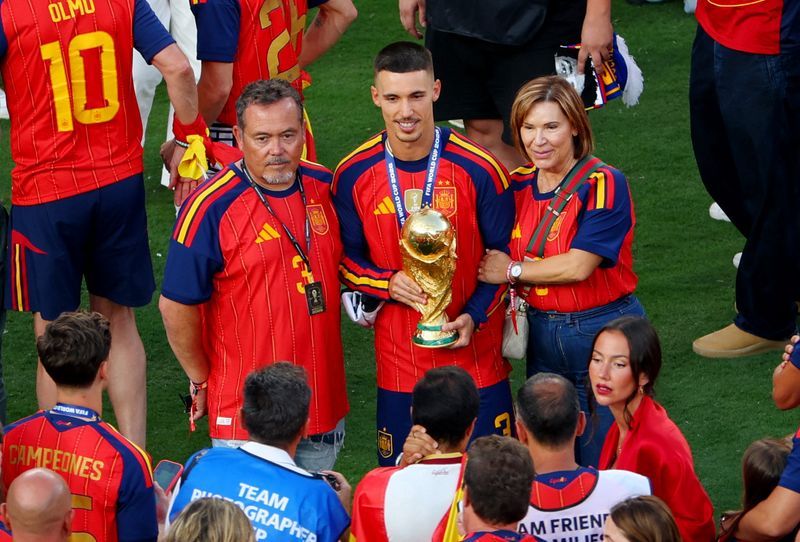
In winning the FIFA World Cup with a 1-0 victory against Argentina, Spain has done far more than claim another trophy. The team's measured, methodical performance has delivered something the country's politicians struggle to achieve—a moment when regional differences fade into insignificance and millions feel genuinely united. Playing in East Rutherford, New Jersey, Spain showcased a footballing philosophy that transcends sport, revealing how shared purpose and collective discipline can overcome deeply entrenched divisions within a complex, multi-ethnic society.
The Spanish approach throughout the tournament, culminating in Sunday's final, defied conventional wisdom about how modern football must be played. Rather than abandoning their possession-based tiki-taka system in pursuit of pragmatism, Luis de la Fuente's squad doubled down on ball control, patience, and territory management. Against Argentina, Spain completed over twice as many passes as their opponents, maintained more than 65 percent of possession, and created twice as many goal-scoring opportunities. This was not defensive, grinding football born of necessity, but rather an affirmation of identity—a refusal to compromise on principles even when facing opponents known for their direct, aggressive approach.
The winning goal itself carried deep symbolic weight. Rather than arriving from an established star player, it was produced by substitutes Nico Williams and Ferran Torres, the third instance in Spain's knockout-round campaign where a replacement player had scored the decisive goal. This pattern speaks volumes about De la Fuente's squad construction and team philosophy. No single individual—not the tournament's brightest talent, not the most celebrated goalscorer—carried Spain's hopes. Instead, the team operated as a coordinated unit where every player, whether starting or waiting on the bench, had internalized the same tactical approach and cultural values. The message was unmistakable: this is not a collection of soloists but an orchestra, where even those entering late know precisely which notes to play.
Spain's dominance throughout the eight-match tournament provided a masterclass in consistency. The team accumulated 14 goals across their campaign, shared among eight different scorers—a distribution that mirrors their European Championship success in 2024, when 10 different players contributed to a tournament record of 16 goals. This spreading of responsibility reflects a deliberate cultural choice. Spanish football at its highest level has moved beyond depending on talismanic forwards or mercurial playmakers. The system prioritizes structure, positioning, and the understanding that threats can emerge from multiple points across the pitch. For nations developing football programs, particularly those in Southeast Asia with aspiring federations, this represents a crucial lesson about building sustainable, system-dependent success rather than relying on individual brilliance.
The tournament awards further underscored Spain's comprehensive excellence. Pau Cubarsi received the Best Young Player award, Unai Simon was named Best Goalkeeper, and Rodri claimed the Most Valuable Player honor. Only the Golden Boot, awarded to France's Kylian Mbappe, escaped Spanish hands. The absence of a world-class, traditional centre forward—Spain's most persistent vulnerability—paradoxically became less critical as the tournament progressed. Despite creating numerous chances that went unconverted, the team's defensive solidity and midfield control proved sufficient. This defensive discipline helped extend Spain's unbeaten run to 38 consecutive matches, surpassing Italy's previous record and establishing clear supremacy in international football across recent years.
De la Fuente's elevation to World Cup-winning coach represents a personal vindication that carries broader implications. Once dismissed by Spanish media as Luis de la "Who" following decades spent working in Spanish Football Federation youth development, he transformed this patient apprenticeship into football's greatest prize. His journey challenges assumptions about traditional coaching hierarchies and demonstrates how deep familiarity with talent development systems, youth structures, and long-term player development can produce world-class teams. Rather than importing foreign tactical innovations or chasing short-term results, De la Fuente built success through methodical, incremental improvement—a philosophy with resonance beyond football.
Beyond tactical analysis and statistical dominance, Spain's World Cup victory carries profound meaning for a nation repeatedly fractured by regional identity struggles. The squad comprises players from every significant region of Spain: Basque Country natives like Mikel Oyarzabal, Unai Simon, and Mikel Merino; Galicians including Borja Iglesias; Valencian Ferran Torres; Madrileño Rodri; Andalusian contingents led by Fabian Ruiz and Gavi; Canary Islander Pedri; and nine players born in Catalonia, including defenders Lamine Yamal and Marc Cucurella. This geographic diversity reflects something crucial about contemporary Spain—the country comprises smaller nations, each with distinct historical identities, languages, and political autonomies.
Perhaps most significantly, the squad includes Lamine Yamal and Nico Williams, both representing Spain's increasingly multicultural character and the success of immigration policies that have integrated new communities. Williams, son of parents from Ghana and Equatorial Guinea, embodies modern Spanish identity just as completely as players whose families have inhabited the Iberian Peninsula for generations. This integration, reflected in the team's composition, demonstrates how sport can normalize diversity in ways that political discourse often cannot. Football achievements transcend regional pride and create shared national joy that encompasses all Spaniards, regardless of linguistic, cultural, or historical affiliations.
The political relevance of Spain's triumph cannot be understated for countries across Southeast Asia grappling with their own multicultural compositions and regional tensions. Football, when played at the highest level with collective discipline and shared purpose, accomplishes what political institutions frequently cannot: it makes a nation feel whole. The differences between regions did not disappear during Spain's World Cup run—Catalan pride, Basque identity, and regional autonomy movements remain genuine political forces. Yet for one Sunday night in New Jersey, these differences ceased being obstacles to national unity. Instead, they enriched Spain's story, demonstrating that diversity need not be divisive when unified by common goals and mutual respect.
The sustainability of this unity remains an open question. Football's capacity to transcend political division is often temporary, lasting only as long as competitions continue. Yet Spain's example suggests that when institutions are built on genuine collective principles rather than star-dependent models, when talent development prioritizes system understanding over individual brilliance, and when leadership emphasizes patience and incremental progress, the effects can prove more durable. For policymakers and sports administrators throughout Southeast Asia, Spain's approach offers a template worth studying—not merely as a football strategy, but as a model for how to build institutions that genuinely serve collective purposes and celebrate diversity as strength rather than liability.
Spain's World Cup victory, ultimately, transcends sport. It is a statement about how nations can be constructed—not through the dominance of individual superstars, but through the patient development of shared understanding, collective discipline, and institutional structures that value every contributor. The fact that the winning goal came from players off the bench, that goals were distributed among eight different scorers, and that players from every corner of Spain celebrated together, speaks to something deeper than football. It speaks to a vision of national identity large enough to contain all of Spain's complexity, strong enough to withstand its tensions, and generous enough to celebrate its diversity. Whether that unity persists beyond the tournament remains Spain's next challenge.

