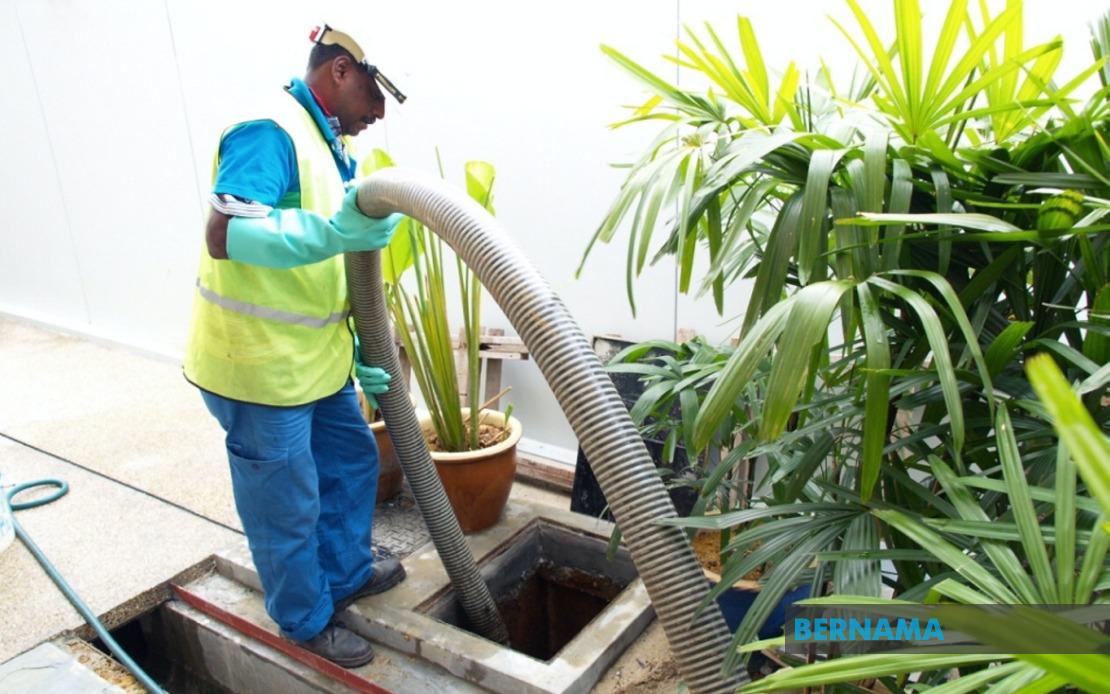
The National Water Services Commission (SPAN) has escalated its enforcement campaign in Sungai Petani by issuing 270 compliance notices to property owners who have neglected their septic tank maintenance obligations. The crackdown, which unfolded during an operation conducted in the business district on August 5, forms part of a broader compliance drive across 341 premises—both commercial and residential—that collectively revealed a pattern of systematic disregard for water infrastructure standards in the city.
The enforcement sweep, known as Ops Padi 2, ran between August 4 and 6 with particular focus on Taman Sejati Indah and surrounding commercial zones. Of the 341 premises inspected, 242 were commercial establishments and 99 were domestic residences, making it a mixed-use operation targeting both business sectors and individual homeowners. SPAN Operations Division Enforcement Section director Ainal Yusman Mohamad Yusop explained that the notices were issued after all inspected premises were discovered to have breached earlier warnings from Indah Water Konsortium Sdn Bhd (IWK), the country's primary wastewater management contractor, to carry out desludging work on their septic systems.
What emerged from the inspection was a troubling picture of infrastructure neglect spanning decades. The majority of properties involved were constructed during the 1970s and 1980s, meaning many of their septic systems have reached or exceeded their intended operational lifespan. More alarming still, Ainal Yusman revealed that some septic tanks had gone without any maintenance for periods stretching between 10 and 15 years, with records indicating that certain premises had last serviced their systems in 1997 or 1999—gaps of over two decades. This extended dormancy places both the property owners and surrounding communities at risk of environmental contamination and public health hazards, as ageing and unmaintained septic systems can leach untreated waste into groundwater and soil.
Under Section 65(1)(c) of the Water Services Industry Act 2006 (Act 655), property owners bear a legal responsibility to maintain their septic systems by engaging licensed service providers or permit holders to conduct regular desludging operations. This regulatory framework exists to ensure that private wastewater systems function safely and do not become environmental liabilities. The enforcement action taken during Ops Padi 2 represents SPAN's attempt to force compliance with this statutory obligation, which has clearly fallen into disrepair across significant portions of Sungai Petani's commercial and residential landscape.
Property owners who have received the compliance notices now face a strict timeline. They have been granted a 14-day window to respond to the enforcement action and complete the necessary septic tank emptying. This deadline is not merely advisory but forms a critical juncture in the escalation of penalties. Ainal Yusman made clear that failure to act within this period will trigger secondary enforcement mechanisms, including the issuance of formal notices of offence and the opening of official investigations into the non-compliance.
The financial consequences of continued non-compliance are severe and potentially ruinous for small business operators or property owners with limited resources. Under Act 655, individuals or entities found guilty of violating Section 65(1)(c) face fines not exceeding RM50,000—a substantial penalty that could exceed the cost of multiple years of routine septic tank maintenance. For small businesses already operating on tight margins, such fines represent a disproportionate burden compared to the cost of preventive maintenance, creating an incentive structure that rewards proactive compliance over procrastination and penalty absorption.
The concentration of non-compliance in Sungai Petani points to broader systemic issues in how older Malaysian commercial and residential zones manage their wastewater infrastructure. The city's business district, dominated by properties built four to five decades ago, appears to lack either the awareness or institutional mechanisms to ensure regular maintenance schedules for aging septic systems. Property managers, business owners, and landlords may have overlooked these obligations amid the pressures of daily operations, or alternatively, they may have assumed that the responsibility belonged to another party—IWK, the local authority, or the property developer.
For Malaysia's water management sector, operations such as Ops Padi 2 reflect growing recognition that compliance cannot be achieved through passive regulation alone. SPAN's enforcement division is adopting a more assertive posture, conducting targeted sweeps in high-risk areas and imposing consequences proportionate to the scale of violation. This represents a shift toward active environmental policing rather than reliance on voluntary cooperation. The success of such campaigns depends partly on whether the 14-day compliance window produces genuine action or whether property owners view it as merely the opening move in a protracted negotiation with regulators.
The implications extend beyond Sungai Petani's municipal boundaries. Many Malaysian towns and suburbs contain similar ageing properties with septic systems that have accumulated decades of deferred maintenance. If Sungai Petani serves as a test case for SPAN's enforcement capacity, other cities may soon face comparable operations, suggesting that property owners nationwide should review their septic maintenance records and schedule urgent desludging if they have fallen behind. The regulatory environment surrounding water infrastructure maintenance is tightening, and compliance has shifted from a matter of local custom to a matter of legal necessity backed by substantial financial penalties.
The human cost of septic system neglect also warrants consideration. Beyond the regulatory and financial dimensions, unmaintained systems pose genuine public health risks. Contaminated groundwater, soil pollution, and vector-borne disease transmission represent concrete dangers to communities living or working near these aging properties. SPAN's enforcement push, despite its appearance as purely regulatory activity, ultimately serves to protect environmental and public health outcomes that benefit residents and businesses throughout the region.
Moving forward, property owners in Sungai Petani and elsewhere would be wise to treat the 14-day compliance window not as a final opportunity to negotiate but as a firm deadline. The cost of engaging licensed desludging contractors now pales in comparison to the potential RM50,000 fine and legal exposure that awaits non-compliance. For municipal planners and water authorities across Malaysia, the operation underscores the importance of maintaining registries of septic-dependent properties, conducting regular awareness campaigns, and establishing clear communication channels between IWK, SPAN, local councils, and property owners to prevent similar patterns of neglect from developing elsewhere.

