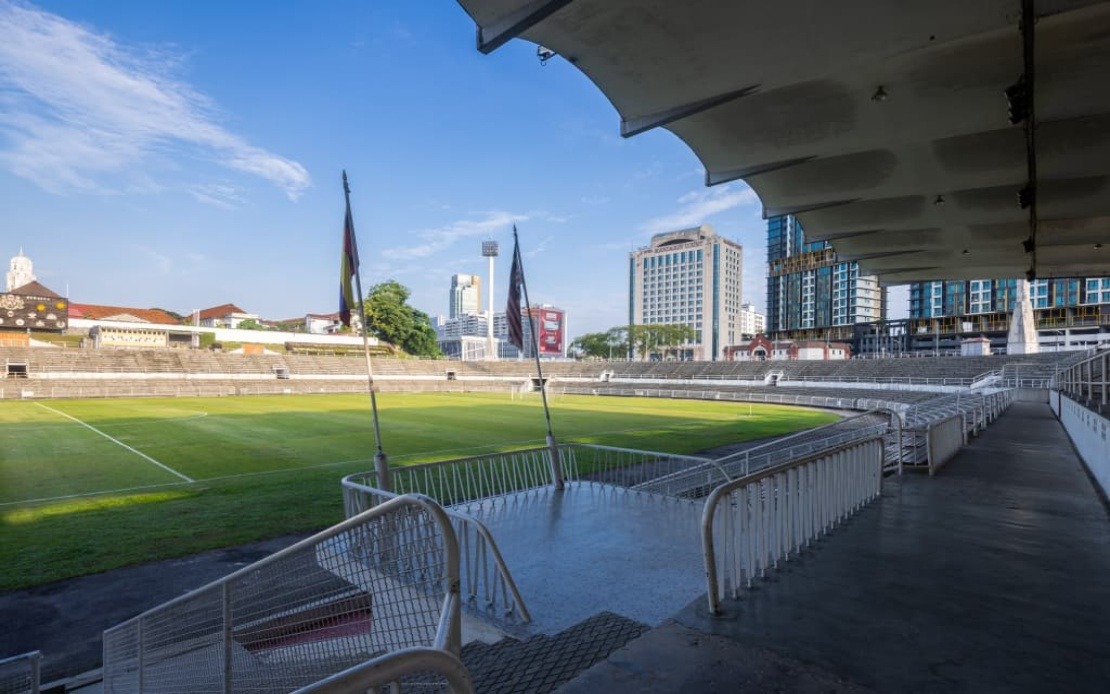
Nearly seven decades have passed since Stadium Merdeka witnessed one of the most transformative moments in Malaysian history, yet the venue remains as vital today as the day Tunku Abdul Rahman Putra Al-Haj proclaimed the nation's independence. Standing beside the modern Merdeka 118 skyscraper, the stadium demonstrates how historical spaces can coexist with contemporary development while maintaining their essential role in a nation's collective memory and identity.
The construction of Stadium Merdeka itself was a remarkable feat of planning and execution. Completed in just twelve months at a cost of approximately RM2.3 million, the venue became the chosen location for one of the most significant announcements in Southeast Asian history. On August 31, 1957, the proclamation of Malaya's independence took place within its confines, marked by Tunku Abdul Rahman's seven resounding declarations of "Merdeka!" and the first playing of the national anthem. This singular event fundamentally altered the course of Malaysian history, ending British colonial governance and establishing the Federation of Malaya as a sovereign nation.
The historical significance of Stadium Merdeka extended beyond the independence proclamation. In 1963, the venue hosted another momentous occasion—the formation of the Malaysian Federation. This second gathering represented the expansion and consolidation of the nation, incorporating Sabah and Sarawak while marking the continuation of British colonial administration ending for these territories. Though Singapore's eventual separation diminished the federation's geographical scope, the moment itself underscored Stadium Merdeka's role as the stage for Malaysia's most pivotal political transformations.
According to Prof Dr Sarjit Singh Gill, a social anthropology expert at Universiti Putra Malaysia and Chairman of the National Council of Professors' National Unity Cluster, the stadium transcends its function as a mere sporting venue. He emphasises that Stadium Merdeka embodies the nation's identity, dignity and historical heritage. The independence proclamation represented far more than a administrative change; it symbolised the conclusion of an entire era of foreign domination and the commencement of self-determination. For contemporary Malaysians, understanding this venue means comprehending the foundational aspirations upon which the modern nation was constructed.
The stadium's survival through modernisation pressures demonstrates the importance of heritage preservation in rapidly developing societies. During the late 1990s, the venue faced potential redevelopment threats as Kuala Lumpur's real estate boom accelerated. However, public opposition and government intervention secured its preservation. Permodalan Nasional Berhad assumed stewardship of the site in 2000, recognising that certain spaces possess value beyond commercial calculation. Datuk Dr Izwan Ibrahim, Chief Executive Officer of PNB Merdeka Ventures Sdn Bhd, articulates this philosophy, emphasising that maintaining the stadium's authenticity remains paramount to its function as a historical institution.
The restoration process adhered rigorously to historical accuracy, utilising original Public Works Department construction drawings as reference materials. Subsequent modifications, particularly the upper seating tiers added in later decades, were removed to restore the stadium's original 20,000-seat configuration. Meticulous work on features including the scoreboard, sanitary facilities, distinctive mosaic tilework and the iconic cantilevered roof structure ensured that visitors encounter the venue much as it appeared during those momentous occasions in 1957 and 1963. This commitment to authenticity transforms Stadium Merdeka into an educational space where history becomes tangible rather than abstract.
Recognition of Stadium Merdeka's significance has come through international channels as well as domestic acknowledgement. The venue received a UNESCO Asia-Pacific Heritage Award in 2008, affirming its global importance as a site of historical consequence. Subsequently, it was gazetted as a National Heritage site in 2009, providing legal protection and establishing standards for its maintenance and public accessibility. These designations reflect a growing international consensus that post-colonial independence sites merit preservation and study as part of humanity's shared twentieth-century experience.
The stadium has undergone substantial transformation in its contemporary function. Once primarily a venue for National Day celebrations and sporting events, it has evolved into a multifaceted national landmark accessible to the general public. The refurbished track now serves community recreational purposes, while the broader venue hosts cultural events and public gatherings. The Bazram Merdeka bazaar, held during the Ramadan month, drew over 250,000 visitors earlier this year, demonstrating the venue's capacity to generate meaning through contemporary celebrations while maintaining historical gravitas. This dual functionality—preserving the past while facilitating present-day community engagement—represents an effective model for heritage site management.
Engaging younger generations with historical sites presents particular challenges in societies experiencing rapid modernisation and digital transformation. For most Malaysians born after independence, 1957 exists primarily in textbooks and family narratives rather than living memory. Recognising this generational distance, PNB Merdeka Ventures has prioritised direct experiential engagement for young people. Izwan Ibrahim notes that while schoolchildren study independence in formal education settings, the impact of visiting Stadium Merdeka in person creates qualitatively different understanding. Programs encouraging youth participation, including visits from neighbouring schools, attempt to bridge the temporal gap between historical events and contemporary consciousness. By enabling younger Malaysians to physically inhabit the space where their nation's founding occurred, institutions cultivate deeper emotional and intellectual connections to national identity.
The human dimension of heritage preservation emerges through the experiences of those dedicated to maintaining these spaces. Alias Daud, a long-serving stadium staff member whose 35-year career with PNB concluded with a decade devoted to the venue's care, embodies this commitment. For Daud, Stadium Merdeka transcends professional responsibility, representing something approaching personal homeland. He describes feelings of pride, gratitude and nostalgia when entering the stadium, recognising that visitors from diverse backgrounds carry their own narratives and relationships to the space. His observations about visitors' reactions—their reading of historical information, photography and evident appreciation of significance—suggest that the venue succeeds in communicating its importance to those who experience it.
The stadium's role expands during Malaysia's national month, when heightened patriotic observance brings government agencies, educational institutions and universities through its gates. These organised visits, often resulting in recorded content related to Merdeka celebrations, integrate Stadium Merdeka into contemporary national commemorative practices. Young visitors particularly appear impressed upon learning that this specific location hosted the independence proclamation, underscoring how tangible connection to historical sites can generate enthusiasm more effectively than distant study. The venue thus functions as an active participant in Malaysia's ongoing national conversation about identity and sovereignty.
As modern skyscrapers increasingly dominate Kuala Lumpur's landscape, Stadium Merdeka's relatively modest structure assumes greater symbolic weight through contrast. The juxtaposition between contemporary development and the preserved stadium reflects tensions inherent in balancing progress with historical consciousness. Yet this physical arrangement also presents an opportunity—the stadium's survival amid modernisation demonstrates that societies need not sacrifice historical memory for economic advancement. Rather, these can coexist, with preserved sites providing counterweight and context to contemporary change. Stadium Merdeka thus stands as both monument and active space, preserving the spirit of Merdeka while remaining relevant to present generations.
The long-term sustainability of Stadium Merdeka depends on continued institutional commitment and public appreciation. Museums and heritage sites require consistent funding, thoughtful programming and regular physical maintenance to remain viable. As the venue enters its eighth decade, questions about future restoration needs, technological integration and adaptive reuse will inevitably arise. However, the site's proven significance to Malaysian national identity, combined with its UNESCO recognition and heritage designation, suggests that necessary resources will likely remain available. For generations to come, Stadium Merdeka will likely continue serving its dual role—silently bearing witness to the moment independence arrived, while actively engaging Malaysians with the historical understanding necessary for informed citizenship in the twenty-first century.

