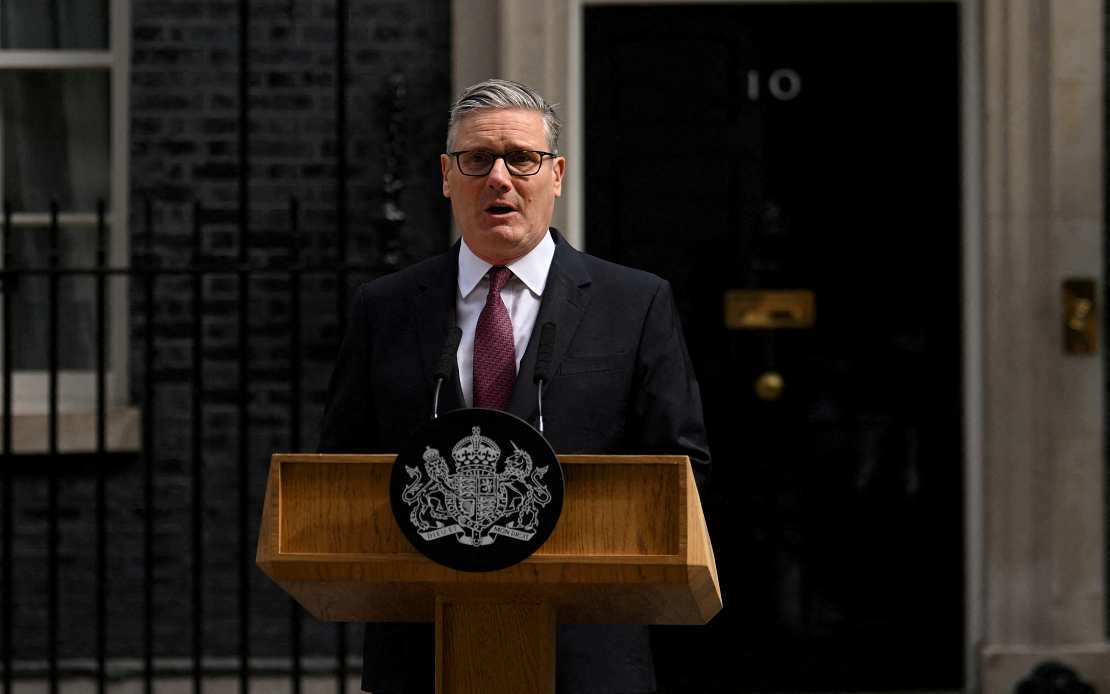
Keir Starmer made his final appearance as Prime Minister of the United Kingdom on Monday, declaring that his tenure has reached its natural conclusion and that he departs with satisfaction. Speaking from Downing Street before travelling to Buckingham Palace to formally tender his resignation to King Charles, Starmer struck a reflective tone about his time leading the nation. Flanked by his wife Victoria Starmer along with senior colleagues and friends who have accompanied him through his political journey, he reflected on the transformation of his party and his stewardship of the country.
Starmer's departure marks a significant turning point in British politics after two years at the helm of government. The Labour leader's decision to step aside comes at a moment when he believes the foundational work of his administration has been accomplished. His statement that "my work is done" suggests a deliberate conclusion to his premiership rather than a forced exit, framing his departure as a carefully timed transition rather than a crisis-driven resignation.
The outgoing prime minister drew attention to the Labour Party's remarkable political trajectory that culminated in the 2024 general election landslide. Beginning from the devastating defeat in 2019, which left the party in disarray following years of internal turbulence, Starmer undertook a comprehensive rebuilding effort. He repositioned Labour as an electable force capable of addressing the concerns of ordinary British voters, ultimately transforming the party's electoral fortunes sufficiently to secure a commanding mandate from the British electorate less than two years ago.
In his assessment of his time in office, Starmer characterised the nation as having become "stronger and fairer" compared to the circumstances he inherited. This claim encompasses both the economic and social dimensions of governance that his administration has attempted to influence. The declaration reflects his interpretation of whether his government has succeeded in its core objectives during what he evidently views as a transitional phase of his political leadership.
Andy Burnham emerges as Starmer's chosen successor, receiving the symbolic passing of the baton from the outgoing premier. Burnham, who has built a substantial profile through his work in government and regional politics, now stands positioned to take the reins of the Labour government. The smooth succession planning indicates a deliberate strategy to ensure continuity within the party's leadership structure whilst allowing for a fresh phase of governance.
The timing of Starmer's announcement carries implications for British political stability and Labour's broader strategic positioning. By orchestrating a planned transition rather than allowing circumstances to force his hand, Starmer maintains control over the narrative surrounding his departure. This measured approach to relinquishing power contrasts with many transitions in British politics, which are frequently marked by acrimony, party divisions, or external pressures that diminish an outgoing leader's influence over their successor.
For Malaysian observers, Starmer's transition offers insights into how established democracies navigate changes in executive leadership. Unlike systems where power transfers are precipitated by electoral defeats or institutional crises, the British arrangement allows sitting prime ministers considerable discretion over the timing and terms of succession. This reflects the Westminster model's emphasis on party cohesion and parliamentary confidence rather than fixed constitutional term limits.
The Labour Party's consolidation of power following its 2024 election victory, and the smooth handover now occurring within two years of that triumph, demonstrates how governing parties can maintain internal discipline and forward momentum. The absence of public acrimony or factional conflict surrounding Starmer's departure and Burnham's ascension suggests that Labour has successfully established itself as an effective governing force capable of managing institutional transitions professionally.
Burnham's assumption of the premiership represents a continuation of Labour governance whilst introducing new personnel and potentially adjusted policy emphases. His background and leadership approach may shape how the Labour government addresses ongoing challenges in areas such as public services, regional development, and social policy during its remaining time in office. The transition preserves Labour's governing majority whilst allowing for the renewal that often accompanies leadership changes.
The broader regional context matters for understanding this British political development. Stable transitions of power within governing parties, managed without destabilising conflict, contribute to the predictability and credibility of British governance on the international stage. For Southeast Asian observers, such orderly successions underscore how institutional maturity and party discipline can facilitate management of political change without disrupting governmental continuity or investor confidence.
Starmer's characterisation of his achievement—rebuilding a defeated party and then governing effectively—frames his political legacy around the transformation of Labour's electoral viability and the completion of an initial governing mission. Whether subsequent Labour governments under Burnham's leadership will validate this assessment depends largely on whether the policies implemented during Starmer's tenure prove durable and whether public confidence in Labour persists through whatever challenges lie ahead.

