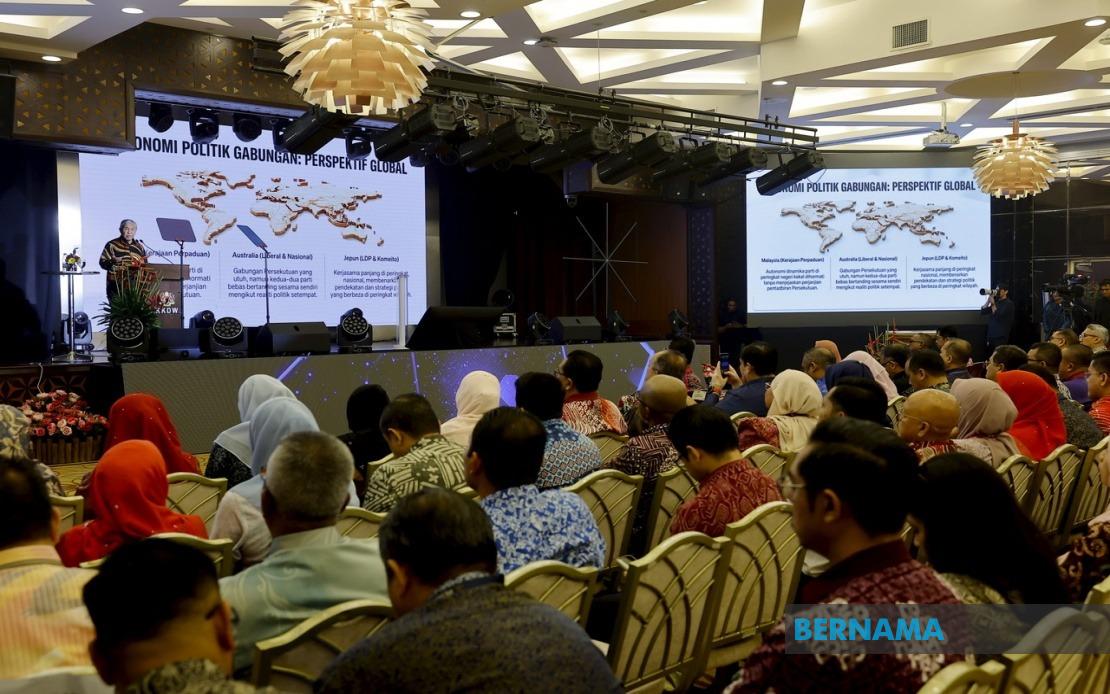
Malaysia's federal administration will remain unshaken by political competition unfolding at the state level, Deputy Prime Minister Datuk Seri Dr Ahmad Zahid Hamidi declared on Tuesday, seeking to reassure the public that the Unity Government possesses the structural resilience to withstand regional electoral contests. Speaking at the Rural and Regional Development Ministry's monthly assembly in Putrajaya, the Barisan Nasional chairman outlined a framework that distinguishes between competition among coalition partners in individual states and the foundational stability that binds the federal coalition, a distinction increasingly important as state elections—including contests in Johor and Negeri Sembilan—reshape political configurations across the country.
The core of Ahmad Zahid's message centres on the contractual nature of the Unity Government's formation. The coalition was not, he emphasised, an agreement of indefinite duration or one vulnerable to erosion through ordinary political manoeuvring. Rather, it rests on explicit mutual understanding and formal consent among constituent parties, an arrangement that exercises binding force for as long as Parliament remains in session. This framing converts what might otherwise appear as a fragile alliance of convenience into something resembling a constitutionally anchored compact, one that survives the flux of state-level outcomes precisely because its architects designed it to endure independent of such contests.
Ahmad Zahid's assertion that state elections will not alter the MADANI Government's administrative direction or disrupt the execution of planned policies and programmes addresses a widespread anxiety in Malaysian political circles. Regional victories or defeats for coalition partners have historically created pressure for federal realignment, with winning parties demanding greater federal influence or losing partners threatening to withdraw from national arrangements. By explicitly decoupling state electoral outcomes from federal stability, the Deputy Prime Minister attempts to interrupt this cycle, signalling that the Unity Government operates according to its own logic rather than responding reactively to the verdict of voters in individual states.
The constitutional and political legitimacy of this position gains weight from the parliamentary context. As long as Parliament remains unsummoned for dissolution—a step that would trigger general elections—the government retains its mandate and its majority. State elections, regardless of their outcomes, do not alter parliamentary mathematics at the federal level. This technical reality underpins Ahmad Zahid's confidence that the government will persist in fulfilling its responsibilities and implementing its agenda without interruption. The federal administration's continuity does not depend on the political complexion of state governments; it depends on the maintenance of a parliamentary majority, a different matter entirely.
However, Ahmad Zahid's remarks also acknowledge the political sensitivities that state elections generate within coalition politics. His observation that cooperation within government need not require parties to surrender their individual identities or political principles represents a careful calibration of expectations. Coalition partners, particularly those with substantial state-level support, require reassurance that they retain room to manoeuvre politically without triggering accusations of disloyalty to the federal arrangement. By framing political autonomy within coalition governance as legitimate and compatible with stability, Ahmad Zahid appears to be offering such reassurance, effectively arguing that parties can contest elections and advance their own interests without destabilizing the broader compact.
This conception of political autonomy within coalition governance—where each constituent party reserves the right to determine its own strategic direction while respecting the binding agreement underlying federal cooperation—reflects a maturation of Malaysian coalition politics. Earlier iterations of grand coalitions often demanded uniformity and subordination of party interests to collective arrangements. The Unity Government, by contrast, seems premised on the notion that lasting stability derives not from enforced uniformity but from transparent recognition of parties' legitimate pursuit of their own interests within agreed boundaries. This model theoretically allows coalition partners to compete aggressively in state elections and even advocate for voters to support their candidates without triggering a crisis at the federal level.
Yet significant challenges lurk beneath this theoretical framework. If one coalition partner emerges decisively stronger from state elections—particularly in economically significant or politically strategic states—pressure will inevitably mount for greater representation in federal ministerial portfolios, cabinet committees, and policy influence. Conversely, a coalition partner suffering substantial state-level losses may face internal pressure from its own rank-and-file demanding that the party leadership negotiate harder for federal concessions or threaten withdrawal. Ahmad Zahid's assurances, while politically necessary, sidestep these complex dynamics that may yet test the stability he is predicting.
The Deputy Prime Minister's emphasis on the durability of the Unity Government until Parliament is dissolved also carries implications for the timeline of the next general election. Malaysia's constitution permits a sitting government to govern for up to five years after the most recent general election. Ahmad Zahid's framing suggests confidence that the coalition will maintain its parliamentary majority and coherence throughout this period, or at least until the coalition parties jointly decide to dissolve Parliament. This implicit projection of stability extends several years forward, a notable assertion given the relatively recent and still-evolving nature of the Unity Government arrangement.
For Malaysian voters and observers in Southeast Asia more broadly, Ahmad Zahid's statement reflects an attempt to professionalize the relationship between state-level political competition and federal governance. In some regional democracies, state elections routinely trigger crises of federal coalition stability, leading to government collapses or desperate scrambles for new coalitional partners. By clearly articulating that state electoral contests will occur without federal consequences, Malaysia's leadership signals confidence in institutional frameworks and the binding power of coalition agreements. Whether this confidence proves justified will become clear as state elections continue and their political aftermath unfolds.
The practical test of Ahmad Zahid's assurances will arrive in the months ahead as coalition partners interpret their state electoral mandates and pursue their resulting political agendas. If parties interpret state victories as licenses to extract federal concessions or behave as if state outcomes should trigger federal realignment, the Deputy Prime Minister's careful distinction between state and federal politics will face severe strain. Conversely, if coalition partners respect the boundaries he has outlined and maintain their federal cooperation regardless of state-level outcomes, the model he has articulated may indeed prove durable and serve as a template for stable coalition governance in Malaysia and the broader region.

