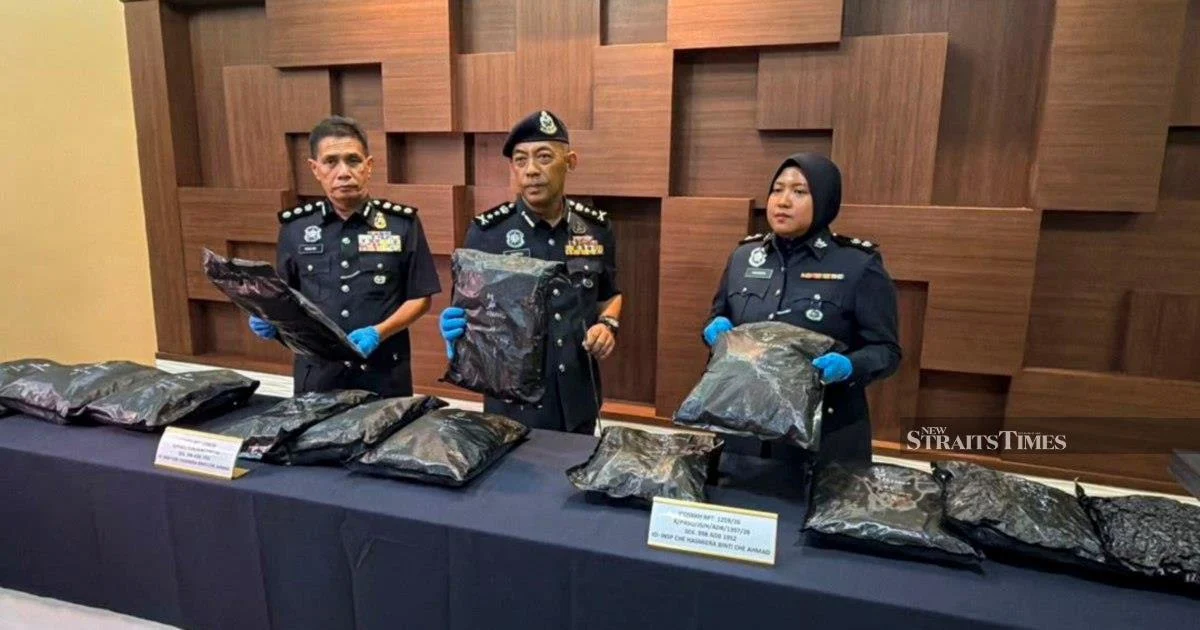
A student enrolled at a private higher education institution has been taken into police custody following his attempt to transport approximately 14.63 kilograms of cannabis buds across the border at Bukit Kayu Hitam, with the contraband valued at RM1.17 million. The arrest, made on Monday, underscores the persistent threat posed by drug trafficking networks exploiting Malaysia's porous northern borders and the vulnerability of young individuals recruited into smuggling operations.
Bukit Kayu Hitam, situated in the Kedah district of Alor Star, serves as one of Malaysia's primary international boundary crossings. Its location along the Thai-Malaysia border makes it a critical checkpoint for law enforcement agencies combating contraband smuggling. The interception reveals how traffickers continue to route narcotics through established crossing points despite heightened security measures and increased police surveillance at these high-risk corridors.
The scale of the seizure is significant within the context of regional drug enforcement. At RM1.17 million, this single haul represents a substantial quantity of controlled substances that would have entered the illicit domestic market or potentially been distributed further throughout Southeast Asia. Cannabis trafficking has intensified across the region as demand grows and sophisticated criminal networks exploit cross-border routes, particularly where enforcement resources remain stretched and coordination between neighbouring countries faces logistical challenges.
The arrestee's profile as a student represents a troubling pattern observed by Malaysian authorities over recent years. Educational institutions have inadvertently become recruitment grounds for trafficking syndicates seeking couriers, with young adults often lured through financial incentives or coercion. The promise of quick monetary gains appeals to cash-strapped students, while traffickers exploit their relative anonymity and lower suspicion levels compared to professional smugglers. This case illustrates how criminal organisations deliberately target the student demographic to sustain their operations.
The circumstances surrounding the apprehension indicate that border enforcement mechanisms remain functional and capable of detecting large-scale trafficking attempts. However, such seizures simultaneously demonstrate that drug smuggling networks possess sufficient resources and logistical capability to mount regular crossing attempts, accepting periodic losses as an operational cost. The volume intercepted suggests this was not an isolated amateur venture but rather part of a structured trafficking pipeline with upstream suppliers and downstream distribution networks requiring investigation.
Malaysia's drug laws impose severe penalties for trafficking offences, with cannabis smuggling carrying potential sentences of up to 15 years imprisonment depending on quantity and aggravating circumstances. Beyond the immediate criminal prosecution, authorities will likely investigate the supply chain, seeking to identify higher-level operatives, funding sources, and distribution networks connected to this particular shipment. Intelligence gathered from such cases contributes incrementally to broader law enforcement strategies targeting major trafficking organisations.
The broader implications for Malaysia's security landscape merit consideration. Bukit Kayu Hitam's strategic position at an international frontier renders it perpetually vulnerable to exploitation by transnational criminal enterprises. While this arrest demonstrates vigilance, the attempt itself underscores that traffickers view the border as a viable operational corridor. Enhancing detection capabilities at such checkpoints requires sustained investment in technology, training, and personnel, alongside strengthened cooperation with Thai authorities to intercept shipments before they reach Malaysian territory.
For educational institutions, this incident highlights the necessity of awareness campaigns addressing the recruitment tactics employed by trafficking networks. Students require clear communication about the severe legal consequences and personal risks associated with involvement in drug smuggling, extending beyond mere legal jeopardy to encompass threats from criminal organisations and potential victimisation. Campus-based intervention programmes targeting at-risk populations could mitigate institutional vulnerability to infiltration by traffickers.
The case also reflects broader regional dynamics affecting drug enforcement. The Golden Triangle region spanning Thailand, Laos, and Myanmar remains a primary source for cannabis and synthetic drugs infiltrating Malaysian markets. As production techniques improve and cultivation expands, traffickers increasingly attempt to move larger quantities through established checkpoints, counting on the volume overwhelming detection systems or achieving breakthrough success on occasional attempts. This particular seizure suggests interdiction efforts are functioning, yet the persistence of smuggling attempts indicates an ongoing arms race between enforcement and criminal adaptation.
Moving forward, this apprehension reinforces the importance of intelligence-led operations targeting trafficking networks rather than focusing solely on individual couriers. While street-level enforcement remains necessary, dismantling the organisations directing such operations requires sustained investigation, financial tracking, and coordination with international partners. The student's cooperation and testimony could prove valuable in unravelling the upstream suppliers and downstream distribution mechanisms connected to this seizure, potentially yielding broader security benefits beyond the immediate criminal prosecution.