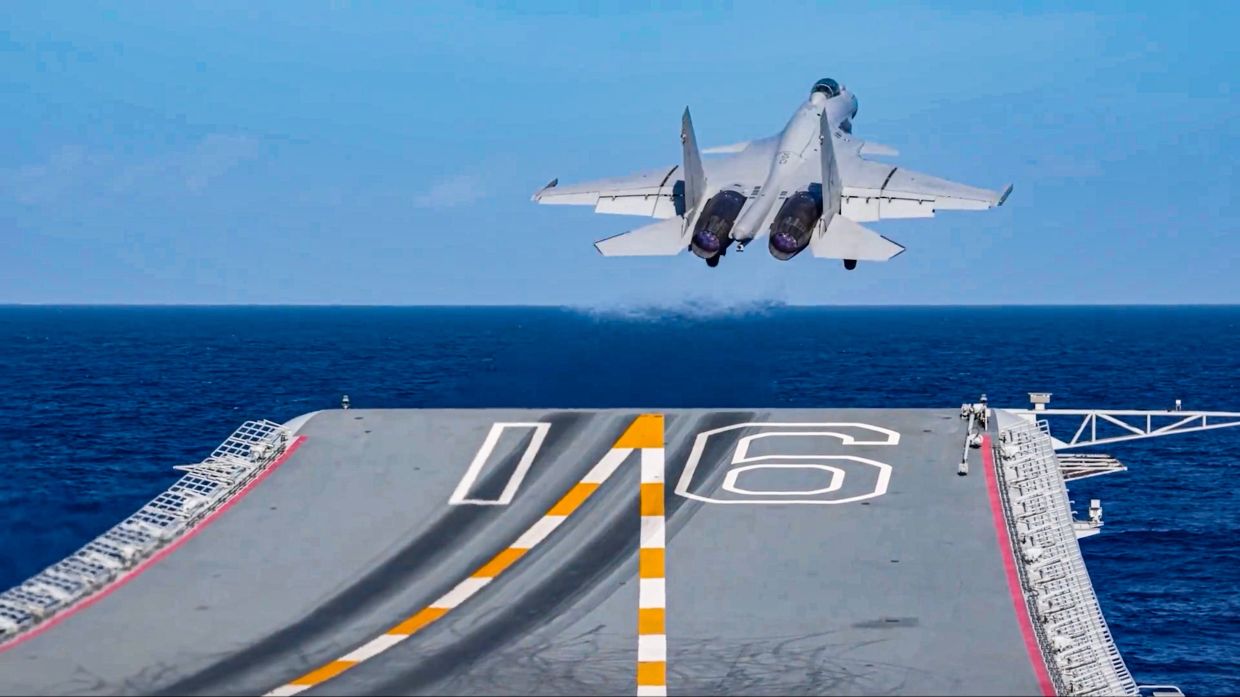
Beijing's construction of an increasingly sophisticated carrier fleet represents a defining shift in Chinese naval power, yet defence analysts argue the centrepiece of this expansion harbours a critical weakness that could fundamentally limit its effectiveness in regional conflicts. Submarines, particularly those operated by the United States and allied navies, pose what many strategists consider the greatest existential threat to these high-value vessels, primarily because China's undersea detection systems remain substantially inferior to those of Washington and its partners.
The vulnerability stems from a straightforward but consequential gap: the People's Liberation Army Navy lacks the sophisticated oceanographic knowledge and advanced sensor networks necessary to reliably detect and track hostile submarines across the western Pacific and beyond. A recent strategic assessment by the Centre for Strategic and International Studies proposed a "cost-imposition" framework through which the United States and regional partners could systematically threaten Chinese carrier groups. This approach encompasses multiple elements—land-based strike networks, satellite-guided long-range air operations, cyber warfare, and drone swarms—yet analysts consistently identify submarine operations as the domain in which Chinese naval defences prove most porous.
Geography compounds this disadvantage significantly. The maritime corridors through which Chinese carriers must transit to project power beyond their immediate coastal waters represent natural chokepoints where submarine forces can be concentrated with minimal logistical complexity. US attack submarines operating throughout the western Pacific remain among the world's quietest and most capable underwater platforms, giving them substantial tactical advantages over Chinese detection systems. Christopher Sharman, director of the China Maritime Studies Institute at the US Naval War College, observed that while China has undertaken recent improvements, fundamental gaps persist in undersea awareness and oceanographic understanding that limit the PLAN's capacity for submarine warfare operations, particularly in waters beyond the first island chain.
Peking has clearly recognised this vulnerability and invested heavily in addressing it. The Transparent Ocean programme, initially proposed over a decade ago, represents an ambitious national effort to construct a comprehensive oceanographic intelligence network spanning strategically vital regions including the western Pacific, South China Sea, and Indian Ocean. This system incorporates satellites, research vessels, autonomous underwater gliders, and seafloor sensor arrays designed to furnish real-time data on ocean conditions affecting submarine operations. Chinese authorities and academic institutions have explicitly framed this initiative as a national security imperative, underscoring the strategic importance Beijing assigns to closing the undersea awareness gap.
Simultaneously, the PLAN has expanded its anti-submarine warfare apparatus considerably. The fleet now includes growing numbers of fixed-wing maritime patrol aircraft equipped with advanced sensor suites, purpose-built ocean surveillance vessels mounting towed-array sonar systems, and upgraded helicopter platforms optimised for submarine hunting. The Type 927 class of reconnaissance ships exemplifies this modernisation, providing the navy with enhanced detection capabilities across broader operational areas. Despite these investments, defence analysts widely acknowledge that China continues to trail the United States and its allies in fundamental undersea warfare competencies.
The implications extend well beyond carrier protection. Naval strategists emphasise that undersea operations represent a foundational element of Beijing's broader maritime strategy, particularly regarding Taiwan contingencies. Within the first island chain—the archipelago extending from Japan through the Philippines—effective submarine warfare becomes essential to achieving the PLAN's objective of establishing sea control during wartime. Beyond that boundary, into the Indian Ocean, undersea capabilities acquire even greater strategic significance as instruments for countering American naval superiority and complicating potential third-party intervention in any conflict with Taiwan. Chinese military analysts have sometimes characterised their nation's coastal waters as a "wide-open door" they cannot adequately monitor or defend, a candid assessment that underscores the depth of the challenge.
Japan introduces an additional complicating factor that reshapes strategic calculations fundamentally. Should Tokyo intervene militarily in a Taiwan conflict—an increasingly plausible scenario given strengthening US-Japan coordination and Tokyo's own security concerns—Japanese submarines and anti-ship capabilities would compound the threats facing Chinese carrier formations. Japanese naval vessels operating in waters proximate to their home islands benefit from superior oceanographic knowledge and proximity to their bases, creating asymmetrical advantages. Timothy Heath, head of Perceptum defence research, noted that deploying carriers at distances sufficient to avoid these layered threats would render them operationally ineffective, whilst positioning them closer to shore exposited them to the very submarine and missile attacks they seek to escape.
This dilemma informs a broader debate among Chinese strategists regarding optimal carrier deployment doctrine. Heath argued convincingly that deploying carriers to the second island chain—the strategic boundary substantially farther from Chinese shores—would represent foolish strategic overextension given the multiplicity of weapons systems capable of targeting them at such distances. Land-based intermediate-range ballistic missiles remain far more cost-effective instruments for projecting power across these distances whilst maintaining survivability and flexibility. Carriers, despite their symbolic and operational significance, represent extraordinarily expensive and vulnerable platforms when deployed in such exposed circumstances, creating an unfavourable strategic calculus for Beijing.
The strategic stalemate emerging from these competing factors possesses profound implications for regional security dynamics and the military balance across East Asia and the western Pacific. China's inability to fully overcome submarine-related vulnerabilities constrains where it can realistically deploy its carrier fleet, thereby limiting its capacity to exercise sea control across contested maritime zones. American strategists and allied defence planners increasingly view this asymmetry as an exploitable advantage, recommending substantial increases in submarine-related procurement including advanced torpedoes, autonomous undersea platforms, and missile production undertaken jointly with Japan and Australia. These recommendations reflect confidence that the undersea domain will prove the decisive arena in any potential great power naval conflict.
The trajectory suggests China faces a prolonged period of strategic vulnerability in carrier operations that cannot be resolved through conventional force modernisation alone. Closing the oceanographic knowledge gap with the United States requires sustained investment across infrastructure, scientific expertise, and technological systems extending well beyond military acquisitions. Even if Beijing successfully narrows this gap over the coming decade, the reactive nature of submarine warfare—where attacker advantages typically exceed defender capabilities—means complete resolution remains elusive. For Malaysia and other Southeast Asian nations whose security depends upon maintaining freedom of navigation and balanced great power competition, these undersea warfare challenges carry direct implications, influencing everything from naval procurement decisions to strategic alliance management and regional stability calculations.

