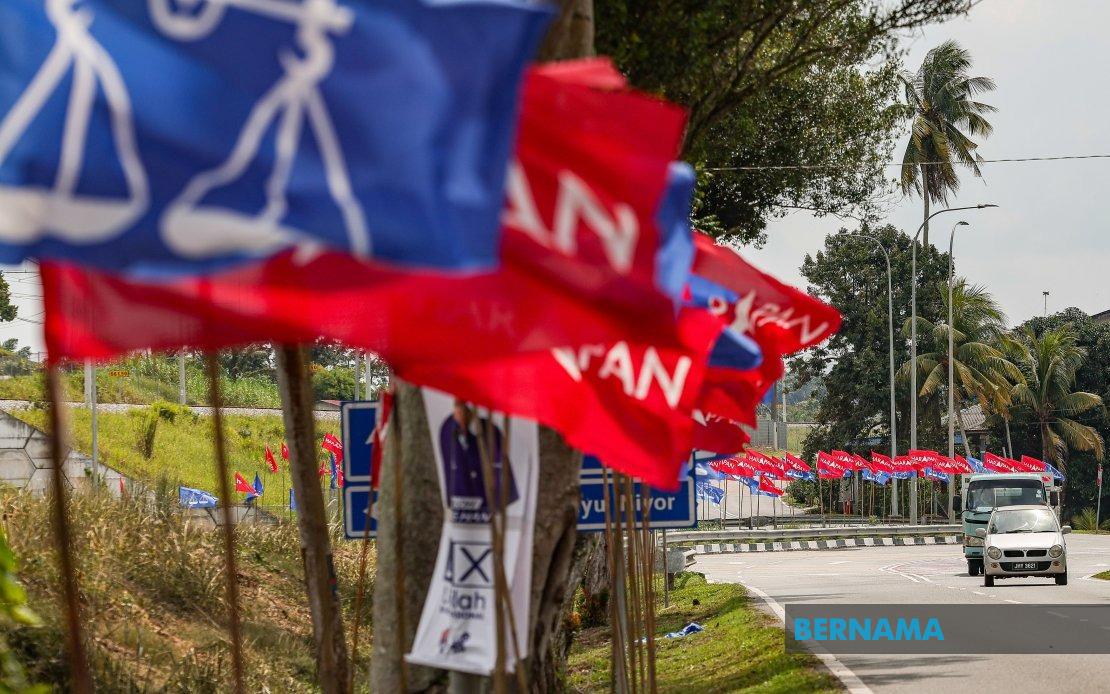
The Pakatan Harapan campaign in Johor's Larkin constituency is building its recovery strategy around a single critical variable: voter turnout. Speaking after grassroots engagement in the constituency on June 30, PH candidate Suhaizan Kaiat articulated a measured optimism rooted in historical electoral data rather than contemporary polling, suggesting that the bloc's path back to power in this closely-watched seat hinges on mobilising supporters who stayed home during the last state election.
Suhaizan's reasoning draws directly from the contrasting outcomes in Larkin across two electoral cycles. During the 14th General Election, the constituency proved vulnerable to opposition advances, demonstrating that BN's hold on the seat was breakable under the right circumstances. When Mohd Izhar Ahmad contested for PH-aligned Bersatu, he secured victory, establishing a precedent that challenges the notion of Larkin as a safe government stronghold. That breakthrough, however, proved temporary. In the 2022 state election, BN's Mohd Hairi Mad Shah reclaimed the seat with a commanding majority of 6,178 votes, a result that some observers cite as evidence of shifting voter sentiment.
Yet Suhaizan and PH strategists offer an alternative interpretation: the 2022 result reflected a depressed electoral environment rather than genuine preference shifts. The state election that year recorded only 51 per cent voter turnout, a figure significantly suppressed by pandemic-related restrictions and public health concerns that discouraged participation. When turnout climbs toward levels seen in general elections, Suhaizan argues, the electoral mathematics change substantially. This interpretation reflects broader PH calculations that COVID-era state elections may not function as reliable predictors of voter behaviour under normal electoral conditions, a thesis that will either be validated or refuted on July 11.
The upcoming contest carries genuine three-way complexity, complicating traditional binary narratives of government versus opposition. Beyond Suhaizan and incumbent Mohd Hairi, PH faces a splitter challenge from Bersama candidate Norsinah Abu. This triangular configuration mirrors patterns seen across urban Malaysian constituencies where new political permutations have fragmented what were once predictable voting blocs. Historically, such three-cornered races benefit whichever candidate maintains the strongest core support and party machinery, though Malaysian electoral outcomes in these scenarios have proven increasingly volatile.
Suhaizan's secondary strategic calculation involves Bersatu's repositioning in the Johor political landscape. The Pulai Member of Parliament perceives an opening created by recent strain in Bersatu-PAS relations, banking on the possibility that voters who previously supported Bersatu may reconsider their allegiances. Critically, Bersatu is not fielding a direct candidate in Larkin, which PH interprets as an implicit signal that former Bersatu supporters have limited partisan incentive to vote for their previous coalition partner. In theory, this creates a pathway for PH to capture votes from disillusioned Bersatu supporters, particularly those who valued the 2018-2020 PH-Bersatu partnership and view recent Bersatu moves toward PAS with scepticism.
This analysis reflects the peculiar volatility of contemporary Malaysian politics, where traditional communal voting patterns have become complicated by elite faction shifts and coalition realignments. Larkin, located in Johor Bahru, encompasses a diverse demographic makeup that has historically responded to both bread-and-butter economic messaging and broader themes of governance change. The constituency's urban character means that voter mobility—both geographic and political—tends to be higher than in rural areas, suggesting that campaign messaging and ground organisation could indeed prove decisive.
The broader context of the 16th Johor state election underscores the significance attached to contests like Larkin. With 56 state seats and 172 candidates in contention, Johor remains a crucial battleground for PH's renewal as a viable national alternative. The state has historically served as a kingmaker in Malaysian politics, and PH's performance here will significantly influence calculations about the coalition's viability ahead of the next general election. A strong showing could rebuild momentum and credibility that has eroded since the 2022 general election setback, while a disappointing result would intensify scrutiny of PH's ability to compete effectively.
Voter turnout projections for the July 11 election will therefore carry outsized analytical weight. If participation substantially exceeds the 51 per cent recorded in 2022, Suhaizan's thesis gains credence, and constituencies like Larkin could shift toward opposition parties. If turnout remains modest or dips further, then BN's incumbent position becomes more defensible, and the 2022 result may prove more predictive than PH strategists hope. Early voting is scheduled for July 7, potentially offering first indicators of engagement levels across the state.
For Southeast Asian observers tracking Malaysia's electoral dynamics, the Larkin contest exemplifies how turnout mechanics have become central to political strategy in an era of fragmented coalitions and dealigned voter bases. Neither BN nor PH can assume traditional voting patterns will hold, making ground organisation, voter registration drives, and get-out-the-vote operations disproportionately important. Suhaizan's confidence, thus framed, represents less an expression of absolute conviction and more an acknowledgement that PH's chances rest on factors substantially within its control—specifically, its capacity to mobilise supporters who possess the demonstrated capacity to vote opposition but may lack the motivation to participate in state elections held during uncertain times.

