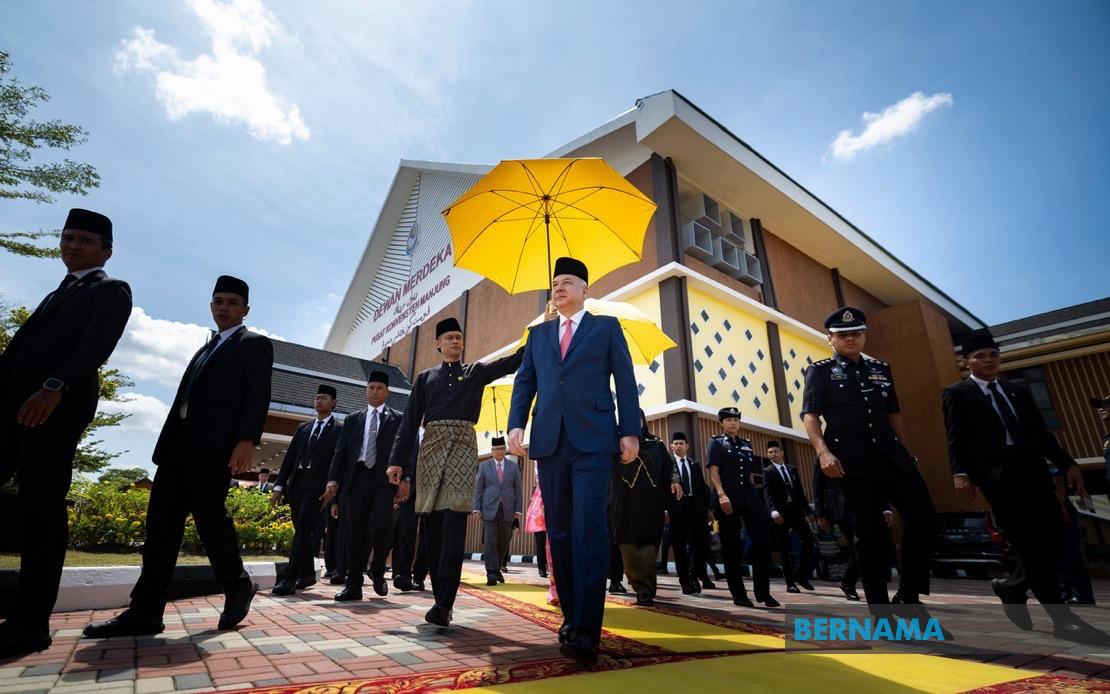
Sultan Nazrin Shah, the reigning monarch of Perak, formally opened the Merdeka Hall in Lumut yesterday in a ceremony that brought together key state and federal figures. The event saw attendance from Raja Permaisuri Tuanku Zara Salim and Raja Di Hilir Raja Iskandar Dzurkarnain Sultan Idris Shah, alongside Perak Menteri Besar Datuk Seri Saarani Mohamad and Higher Education Minister Datuk Seri Dr Zambry Abd Kadir. The inauguration represents a significant milestone for the Manjung district, combining infrastructure development with symbolic national remembrance.
The newly completed hall, constructed at an investment of RM12.7 million, accommodates up to 2,500 attendees and will serve multiple functions within the local community. Beyond its role as a venue for official state ceremonies and conferences, the facility is positioned as a multipurpose space capable of hosting cultural events, gatherings, and various community-driven initiatives. The substantial capacity underscores the local authority's ambition to position Manjung as a destination capable of attracting larger regional and national events.
Menteri Besar Saarani characterised the opening as the convergence of three interconnected achievements. The first involves the realisation of a rebuilding initiative that commenced nearly a decade ago in 2016, reflecting years of planning and resource allocation. The second milestone acknowledges that 2024 marks the 25th anniversary of the Manjung Municipal Council's elevation from district council status, achieved on August 1, 2001, representing a quarter-century of local governance evolution. The third dimension ties the infrastructure completion to the district's broader economic vision, which targets attainment of Tourism and Maritime City designation within the next six years.
The origins of the hall's reconstruction trace back to 2016, when the then-sitting Menteri Besar identified the necessity to rebuild the facility as part of Perak's development agenda. This championing of the project eventually translated into securing Federal Government budgetary allocation, demonstrating the collaborative approach required for major municipal infrastructure projects in Malaysia. The successful completion reflects how sustained advocacy and inter-governmental cooperation can transform long-term development aspirations into tangible community assets.
According to Saarani's remarks, the project's completion exemplifies continuity in governance structures and the productive relationship between federal and state administrations. Such collaborations are essential in Malaysia's federal system, where major developmental initiatives frequently depend on coordinated effort between Putrajaya and state capitals. The hall thus becomes not merely a building but a physical manifestation of institutional coordination and shared development priorities.
The symbolism embedded in naming the facility Merdeka Hall extends beyond architectural nomenclature. Saarani emphasised that the designation serves as an ongoing reminder of the responsibilities incumbent upon Malaysian society regarding independence and national sovereignty. He articulated the concept that independence constitutes a trusteeship requiring continuous protection and the perpetuation of values that sustain social dignity and cohesion. This framing positions the hall within Malaysia's national narrative, connecting local infrastructure development to broader questions of national identity and governance.
Manjung's trajectory toward Tourism and Maritime City status represents an economic repositioning strategy for the district. Located in Perak with proximity to coastal resources and existing maritime infrastructure, the municipality seeks to leverage these geographical advantages to diversify its economy beyond traditional sectors. The Merdeka Hall becomes instrumental in this transformation, providing the conference and event infrastructure necessary to attract tourism-related investments, maritime industry gatherings, and business conferences that depend on quality venue availability.
The 25-year operational history of Manjung Municipal Council reflects significant institutional development since its establishment as a district council on January 1, 1980. The subsequent upgrade to municipal status over two decades later represented expanded administrative authority and responsibilities. This expansion parallels the evolution of many Malaysian local authorities that have grown in sophistication and scope as urbanisation and economic development have advanced.
For Malaysian readers and Southeast Asian observers, the Merdeka Hall opening illustrates broader patterns in Malaysian development policy: the combination of physical infrastructure investment with long-term strategic economic positioning. Perak, historically dependent on primary industries including mining and agriculture, increasingly pursues service-sector diversification through tourism and value-added activities. Lumut, home to naval installations and coastal assets, represents a node where maritime commerce and tourism can intersect productively.
The investment magnitude of RM12.7 million reflects the contemporary scale of municipal infrastructure commitments in Malaysia. Such expenditures typically require multi-year budgeting cycles and competitive justification against alternative development priorities. The successful approval and completion suggest that state and federal decision-makers viewed the project as strategically justified within Perak's longer-term development framework.
Looking forward, the operational success of the Merdeka Hall will depend on effective management and programming that attracts sufficient utilisation to justify the investment. Malaysian municipal councils face ongoing challenges in ensuring venue profitability and relevance, particularly in smaller districts competing for major events. The hall's dual positioning—as both a community facility and a tourism-oriented venue—suggests management will need to balance local accessibility with commercial event attraction.
The ceremony itself, featuring the Sultan's personal patronage, signals official endorsement of Manjung's development aspirations. Monarchical participation in such events carries particular significance in Malaysia's constitutional system, where the sultans serve as custodians of state welfare and development. The presence of both the Sultan and Higher Education Minister also hints at connections between the hall and knowledge-based activities that may extend beyond conventional tourism.
Manjung's 2030 ambitions thus rest partly on this new infrastructure platform. The district must now leverage the venue to attract business conferences, maritime industry events, cultural gatherings, and tourism-related activities that justify the substantial capital investment and position it competitively within Malaysia's emerging tourism and service-economy landscape.

