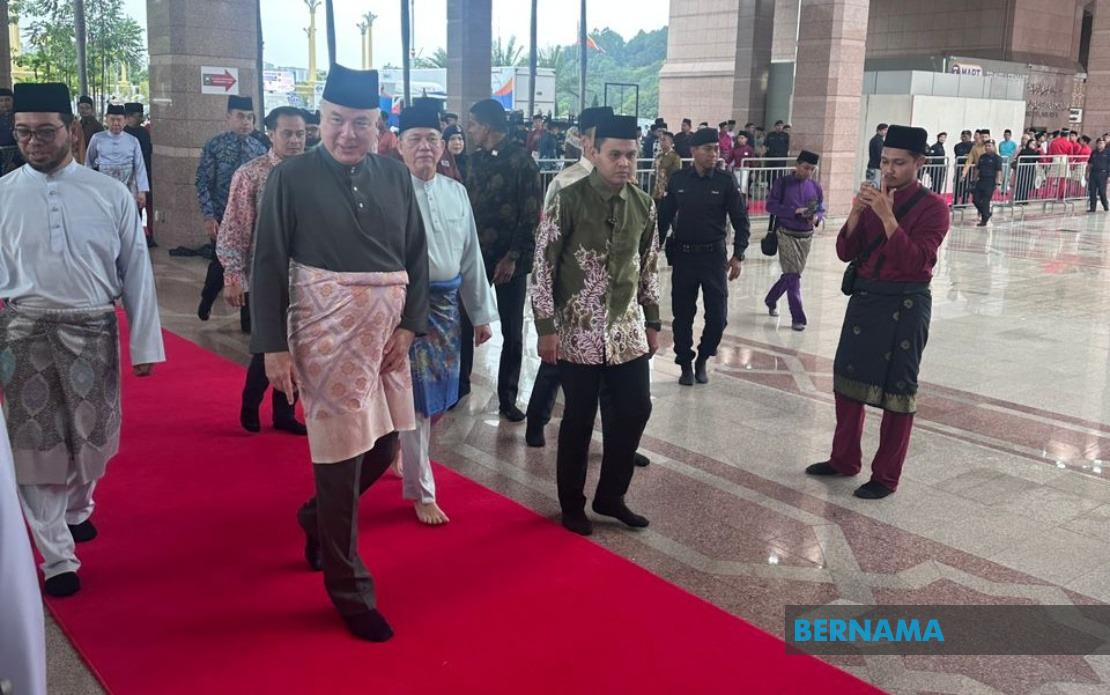
The Deputy Yang di-Pertuan Agong Sultan Nazrin Shah delivered a pointed message to Malaysia's leadership establishment at Putrajaya's National Level Maal Hijrah 1448 Celebration, warning that nations suffer when their leaders succumb to impulse and emotional reactivity. Speaking before some 5,000 attendees gathered at the Putra Mosque, the Sultan of Perak articulated a vision of governance that prioritises careful deliberation over knee-jerk responses, a particularly resonant concern in a region where policy whipsaws and sudden reversals have repeatedly unsettled markets, investors, and public confidence.
The crux of Sultan Nazrin's critique centres on a modern plague afflicting executive decision-making: the prioritisation of short-term political advantage over long-term national welfare. Leaders who permit personal sentiment and emotional currents to steer policy, he cautioned, ultimately saddle ordinary citizens with the consequences of their recklessness. This observation carries particular weight in Malaysia's current context, where rapid shifts in policy direction and ministerial positions have occasionally created uncertainty among businesses and civil society. The Sultan's emphasis on "calmness, openness, and cautiousness" in making decisions grounded in rigorous analysis represents a call for institutional maturity and intellectual discipline that transcends immediate partisan calculations.
Sultan Nazrin anchored his argument in the historical example of Prophet Muhammad's migration to Medina, the Hijrah itself. Rather than treat this foundational Islamic event as merely symbolic, the Sultan extracted from it a lesson in pragmatic wisdom: the Prophet appointed Abdullah bin Uraiqit, a non-Muslim, as his guide on the basis of expertise, integrity, and trustworthiness. This choice, the Sultan explained, demonstrates Islam's recognition that competence and character matter more than religious affiliation when stakes are highest. For Southeast Asian nations grappling with diverse populations and complex governance challenges, this principle carries contemporary relevance—suggesting that meritocratic appointments and inclusive decision-making structures produce superior outcomes to factional loyalty.
Beyond decision-making methodology, the Sultan pivoted to what he termed the diminishing spirit of sacrifice within the Muslim community. He distinguished sharply between rhetorical invocations of sacrifice and its actual practice, warning that the ummah risks losing this foundational virtue precisely when its challenges mount. Sacrifice, in his formulation, transcends mere loss or discomfort; it demands the subordination of personal interest to collective good, requiring courage, perseverance, and genuine conviction. This framing suggests an anxiety about the atomisation of public life, where individual gain increasingly overshadows communal obligation—a concern shared across the diverse societies of the region as development pressures fragment traditional solidarities.
The Sultan proceeded to connect sacrifice directly to national resilience and advancement. In an era when Southeast Asia confronts mounting geopolitical tensions, economic volatility, and environmental pressures, his assertion that sacrifice constitutes "the fundamental factor behind every great success" reads as both historical observation and contemporary exhortation. A nation sustained by citizens unwilling to defer gratification, accept collective burdens, or subordinate narrow interests to broader objectives risks institutional fragility when crisis strikes. Malaysia, with its complex ethnic and religious tapestry, requires precisely this spirit to navigate deepening regional tensions and internal divisions.
Sultan Nazrin then expanded his lens to encompass unity and cooperation, drawing from the Medina Charter's historical achievement in bridging diverse populations through tolerance and equitable governance. This reference is laden with contemporary significance for Malaysia. The Medina Charter, forged in the seventh century, succeeded in creating functional pluralism and mutual respect among disparate communities—an experiment Malaysia's founders explicitly emulated through the social contract underpinning the Federal Constitution. Yet decades of incremental erosion of interfaith dialogue, rising majoritarian rhetoric, and occasional inflammatory statements from political figures suggest that this foundational principle requires renewal and reinvigoration.
The Sultan's observation that national success rests on "the willingness of its people to cooperate, respect one another, and live harmoniously despite differences in ethnicity, culture, and religion" under just and wise governance implicitly critiques recent political trends. Malaysia has witnessed increasing assertions of religious exclusivity, hardening of communal boundaries, and periodic challenges to the constitutional bargain. When the deputy head of state—a position traditionally embodying constitutional rectitude and national unity—emphasises these principles with such deliberation, it suggests concern about their weakening hold on public discourse. The inclusion of Deputy Prime Minister Datuk Seri Fadillah Yusof and Religious Affairs Minister Dr Zulkifli Hasan in the audience underscores the message's intended audience among the political elite.
Sultan Nazrin concluded by reframing Maal Hijrah celebration itself as something far more consequential than commemorative ritual or nostalgic reflection on ancient events. He positioned it instead as an occasion for rigorous self-examination, an opportunity for the nation to scrutinise its accumulated mistakes with genuine intent toward reform. This conception of religious observance as catalyst for institutional improvement rather than mere piety marks a sophisticated understanding of how cultural practice can drive political consciousness. In the Malaysian context, where periodic celebrations provide moments when national leaders address large audiences, such reorientation of meaning proves significant—converting observance into mechanism for promoting accountability and introspection.
The broader implications of the Sultan's address extend beyond ceremonial pronouncement. His carefully calibrated critique of impulse-driven leadership, combined with emphasis on sacrifice, unity, and just governance, amounts to a gentle yet unmistakable warning to Malaysia's political leadership about the costs of short-termism and factional calculation. In a region where democratic institutions face mounting pressures and where rapid policy oscillations undermine confidence, such articulations from constitutional heads of state carry outsized weight. Sultan Nazrin's speech, delivered in the year 1448 of the Islamic calendar, thus functions simultaneously as reflection on historical principle and diagnosis of contemporary ailment—reminding Malaysians and regional observers alike that sustainable governance rests not on transient impulse but on enduring commitments to wisdom, sacrifice, and inclusive unity.