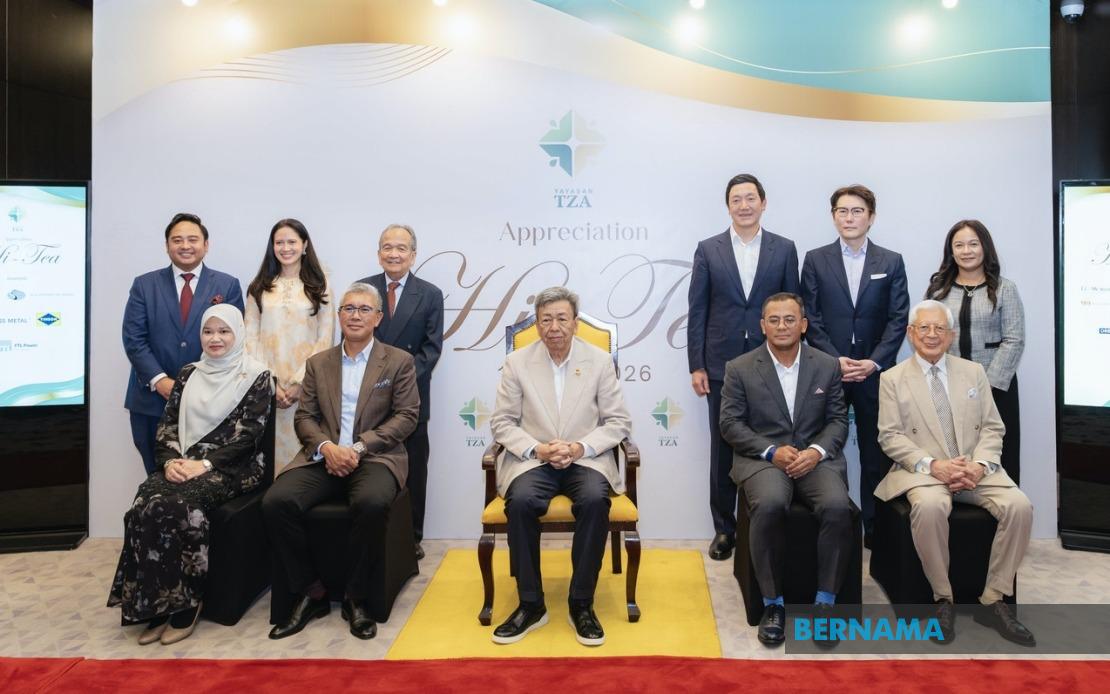
The Sultan of Selangor, Sultan Sharafuddin Idris Shah, attended an appreciation ceremony honouring Yayasan TZA (YTZA) on June 18, lending royal patronage to the foundation's educational and community development efforts. The gathering reflected the growing convergence between Malaysia's royal institutions and civil society organisations focused on social uplift, particularly in addressing educational disparities among economically disadvantaged communities.
The Sultan arrived at the hi-tea ceremony at approximately 3.50 pm and was formally received by YTZA chairman Tan Sri Arshad Raja Tun Uda and YTZA advisor Tengku Datuk Seri Zafrul Abdul Aziz. The event underscored the foundation's standing within Malaysia's development ecosystem, drawing attendance from senior government figures including Selangor Menteri Besar Datuk Seri Amirudin Shari and Education Minister Fadhlina Sidek. This confluence of royal, state, and federal representation signalled institutional support for YTZA's agenda across multiple governance levels.
Tengku Zafrul articulated the foundation's operational philosophy during remarks, emphasising that its programmes transcend immediate charitable relief to instead catalyse lasting structural change. Rather than addressing symptoms of poverty in isolation, YTZA positions itself as an agent of systemic empowerment, integrating educational scholarships, environmental sustainability projects, community engagement initiatives, and cultural celebrations into a cohesive framework. This holistic approach reflects contemporary thinking about development work in Malaysia, moving beyond traditional patronage models toward comprehensive community transformation.
The foundation's flagship initiative, ACE SPM, represents a strategic intervention targeting a critical juncture in Malaysian students' educational trajectories. The Sijil Pelajaran Malaysia examination functions as a gatekeeping mechanism determining access to tertiary education and professional pathways, making SPM performance disproportionately consequential for students from lower-income backgrounds who lack tutoring resources available to wealthier peers. By concentrating support on B40 students specifically, YTZA addresses a documented equity gap in academic preparation that conventional schooling systems have not adequately resolved.
The programme's quantifiable reach demonstrates meaningful scale. In 2025 alone, ACE SPM engaged 467 students across ten Selangor schools through direct academic support, whilst digital initiatives—likely online learning platforms and virtual coaching—extended to over 4,000 students. This dual approach leverages digital accessibility to overcome geographic and cost barriers, enabling a single foundation to serve student populations across dispersed locations simultaneously. The differential between direct and digital reach suggests YTZA's recognition that scalability through technology permits deeper impact than in-person programming alone could achieve.
During the ceremony, corporate commitments materialised in concrete form. Kuok Brothers Sdn Bhd pledged RM1 million whilst YTL Power International Berhad contributed RM300,000, totalling RM1.3 million in immediate funding. These donations from substantial Malaysian conglomerates indicate corporate sector recognition of YTZA's effectiveness and legitimacy as a development intermediary. The public witnessing of these transfers by the Sultan transformed individual corporate contributions into performances of shared national commitment to social equity, amplifying their symbolic and reputational value beyond the financial transactions themselves.
YTZA simultaneously announced Larian KITA@Klang, a community fun run scheduled for October 10 as part of the Sultan of Selangor's Silver Jubilee celebrations. This represents the foundation's fourth iteration of its Larian KITA series, positioning running events as vehicles for inclusive community mobilisation. Unlike purely recreational marathons, Larian KITA explicitly celebrates cultural and culinary dimensions of chosen locales, embedding physical activity within broader community identity and heritage contexts. This approach transforms fitness activities into platforms for social cohesion and cultural expression, particularly valuable for underrepresented communities often marginalised from mainstream civic participation.
The convergence of YTZA's educational programmes with community engagement activities reflects an integrated development philosophy increasingly prevalent among Malaysian civil society organisations. Educational support without corresponding community empowerment initiatives risks reinforcing individualistic achievement frameworks that may alienate successful students from their communities, whilst community programmes without educational anchoring lack mechanisms for sustained mobility. YTZA's simultaneity of these approaches suggests understanding that equitable development requires concurrent intervention across multiple life domains.
For Malaysian stakeholders monitoring development sector effectiveness, YTZA's model offers insights into scaling social impact through hybrid delivery mechanisms. The foundation combines traditional one-to-one mentoring with technological reach, corporate partnerships with grassroots engagement, and formal educational support with cultural celebration. This diversification permits YTZA to serve heterogeneous student populations with varying needs, learning styles, and access constraints simultaneously. The Sultan's attendance legitimises this multi-pronged approach as aligned with constitutional commitments to social welfare and educational access that undergird Malaysia's development agenda.

