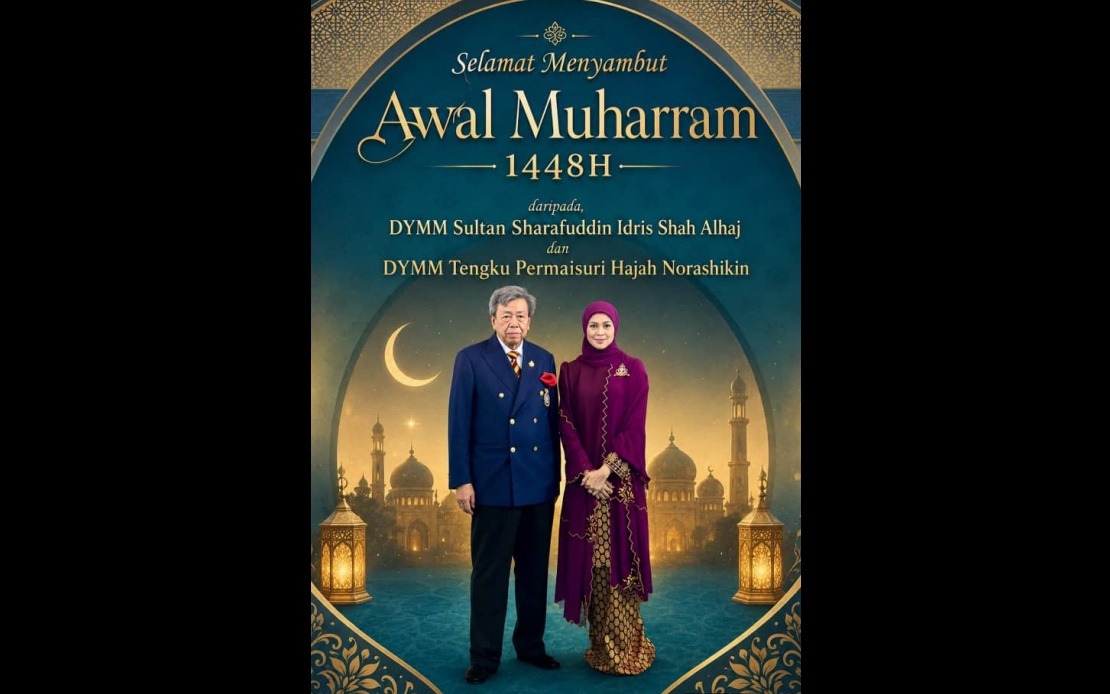
Sultan Sharafuddin Idris Shah has renewed his call for the Muslim community to place unity at the forefront of their efforts in navigating contemporary challenges, offering this message as Selangor marked the Maal Hijrah 1448H celebrations in Shah Alam. The sovereign's remarks centred on a reinterpretation of the Hijrah narrative—one that extends beyond the historical physical migration of the Prophet Muhammad and his followers from Mecca to Medina, instead casting it as a metaphor for spiritual transformation and the cohesion of the broader Islamic community.
The Selangor ruler drew upon the wisdom of his late father, Sultan Salahuddin Abdul Aziz Shah, in articulating a philosophy rooted in restraint and measured discourse. According to Sultan Sharafuddin, the elder monarch consistently advised against allowing divisions to fester openly, a principle the current Sultan views as increasingly relevant to contemporary Muslim societies. This inheritance of paternal counsel underscores a tradition of monarchical stewardship in Selangor that privileges consensus-building over confrontation, a characteristic that distinguishes the state's approach to communal governance.
The substantive thrust of the Sultan's message centres on the proper channels and manner for addressing grievances within the ummah. He articulated a framework wherein disputes, disagreements, and matters requiring correction ought to be pursued through dignified private dialogue rather than exposed to public scrutiny. When correction or counsel becomes necessary, the Sultan emphasised, such communication should be delivered with grace and courtesy, preserving the dignity of all parties involved. This methodology reflects a traditional Islamic jurisprudential emphasis on nasihah—sincere advice offered in confidence—as distinct from public criticism that may serve other motives.
The Sultan articulated a practical rationale for his position by highlighting the strategic vulnerabilities that accompany open discord within Muslim societies. When the ummah engages in visible quarrels and disputes, he noted, external observers gain insight into internal weaknesses and fractures. This exposure creates opportunities for those with vested interests in Muslim disunity to exploit these divisions for their own advantage. The cumulative effect of persistent public discord, the Sultan warned, is that no faction emerges victorious; rather, all parties suffer diminishment through the erosion of collective strength and credibility. This argument carries particular weight in the Malaysian context, where religious and ethnic plurality necessitates a united Muslim front to navigate broader societal negotiations.
In channelling the spirit of Hijrah into contemporary practice, Sultan Sharafuddin called upon Muslims to actively cultivate several interconnected virtues. Strengthening unity within the community forms the foundational imperative, while fostering tolerance across lines of difference emerges as a complementary necessity. Most significantly, the Sultan enjoined believers to subordinate personal ambitions and group interests to the higher callings of religious obligation, ethnic harmony, and national advancement. This hierarchy of values reflects an understanding that individual and factional interests, while legitimate in measure, cannot be permitted to override the collective good.
The Sultan's emphasis on private resolution of disputes also carries implications for Malaysia's plural democracy and multi-faith society. In a nation where Muslims constitute the majority but exist alongside substantial Hindu, Buddhist, and Christian populations, the cultivation of internal Muslim unity and restraint in public discourse serves broader national cohesion. When Muslim leaders model dignified disagreement resolved through quiet dialogue rather than public acrimony, they establish precedent for intercommunal conduct that benefits the entire social fabric. The Selangor ruler's message thus resonates beyond strictly Islamic circles, offering a template for democratic discourse that preserves institutional legitimacy and social stability.
The timing of these remarks during the Maal Hijrah observance carries symbolic weight. The Islamic new year traditionally invites reflection on spiritual progress and renewal of commitment to core values. By tethering his calls for unity to this annual occasion, Sultan Sharafuddin aligned practical governance philosophy with religious calendar and theological meaning. The message transforms Maal Hijrah from a commemorative observance into an actionable framework for community conduct, infusing sacred time with immediate relevance to contemporary challenges.
Sultan Sharafuddin's articulation of hope for the new Islamic year extended beyond internal Muslim relations to encompass society writ large. He expressed aspiration that the coming year would deliver blessings, tranquility, and material prosperity to all inhabitants, while catalysing renewed dedication to strengthening both Muslim unity and broader social harmony. This expansive vision suggests that the Sultan perceives Muslim communal cohesion not as an insular project but as foundational to national wellbeing and regional stability. In an era of globalisation and rapid social change, such leadership rhetoric affirming the connection between internal religious community strength and external national health addresses anxieties that transcend purely theological domains.
The Sultan's intervention in this matter reflects the continuing relevance of Malaysia's constitutional monarchy in providing moral and spiritual guidance to the nation. While the Sultan of Selangor exercises limited constitutional executive authority in an era of parliamentary democracy, his role as patron and custodian of Islam within his state endows such pronouncements with considerable symbolic and practical weight. His capacity to frame national challenges through religious language and to invoke ancestral wisdom grants legitimacy to his prescriptions that secular governance alone might struggle to achieve.
For practitioners of Islamic reform and modernisation across Southeast Asia, the Sultan's framework offers a middle path between rigid traditionalism and wholesale embrace of Western adversarial discourse models. By insisting that differences be addressed with wisdom and courtesy within bounded communities rather than through public contestation, he preserves space for genuine intellectual and theological development while maintaining social cohesion. This approach acknowledges that Muslim societies inevitably harbour diverse viewpoints and competing interests, yet posits that such plurality need not manifest as civilisational crisis when managed through appropriate institutional channels and communicative protocols.