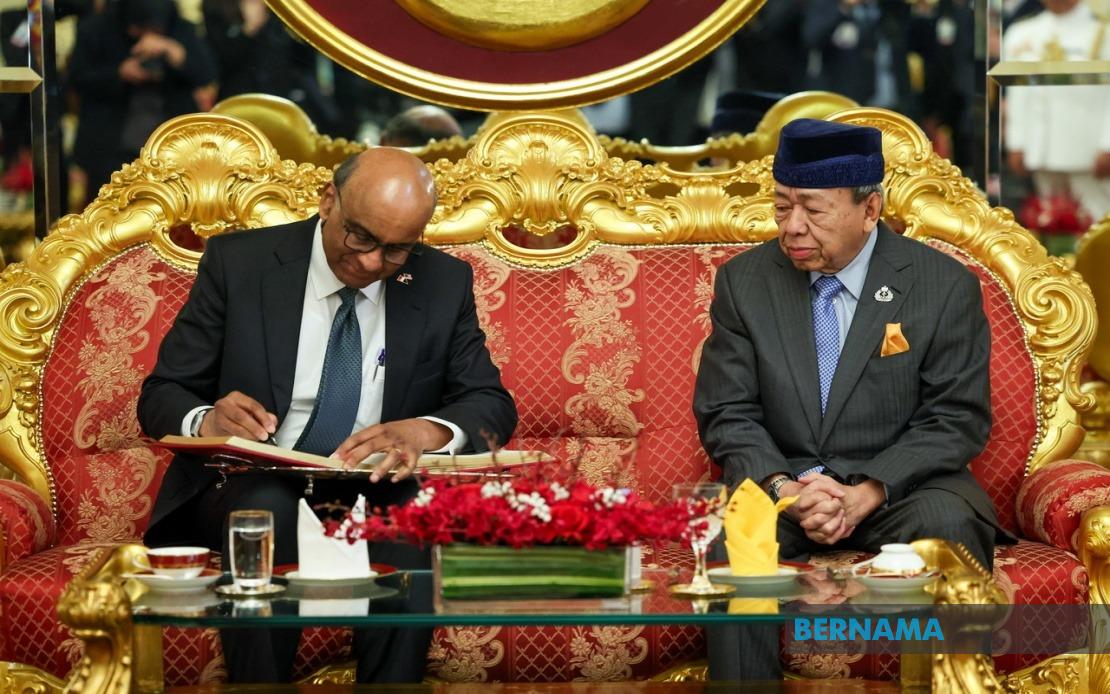
Singapore President Tharman Shanmugaratnam met with Sultan Sharafuddin Idris Shah, the Sultan of Selangor, on July 14 at the royal palace in Klang as part of his official state visit to Malaysia. The high-level engagement underscores the ongoing importance of bilateral relations between the two nations, with the summit representing a formal diplomatic courtesy that reflects protocol between neighbouring governments in Southeast Asia.
The president arrived at Istana Alam Shah at 11 am and was warmly received by Tengku Amir Shah, the Raja Muda of Selangor, signalling the significance accorded to the occasion. The substantive discussion extended for approximately one-and-a-half hours before concluding at 12.40 pm, indicating the depth of the conversation and the breadth of matters addressed during this diplomatic encounter. Entrepreneur Development and Cooperatives Minister Steven Sim attended the meeting in his capacity as minister-in-attendance, providing government representation and facilitating dialogue on matters of mutual interest.
Tharman's visit forms part of a broader three-day state visit spanning July 13 to 15, conducted at the formal invitation of His Majesty Sultan Ibrahim, the King of Malaysia. This engagement serves a carefully calibrated diplomatic purpose within Malaysia's bilateral calendar. The visit fundamentally represents reciprocal diplomacy, acknowledging and reinforcing the relationship established when the Malaysian King undertook a reciprocal state visit to Singapore on May 6 and 7, 2024. Such exchanges demonstrate the structured cadence of high-level engagement between the two governments.
The economic dimension of Malaysia-Singapore relations provides crucial context for understanding the significance of this diplomatic interaction. Singapore stands as Malaysia's second-largest trading partner globally and holds the distinction of being the largest trading partner among all ten Association of Southeast Asian Nations member states. This commercial reality underscores why senior leadership from both capitals prioritises regular engagement at the highest levels of government and the royal institution.
The Selangor audience represents more than ceremonial protocol; it acknowledges the state's pivotal role in Malaysia's economic landscape and Singapore's deep integration with Selangor's commercial ecosystem. The Federal Territory of Kuala Lumpur and Labuan are also located within Selangor's governance sphere, making the state a natural focal point for bilateral economic discussions and strategic coordination on matters affecting shared interests.
For Malaysian policymakers and regional observers, such state visits carry practical implications beyond diplomatic niceties. They provide structured forums for addressing substantive bilateral issues, including trade facilitation, cross-border labour movements, investment flows, and security cooperation. The presence of Minister Steven Sim specifically signals that economic development and entrepreneurial collaboration form priority areas within the bilateral agenda.
The timing of Tharman's visit also reflects broader Southeast Asian dynamics. As the region continues navigating post-pandemic recovery, supply chain restructuring, and evolving geopolitical considerations, regular high-level engagement between Malaysia and Singapore helps maintain the institutional relationships that underpin regional stability. Both nations share extensive interconnections spanning finance, manufacturing, services, and logistics, making continuous dialogue essential for managing the practical challenges of deep economic integration.
Within Malaysia's federal structure, the Sultan of Selangor's direct engagement with visiting heads of state carries particular significance. As the monarch of the nation's most developed state by GDP, Sultan Sharafuddin's audience with President Tharman acknowledges Selangor's status as a primary engine of national economic growth and a crucial junction for Malaysia-Singapore cooperation. The palace meeting thus carries implications extending beyond Klang to affect prosperity and policy outcomes across the broader Klang Valley region and beyond.
The three-day timeframe for Tharman's visit allows for engagement across multiple institutional levels, from royal audiences through ministerial meetings to potentially broader civil service and business community interactions. Such comprehensive visits enable participants to address issues spanning political relations, economic cooperation, security matters, and people-to-people exchange—the full spectrum of modern bilateral relations. For regional economies like Malaysia and Singapore, which rely heavily on institutional predictability and regular communication channels, such scheduled high-level encounters serve essential functions in maintaining the trust and understanding necessary for sustained cooperation.

