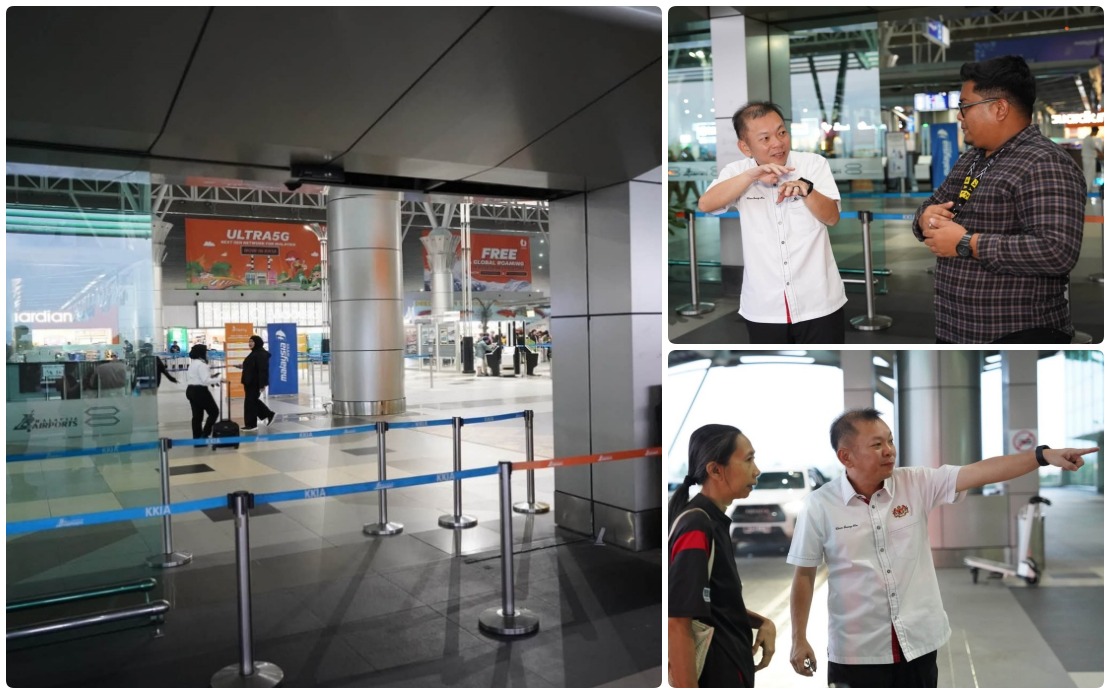
A female driver sustained minor injuries after her sports utility vehicle careened out of control and struck the glass entrance structures at Kota Kinabalu International Airport's departure hall on Wednesday afternoon, disrupting but not halting the facility's operations. The collision occurred at approximately 4:20 pm at the Level 3 kerbside of Terminal 1, where the vehicle smashed through the entrance doors before coming to rest inside the departure area. The impact left the vehicle severely damaged at its front end while shattering the glass door panels that form the terminal's primary public interface.
The immediate response from airport security and customer service personnel proved swift and effective in managing the situation. Aviation Security and Customer Service staff arrived within minutes of the 4:19 pm incident and quickly coordinated medical assistance for the injured driver. An ambulance transported the woman to a nearby hospital, where she received treatment for injuries determined to be minor in nature. Remarkably, the crash resulted in no injuries to other airport visitors or staff members who were present in the departure hall, suggesting either fortunate timing or the vehicle's trajectory missing concentrated pedestrian areas.
Kota Kinabalu District Police Chief ACP Shahrudin Mat Husain confirmed the incident when reached for comment and indicated that a full investigation had commenced to determine the precise cause of the vehicle's loss of control. Police inquiries typically examine whether mechanical failure, driver error, medical emergency, or other factors contributed to the accident. The police investigation represents standard protocol for such incidents and will inform whether charges or safety recommendations emerge from the findings.
Malaysia Airports, the operator of the facility, provided detailed updates on the recovery efforts and operational status in a formal statement issued Wednesday evening. The company emphasized that despite the physical damage and immediate disruption, airport operations sustained no significant interruption to scheduled flights or passenger services. The operator's focus on rapid clearing and repairs demonstrated awareness that any extended disruption to departure procedures could cascade into flight delays and passenger inconvenience.
Critical to restoring normal conditions was the efficient removal of the damaged vehicle and surrounding debris, which Malaysia Airports completed by 6:00 pm—roughly an hour and forty minutes after the initial collision. This timeline allowed airport staff to cordon off the affected entrance, redirect passenger traffic through alternative access points, and initiate repairs to the glass door system. The operator noted that repair works to the entrance doors remained underway at the time of the statement, indicating that full restoration of the primary departure entrance would require additional hours of specialized work.
The airport's backup systems proved essential during this period. Deputy Minister of Agriculture and Food Security Datuk Chan Foong Hin, who coincidentally had just arrived at KKIA when the incident occurred, acknowledged in a social media post that alternative automatic doors throughout the departure hall remained fully operational and unaffected by the crash. This redundancy in entrance systems—a standard feature at modern international airports—ensured that passenger flow and airport throughput experienced no material degradation despite the damage to one primary entrance.
Datuk Chan Foong Hin's public acknowledgment of the airport management's response carried particular significance given his ministerial position. His commendation of KKIA management and personnel for their efficiency and prompt handling of the emergency provided official validation of the emergency response procedures and staff competence. Such statements from visiting officials often reflect broader government assessment of airport operations and can influence public confidence in facility management during unforeseen incidents.
The incident underscores the operational resilience that international airports maintain through multiple redundancies and trained emergency protocols. While glass doors and entrance structures represent relatively routine airport infrastructure, damage requiring same-day repairs demonstrates the specialized nature of airport facilities and the coordination required between airport operators, security services, and emergency responders. For Malaysian airports, such incidents also highlight the importance of rigorous vehicle access controls at sensitive facility areas.
From a passenger experience perspective, the incident likely caused minimal disruption to actual flight operations despite its dramatic nature. The departure hall entrance damage, while visually significant, represents a peripheral rather than core operational system. Airlines and ground handlers were able to continue check-in and boarding procedures through alternative facilities, and the incident generated no flight cancellations or substantial delays according to Malaysia Airports' statement. This outcome reflects successful containment of what could have been far more consequential had the vehicle struck other critical infrastructure or caused injuries requiring extended emergency services response.
The referral of the matter to Royal Malaysia Police for formal investigation ensures that comprehensive factual documentation occurs and that any systemic safety issues receive proper attention. Police findings may inform whether KKIA requires enhanced vehicle management procedures at departure level kerbsides, particularly regarding controlling access by private vehicles to areas immediately adjacent to passenger terminals. Such recommendations, if warranted, would reflect lessons learned from this incident and contribute to refined safety protocols across Malaysia's airport network.

