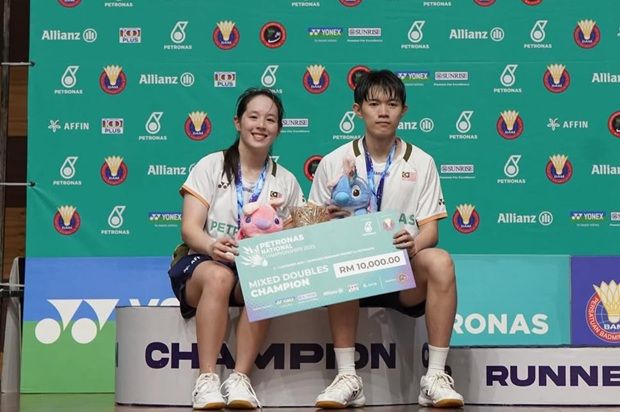
Clarissa San is preparing for the pinnacle of her badminton career so far, heading to the Japan Open next week with advice that cuts through the pressure and expectation: stay composed and savour the moment. The 20-year-old mixed doubles player has been thrust into the spotlight following a partnership reshuffle that sees her competing alongside Chen Tang Jie at one of the world's most prestigious tournaments on the BWF World Tour calendar, a significant leap for a player making her debut at this level.
The opportunity emerged unexpectedly after Toh Ee Wei, Clarissa's original mixed doubles partner, suffered an anterior cruciate ligament injury that has sidelined her for rehabilitation in Melbourne. Rather than view this as a setback, the Malaysian shuttler has embraced the chance to compete at such a high-profile event. Her new pairing with Tang Jie thrusts her onto one of badminton's brightest stages with minimal preparation time, yet Clarissa appears equipped mentally to handle the demands of the tournament.
The guidance Clarissa receives reflects a deliberate support structure designed to insulate her from the pitfalls of tournament nerves. Both Tang Jie and mixed doubles head coach Nova Widianto have made emotional regulation their primary message, recognizing that a player's debut at this calibre of competition carries inherent psychological challenges. Their repeated counsel—to suppress fear and embrace enjoyment—speaks to a coaching philosophy that values composure and presence over rigid performance targets.
Clararissa's own assessment of the partnership reveals maturity beyond her years. She characterizes Tang Jie not merely as a doubles partner but as a combination mentor and older sibling figure, someone who provides technical correction without judgment while fostering the collaborative trust essential in mixed doubles. This dynamic matters considerably in a discipline where communication and synchronized movement separate champions from pretenders. The security of having such a stabilizing presence allows a younger player to focus on execution rather than self-doubt.
Looking ahead to the tournament itself, Clarissa has deliberately tempered her ambitions in a manner that reflects realistic self-assessment rather than lack of confidence. She articulates her primary objective as translating her training work onto the competitive court—a foundational goal that seasoned professionals recognize as more important than specific rankings or match victories at a debut tournament. This perspective suggests coaching wisdom has permeated her thinking, preparing her psychologically for the inevitable challenges and adjustments required at the elite level.
The pairing faces a Taiwanese combination in Yang Po-hsuan and Hu Ling-fang in their opening contest, a matchup that will offer crucial early-tournament data about competitive standards. Tournament debuts at the Japan Open level inevitably expose gaps between domestic excellence and international demands, providing learning opportunities disguised as matches. For Clarissa, the opening rounds represent far more than seeding points; they constitute the foundation for understanding what victory requires at this echelon.
Clararissa's acknowledgment of areas requiring improvement demonstrates the self-awareness coaches seek in developing athletes. Rather than projecting false confidence or defensive certainty, she openly discusses her technical and tactical deficiencies while framing them within a growth trajectory. This candid assessment, coupled with her partnership with Tang Jie, suggests a player poised to extract maximum learning from the experience regardless of match outcomes.
The broader Malaysian badminton contingent competing at the Japan Open reflects the depth of the nation's talent pool in mixed doubles. Jimmy Wong's pairing with Cheng Su Yin will encounter Japan's Yuichi Shimogami and Sayaka Hobara, while the independent combination of Goh Soon Huat and Shevon Lai Jemie meets American opposition in the form of Chen Zhi Yi and Francesca Corbett. Meanwhile, Wong Tien Ci and Lim Chiew Sien face a stern examination against China's fifth-seeded pairing of Guo Xinwa and Chen Fanghui, a matchup that underscores the tournament's competitive intensity.
Tang Jie's mentorship role carries broader significance within the Malaysian badminton ecosystem. Established players who genuinely invest in nurturing emerging talent create organizational culture that values continuity and succession planning. When elite performers like Tang Jie embrace the responsibility of guiding newcomers through high-pressure situations, they reinforce values that strengthen the sport nationally. Clarissa benefits directly from this investment, but the Malaysian badminton fraternity benefits indirectly through the cultivation of resilience, composure, and tactical intelligence in the next generation of players.
For Malaysian readers following the tournament, Clarissa's debut represents more than individual achievement—it exemplifies how injuries, though setbacks for affected athletes like Toh Ee Wei, frequently create opportunities for emerging talent to demonstrate readiness. The Japan Open will reveal whether Clarissa's preparation, temperament, and partnership with Tang Jie position her as a long-term fixture at the sport's highest levels or whether the tournament serves as a valuable learning platform before further development.

