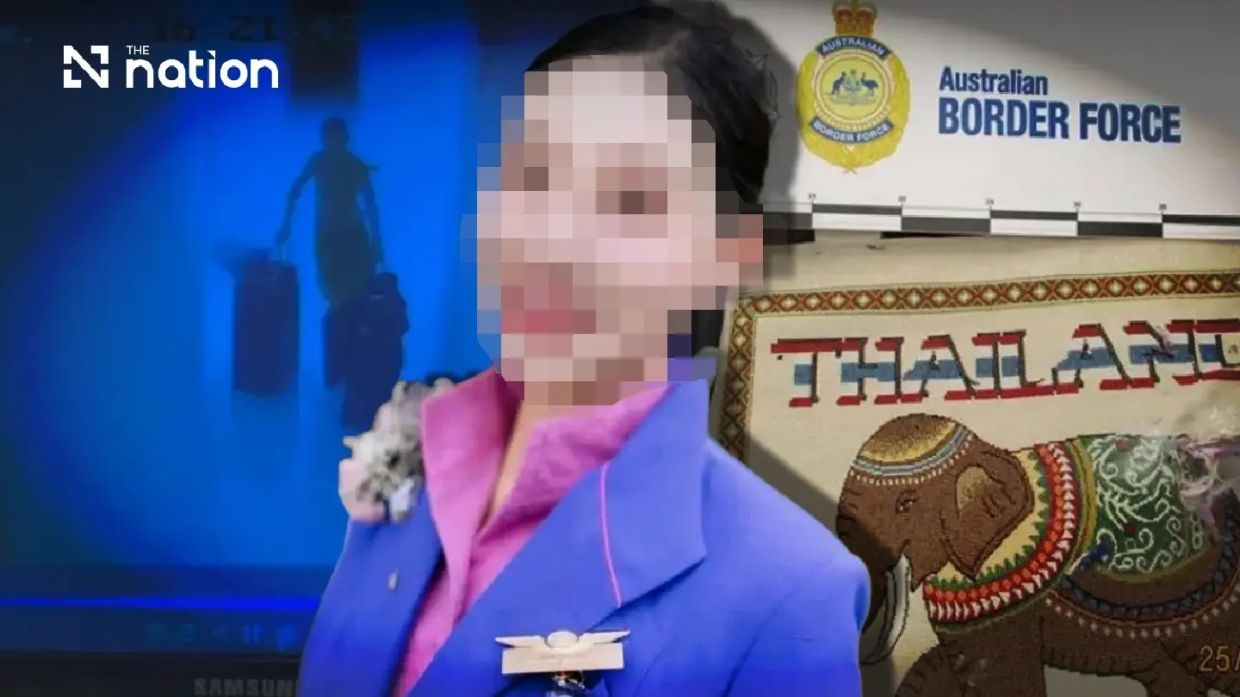
Thai narcotics authorities have significantly expanded their investigation into the arrest of a Thai flight attendant carrying 900 grammes of heroin through Melbourne Airport, with new evidence suggesting the case forms part of a sprawling transnational smuggling operation rooted in the Golden Triangle region. The Office of the Narcotics Control Board (ONCB), coordinating with security agencies and international law enforcement partners, is treating the matter as potential evidence of an organised criminal network that exploits airline workers through deception, rather than a simple case of individual drug trafficking.
Deputy Secretary-General Areepak Ngernbamroong clarified that the flight attendant's legal status remains that of a detainee pending investigation rather than a formally charged person, a distinction that carries significant implications for her potential defence and the trajectory of the inquiry. Thai authorities have compiled evidence and forwarded it to Australian Federal Police (AFP) and Thai consular officials to assist in her legal proceedings, signalling a nuanced investigative approach that acknowledges potential victimhood alongside criminal culpability.
The investigation has revealed a sophisticated modus operandi targeting frequent international travellers. According to findings, scammers operating avatar accounts on social media platforms mass-message flight attendants and other people who travel regularly across borders, offering payment in exchange for transporting parcels. This recruitment method has enabled criminal syndicates to establish reliable supply chains without requiring direct involvement of career smugglers, thereby reducing risks of detection at border checkpoints.
Parallel arrests in Bangkok have yielded more than 26 kilogrammes of heroin, and the Department of Special Investigation (DSI) has assumed primary responsibility for this portion of the case due to indicators of a large-scale transnational criminal organisation. The network appears segmented, with different groups handling procurement from source regions, logistics coordination, recruitment of unwitting couriers, and final distribution to end recipients. This compartmentalisation reflects advanced criminal enterprise structuring that complicates law enforcement efforts across jurisdictional boundaries.
A crucial figure in the Australian network goes by the alias Dear, identified as a Thai national with approximately ten years of residence in Australia whose immigration or citizenship status remains unclear. Investigators believe Dear operates as a primary receiver of narcotics shipments and has successfully coordinated multiple deliveries using identical methods, suggesting an established and trusted position within the wider distribution hierarchy. The AFP has taken charge of expanding investigations to identify the chain of custody beyond Dear and trace final recipients.
Details of the flight attendant's involvement paint a picture of potential manipulation. A delivery rider brought packages containing elephant-pattern bags to her residence, which she placed unopened into her suitcase after her boyfriend opened and inspected them, finding nothing suspicious. The suitcase cleared X-ray screening at the Thai departure airport without raising alerts, suggesting the heroin was somehow introduced during transit through Australia or was concealed in a manner that evaded initial detection mechanisms.
Payment arrangements further complicate the narrative of intentionality. Australian police identified a transaction of 8,800 baht (US$264), yet Thai investigators found no matching bank transfers in the flight attendant's accounts and discovered reports of smaller payments totalling 3,400 baht that could not be verified. The inconsistencies in payment records suggest either communication breakdowns within the smuggling operation or potential manipulation of the participant regarding actual compensation arrangements.
The involvement of Lao nationals in logistics chains points to established trafficking routes that leverage regional geography to circumvent interdiction efforts. Northern Thailand, where the Golden Triangle drug production region operates, has historically been a primary smuggling corridor, but intensified Thai enforcement has pushed networks toward north-eastern Thailand's border regions adjacent to Laos. The Mekong River crossings in provinces including Nakhon Phanom, Bueng Kan, Loei and Nong Khai represent vulnerabilities in border security infrastructure, with narrow waterways and expansive monitoring requirements enabling narcotics to enter Thai territory despite cooperation between Thai and Lao authorities.
Deputy Metropolitan Police Commissioner Pol Maj-General Theeradet Thumsuthee has characterised the operational network as fundamentally built upon scam mechanisms, employing psychological manipulation alongside financial inducements to exploit the specific vulnerabilities of airline workers. The targeting of flight attendants reflects calculation—these individuals possess both access to international travel and relative isolation during abroad assignments, making them susceptible to social engineering that creates perceived opportunities for easy income.
Investigators acknowledge remaining ambiguities about the flight attendant's level of awareness regarding the contraband nature of her cargo. The rider's statement that this represented his first delivery to her specifically, combined with her inspection of packages before packing, could indicate genuine deception by network operatives. However, alternative interpretations suggest deliberate feigned ignorance or willing participation with plausible deniability built into operational procedures.
The broader implications extend across Southeast Asia's air travel infrastructure and border security landscape. As organised crime networks become increasingly sophisticated in exploiting legitimate transport systems and personnel, aviation authorities and law enforcement agencies face mounting challenges distinguishing between complicit operatives and exploited participants. The case demonstrates how geographic production centres in the Golden Triangle remain connected to international distribution through adaptable criminal methodologies that continuously evolve in response to enforcement pressure.
Thailand's coordination with Australian authorities reflects recognition that effective disruption of these networks demands sustained cross-border intelligence sharing and joint investigative efforts. The ONCB's approach—preserving evidence for the flight attendant's legal defence while simultaneously pursuing network participants—balances humanitarian concerns with security imperatives, though ambiguities surrounding her culpability will likely persist throughout legal proceedings in Australia.

