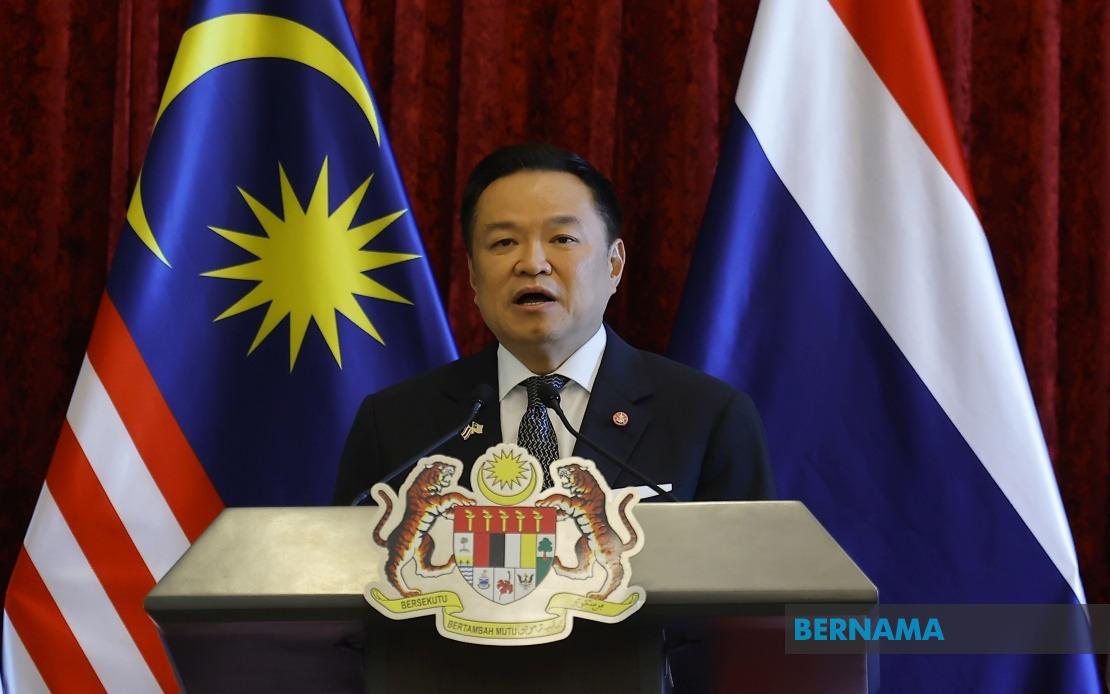
Thai Prime Minister Anutin Charnvirakul has reaffirmed his government's commitment to tackling persistent security challenges in the country's southern border provinces, describing the objective as among his administration's core priorities. Speaking during an official visit to Putrajaya on Thursday, Anutin outlined plans for Thailand and Malaysia to deepen their collaborative approach toward achieving lasting stability in one of Southeast Asia's most complex conflict zones.
The remarks came as Anutin held a joint press conference with Malaysian Prime Minister Datuk Seri Anwar Ibrahim, underscoring the two nations' shared stake in resolving a decades-long insurgency that has claimed thousands of lives and displaced communities across the border region. The Thai leader articulated a strategic vision linking security improvements directly to economic opportunity, arguing that sustainable peace creates the foundations necessary for meaningful development initiatives to take root and flourish in historically marginalised areas.
Anutin emphasised that Thailand and Malaysia would sustain intensive coordination mechanisms to advance both security operations and broader development projects across the border territories. This integrated approach signals recognition that military measures alone cannot resolve the underlying grievances and structural inequalities that have fuelled armed resistance in provinces including Yala, Pattani, and Narathiwat. The strategy implicitly acknowledges that addressing root causes—limited economic opportunity, educational disparities, and historical grievances—remains essential for achieving genuine reconciliation.
A significant component of the bilateral cooperation framework involves Malaysia's increasingly formalised role as facilitator of the Southern Thailand Peace Dialogue process. This mediation capacity represents a delicate diplomatic achievement, given Malaysia's own sensitivities regarding regional stability and cross-border security concerns. Anwar has sought to position Malaysia as a neutral, credible intermediary capable of maintaining relationships with multiple stakeholders in the conflict.
Anutin explicitly acknowledged Malaysia's diplomatic contribution, expressing appreciation for Anwar's clear positioning against violence and commitment to pursuing accountability for those responsible for attacks and killings. This public commendation reflects Thai recognition that Malaysia's willingness to engage in facilitation, despite potential domestic political complications, represents meaningful support for Thai-led peace initiatives. The statement also implicitly validates Malaysia's approach of maintaining engagement with various parties while upholding principled opposition to armed violence.
The peace dialogue framework involves negotiations between the Thai government and the Barisan Revolusi Nasional (BRN), the principal insurgent organisation operating in the southern provinces. These talks represent attempts to move beyond military stalemate toward negotiated settlements that might address insurgent demands for greater autonomy and cultural recognition whilst preserving Thai territorial integrity and sovereignty. Previous dialogue attempts have foundered on fundamental disagreements over autonomy provisions and the scope of any potential political settlement.
Malaysia's facilitation team is headed by Datuk Mohd Rabin Basir, a former director-general of the National Security Council who assumed this appointment on July 1, 2024. Basir brings substantial experience in national security matters and has been tasked with navigating complex discussions involving parties with deeply entrenched positions and competing visions for the region's future. His appointment signals Malaysia's serious commitment to the mediation process and willingness to deploy senior diplomatic talent toward conflict resolution.
Thailand's chief negotiator is Thanat Suwannanont, director of the National Intelligence Agency (NIA), whose intelligence background provides particular perspective on security dimensions of any proposed settlement. The composition of both negotiating teams reflects recognition that resolving the southern insurgency requires combining diplomatic skill with deep understanding of security architecture and intelligence operations. This technical expertise becomes essential when discussing practical implementation mechanisms for any ceasefire or political agreement.
The southern Thai insurgency has claimed an estimated 7,000 lives over two decades, with violence intensifying periodically despite various peace initiatives. Civilian populations have borne disproportionate costs, facing attacks on schools, markets, and transportation networks alongside military operations. The conflict's complexity arises from multiple factors: historical grievances rooted in the region's incorporation into the Thai state, religious and cultural differences, competition for resources, and involvement of external actors with varying strategic interests.
Malaysia's location and demographics make it a natural facilitator, given its Muslim-majority population and historical ties to communities in Thailand's southern provinces. However, this position also creates sensitivities regarding cross-border militant networks, refugee flows, and weapons trafficking that require careful management. Malaysian authorities must maintain credibility with Thai counterparts whilst avoiding appearance of harbouring or supporting insurgent groups, a balancing act requiring sustained diplomatic sophistication.
The bilateral cooperation framework reflects broader Southeast Asian interest in regional stability and counterterrorism cooperation. ASEAN mechanisms have increasingly focused on transnational security challenges, including militant financing, arms flows, and recruitment networks. Success in the southern Thai peace process could provide valuable lessons for other protracted conflicts in the region and demonstrate that sustained diplomatic engagement combined with security operations can achieve incremental progress toward conflict resolution.
Looking forward, the success of renewed dialogue efforts will depend on several factors: whether insurgent organisations demonstrate genuine willingness to engage in negotiations, whether Thai governments can offer sufficiently attractive settlements to compete with continued armed struggle, and whether international actors, including Malaysia, can sustain credible mediation without being drawn into supporting particular factions. These variables remain uncertain, but Anutin's public commitment and Malaysia's active facilitation role suggest renewed determination to pursue political solutions alongside security operations.

