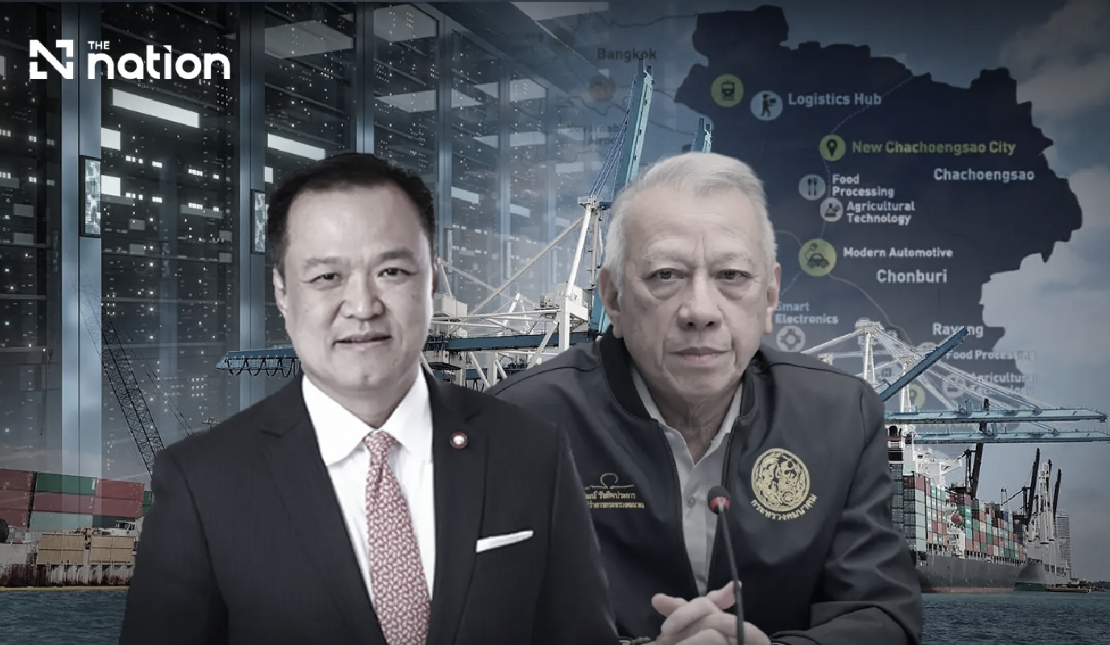
Prime Minister Anutin Charnvirakul has moved to reclaim direct oversight of Thailand's Eastern Economic Corridor, signalling a strategic recalibration of one of the kingdom's most ambitious regional development initiatives. The decision, formalised through Cabinet orders signed on June 15, transfers authority away from Deputy Prime Minister and Transport Minister Phiphat Ratchakitprakarn and positions Anutin as the principal architect of Thailand's revised pitch to international investors seeking to establish operations in Southeast Asia.
The reorientation reflects mounting recognition within Bangkok's policy circles that the EEC cannot sustain its traditional emphasis on heavy industrial manufacturing. Resource constraints—particularly acute shortages in electricity supply and freshwater availability in Thailand's eastern region—have rendered the conventional industrial development model economically unviable. Rather than persist with an outdated framework that struggles against infrastructure bottlenecks, the Thai government is attempting to reposition the corridor around emerging sectors where the eastern provinces possess genuine competitive advantages. This pragmatic pivot away from heavy manufacturing toward knowledge-intensive and agrifood sectors suggests a maturation in Thailand's economic diversification strategy.
The new investment framework centres on establishing the EEC as a global hub for food security, leveraging the eastern region's extensive agricultural and aquacultural resources. Thailand's livestock farming, fishery operations, fruit cultivation, and horticultural production constitute genuine national strengths, and positioning these sectors at the core of the EEC's international marketing could tap into intensifying global competition for agricultural supply chains. As geopolitical tensions increasingly disrupt food production networks worldwide, nations and multinational corporations are actively seeking to diversify their sourcing strategies away from singular dependencies. Thailand's established agricultural infrastructure and expertise position it to capture investment from food-security-conscious foreign enterprises seeking reliable regional production bases.
Equally significant is the government's determination to develop the EEC into a major data centre hub, a sector experiencing explosive growth across Asia as cloud computing, artificial intelligence applications, and digital transformation accelerate across the region. Data centres demand substantial and reliable electricity infrastructure coupled with advanced cooling systems dependent on abundant water supplies. Though these requirements initially appeared problematic given the eastern region's resource constraints, the government is addressing the electricity component through the Energy Ministry's preparation of a new Type 9 user category specifically designed for data centre operators. This category would impose higher tariffs reflecting the sector's intensive power consumption while simultaneously ensuring that data centre investment remains economically rational within Thailand's energy-pricing framework.
The administrative transfer also carries undertones regarding Thailand's ongoing tension between different visions of economic development. Phiphat's previous stewardship of the EEC occurred alongside his advocacy for the long-delayed three-airport rail project connecting Don Mueang, Suvarnabhumi, and U-Tapao airports. The project, which has remained mired in contractual disputes with Asia Era One since the concession was signed in 2019, has become emblematic of Thailand's infrastructure implementation challenges. While government statements deny that Anutin's decision reflects disagreement over the rail project or internal Bhumjaithai party tensions, the timing suggests broader frustrations with the EEC's performance under Phiphat's watch and the deputy premier's approach to managing complex public-private partnerships.
Goverment officials have emphasised that Phiphat voluntarily suggested the transfer, attributing the decision to chronic friction between the EEC Office and the Board of Investment. According to this account, Phiphat deemed the institutional environment too contentious and recommended that Anutin assume direct responsibility to eliminate the interagency conflict. This narrative, whether entirely accurate or partially expedient, suggests that the EEC's organisational structure has become dysfunctional, generating turf wars between competing agencies and impeding coherent investment promotion. Anutin's assumption of direct control theoretically consolidates decision-making authority and reduces the possibility of conflicting signals to potential investors.
The reshuffle also raises questions about strategic priorities that extend beyond the EEC itself. Government House sources indicate that Anutin questioned Phiphat's proposal to develop a Disneyland-scale entertainment complex within the EEC, apparently viewing such a project as speculative and lacking sufficient feasibility studies. This scepticism reflects a broader tension in Thai development policy between imaginative mega-projects with significant branding potential and more measured, evidence-based investment strategies focused on sectors where Thailand possesses demonstrable capabilities. Anutin's preference for food security and data centres suggests a desire to anchor the EEC's international marketing on rational economic analysis rather than aspirational grand schemes.
For Malaysian observers and businesses, Thailand's EEC repositioning carries important implications. As a competing regional investment destination, Malaysia must recognise that Thailand is actively refocusing its economic corridors toward sectors—particularly food security infrastructure and data centre development—where Malaysia itself faces significant strategic opportunities and challenges. Southeast Asia's rapid digital transformation and the intensifying global competition for reliable food supply networks create expanding opportunities for coordinated regional development. However, Thailand's attempt to establish itself as a regional data centre and agrifood hub also represents direct competition for investment capital that Malaysian policymakers are simultaneously attempting to attract toward their own economic zones.
The broader context illuminates Thailand's recognition that traditional heavy industrial development models face structural obsolescence across Southeast Asia. Rising labour costs, environmental regulations, and supply chain vulnerabilities have rendered the export-oriented manufacturing playbook that animated East Asian development in previous decades progressively less attractive. Thailand's pivot toward food security and digital infrastructure reflects this reality—future value creation increasingly derives from managing global supply chains in strategic commodities and providing the digital backbone that enables seamless commerce across borders and oceans.
Anutin's assertion of direct EEC control also signals his consolidation of the premier's economic portfolio, effectively positioning himself as the government's principal interface with foreign investors seeking to position operations within Thailand. This concentration of authority theoretically streamlines decision-making and reduces the institutional friction that plagued the corridor's previous administration. However, it simultaneously creates significant personal accountability for investment outcomes, exposing Anutin to criticism should the rebranded EEC fail to attract anticipated capital inflows or if the pivot toward food security and data centres proves as challenging as traditional manufacturing proved to be.
The technical establishment of the Type 9 electricity category for data centres represents one of several enabling infrastructure decisions the government must execute to render its EEC repositioning credible. Foreign investors evaluating data centre locations assess not merely tariff structures but long-term political stability, regulatory clarity, and infrastructure reliability. Thailand's willingness to create a dedicated utility framework for data centre operations signals seriousness about sector development, though implementation will prove equally important as policy design. If the Energy Ministry executes the Type 9 category effectively and consistently, Thailand could become an attractive secondary hub for companies diversifying away from overdependence on Singaporean or Hong Kong data centre infrastructure.
Moving forward, the EEC's success under Anutin's supervision will substantially hinge on whether the Thai government can transform rhetorical repositioning into concrete institutional change. The corridor's traditional image as a heavy industrial zone required decades to establish; rebranding it as a food security and digital innovation hub demands sustained diplomatic engagement with international agribusiness corporations, cloud computing providers, and technology firms. This outreach requires not merely political leadership but technical expertise in industrial policy, infrastructure coordination, and regulatory design.
Ultimately, Thailand's EEC reshuffle reflects broader patterns visible across Southeast Asia, where policymakers increasingly acknowledge that development models optimised for the 1990s and 2000s no longer generate comparable returns. As countries compete to position themselves within emerging regional supply chains for critical global commodities and digital infrastructure, those possessing both political stability and institutional coherence will capture disproportionate advantages. Whether Anutin's direct stewardship transforms the EEC into a genuinely competitive investment destination or merely postpones reckoning with deeper structural limitations will become apparent only through subsequent implementation and observable capital flows.