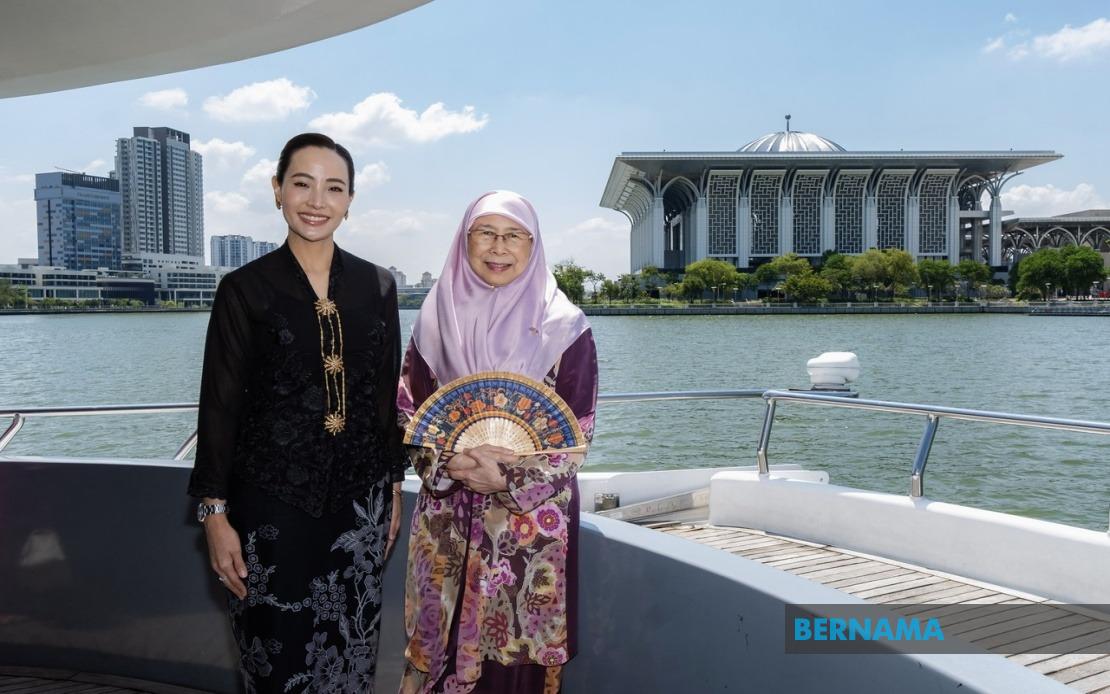
Thailand's First Lady Thananon Charnvirakul spent a contemplative afternoon cruising across Tasik Putrajaya on Thursday, soaking in sweeping vistas of Malaysia's purpose-built administrative hub and its celebrated architectural landmarks. The leisurely voyage, which lasted three-quarters of an hour, represented a gracious cultural interlude during a broader high-level engagement between Bangkok and Kuala Lumpur seeking to deepen economic and diplomatic bonds.
Thananon disembarked at approximately 12.10 pm to a warm greeting from Datuk Seri Dr Wan Azizah Wan Ismail, the wife of Prime Minister Datuk Seri Anwar Ibrahim. The reception underscored the protocol befitting a senior member of a neighbouring government's household, with both dignitaries engaging in animated conversation throughout the water-based tour. Their interaction, observed against Putrajaya's contemporary skyline and orderly landscape design, symbolised the informal yet substantive relationship cultivated between Malaysia and Thailand at multiple levels of governance and society.
Also participating in welcoming arrangements was Hannah Yeoh, the Minister in the Prime Minister's Department overseeing the Federal Territories portfolio. Her presence reflected the coordination across Malaysia's federal apparatus in orchestrating the visitor's programme, demonstrating how such ceremonial engagements integrate the efforts of various government bodies in showcasing the nation's institutional infrastructure and natural assets.
Thananon's excursion arrived as part of a carefully structured two-day official visit undertaken by her husband, Thai Prime Minister Anutin Charnvirakul, and herself. The couple had touched down in Malaysia earlier that day and received formal ceremonial honours at the Bunga Raya Complex of Kuala Lumpur International Airport, establishing the formal tone and diplomatic weight attached to the journey. Such reception protocols signal that Bangkok regards the engagement as substantive rather than perfunctory, a message reinforced through the scheduling of high-profile activities and ministerial interactions throughout their stay.
For Anutin, this represents his inaugural visit to Malaysia in his current capacity following his reappointment as Thailand's Prime Minister in March 2026. The timing carries significance: it marks his first opportunity to engage directly with Malaysian leadership in his restored role, allowing him to recalibrate bilateral relations and signal continuity in Thailand's commitment to regional partnerships. The gap between his reappointment and this visit suggests careful diplomatic choreography, with both governments coordinating their schedules to ensure the engagement receives adequate attention and can achieve substantive outcomes.
The visit materialised at Anwar's personal invitation, a gesture that conveys Malaysia's proactive role in nurturing Thailand ties. This invitation-driven approach differs subtly from routine exchanges, suggesting that Kuala Lumpur views strengthening Bangkok relations as a priority aligned with its broader strategic objectives in Southeast Asia. By extending the invitation, Malaysia positions itself as an initiator of regional dialogue, reinforcing its standing as a committed partner in advancing multilateral cooperation.
Official characterisations frame the visit as evidence of sustained mutual commitment to deepening long-established bilateral relationships. Malaysia and Thailand share extensive historical ties, geographic proximity, and overlapping interests spanning trade, security, tourism, and cultural exchange. The diplomatic language emphasising "longstanding bilateral ties" acknowledges this foundation whilst signalling intent to move beyond maintenance of existing arrangements toward genuine expansion of cooperative frameworks. This framing reflects recognition that regional stability and prosperity increasingly depend on robust bilateral relationships among ASEAN member states.
Cooperation in "areas of mutual interest" encompasses an expansive agenda. Thailand and Malaysia engage on transnational challenges including human trafficking, cross-border crime, terrorism prevention, and maritime security. Economic integration, particularly regarding trade in agricultural products, manufactured goods, and services, remains substantial. Tourism flows in both directions continue growing. These practical dimensions of bilateral engagement often proceed beneath the radar of high-level diplomatic visits, yet visiting delegations provide opportunities to review progress, identify obstacles, and recommit to collaborative goals.
The Putrajaya lake tour carried subtle symbolic weight. The administrative capital, consciously designed as a showcase of Malaysian governance and urban planning, offers international visitors tangible evidence of institutional development and national ambition. By orchestrating Thananon's exposure to these carefully curated landmarks, Malaysian hosts invited reflection on comparable development trajectories and governance models. Tasik Putrajaya itself, as the geographical centrepiece of the capital, functions as a metaphor for ordered harmony and rational planning—qualities that resonate across Southeast Asian governments pursuing development agendas.
Thailand and Malaysia maintain a relationship characterised by cooperation punctuated occasionally by friction over maritime boundaries, cross-border movements of populations, and differing approaches to regional security challenges. Official visits serve important functions in maintaining communication channels, preventing misunderstandings from calcifying into broader disputes, and creating opportunities for leaders to advance bilateral agendas. Anutin's visit, positioned as his first major international engagement following his return to the premiership, carries implications for how Thailand intends to prosecute its regional diplomacy.
For Malaysian observers, the visit reflects ongoing efforts to maintain stable, mutually beneficial relationships with immediate neighbours despite periodic tensions or differing strategic priorities. Thailand's stability matters significantly for Malaysia, given shared borders, transnational populations, and extensive commercial linkages. Reciprocally, Malaysian decision-makers understand that supporting Thailand's political stability and economic development serves Malaysian interests, reinforcing the logic of high-level engagement and cooperative frameworks.
The inclusion of Dr Wan Azizah in welcoming duties and participating in the lake cruise personalised the diplomatic exchange, moving beyond formal state protocol to create informal connection points between First Ladies. Such interactions, often overlooked in conventional political analysis, can establish private channels for communication and build personal rapport that occasionally translates into policy flexibility during negotiations. The visibility of this engagement also communicates to domestic audiences in both nations that bilateral relations enjoy political priority and personal endorsement from the highest levels.
As Anutin and Thananon progress through their remaining Malaysia schedule, further engagements will likely elaborate on the themes introduced during the Putrajaya visit—namely, enduring partnership, mutual respect, and confidence in shared prosperity. The choreography of such visits, from ceremonial receptions through cultural exposure, demonstrates how modern diplomacy melds formal protocol with substantive engagement, creating narratives that domestic constituencies interpret as evidence of national importance and international standing.

