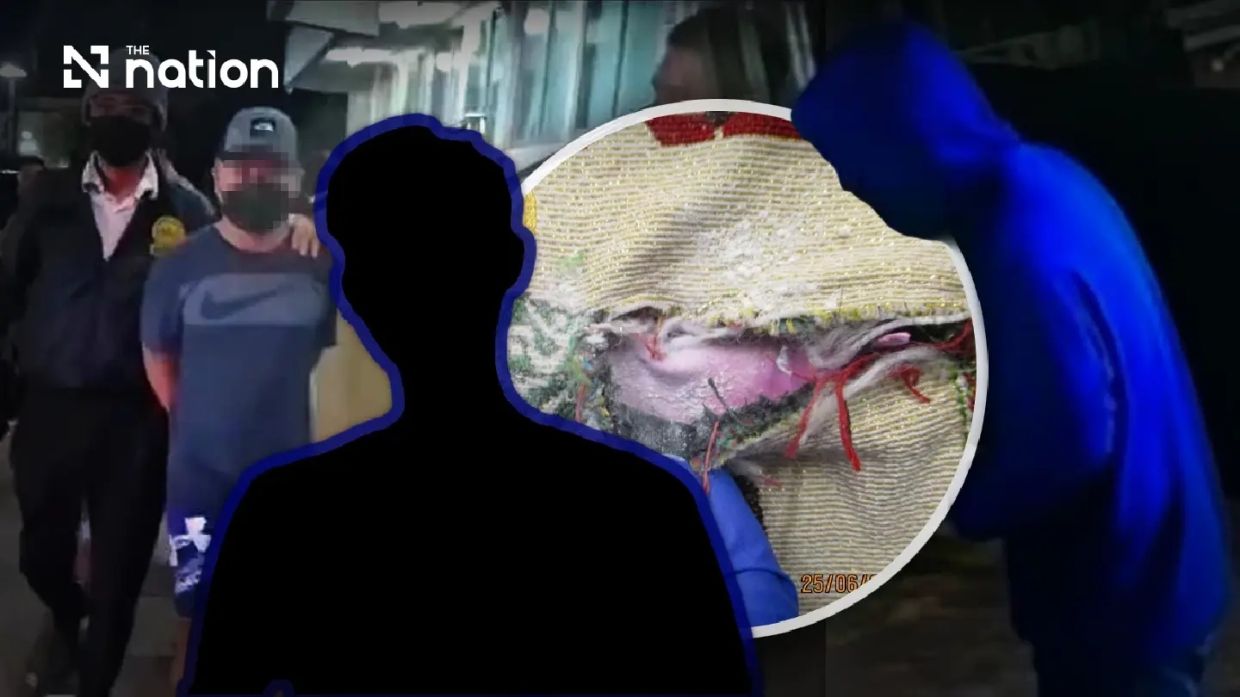
Thai authorities have arrested a man suspected of acting as a crucial middleman in a sophisticated heroin smuggling scheme targeting Australia, marking an escalation in police efforts to dismantle what investigators describe as a multi-tiered trafficking network operating across Southeast Asia.
Ekkawit was taken into custody overnight in Phayao province by Metropolitan Police Bureau officers, according to Pol Maj Gen Theeradej Thamsuthee, the bureau's deputy commissioner. The arrest represents a significant development in an investigation that has already netted several suspects, including a man in a blue hood and a female flight attendant, with authorities alleging that the heroin was destined for delivery in Australia concealed within an distinctive elephant-print fabric bag.
According to police allegations, Ekkawit served as a key logistics operator within the trafficking chain. Using the online alias "Rin Rin," he allegedly coordinated with Uthai, the previously arrested suspect, arranging for him to collect an elephant-print bag containing concealed heroin from Chiang Kham district in Phayao. Ekkawit then allegedly facilitated the onward transfer to a female flight attendant, who was tasked with transporting the contraband to Australia during a scheduled flight. This multi-step handoff approach appears designed to distribute risk and limit the visibility of any single participant to the broader network structure.
When questioned by investigators, Ekkawit reportedly acknowledged his role in the operation and stated he received THB100,000 for his involvement. He further claimed to have executed similar deliveries two or three times previously, suggesting this was not an isolated transaction but rather part of an established operational pattern. During preliminary questioning, he also provided police with crucial intelligence regarding "Rose Rose," another alias used by someone who allegedly recruited the flight attendant Mina to carry the smuggled cargo. This information proved instrumental in helping investigators map the network's communication architecture and identify secondary operatives.
The operational methodology uncovered by police reveals a carefully orchestrated supply chain. According to investigators' findings, Ekkawit purchased the elephant-print bag in Chiang Mai at the direction of the person using the Rose Rose alias. Once acquired, he would notify his contact, who would then arrange for an associate to retrieve the bag and have heroin inserted into its lining. Ekkawit claimed this concealment occurred in Laos, though police expressed scepticism about this assertion. After a delay of one to two days, Rose Rose would arrange for him to recover the now-laden bag, along with THB100,000 in cash, left at a predetermined kilometre marker location. Ekkawit would then orchestrate Uthai's receipt of the cargo by depositing THB60,000 into a cash machine account, completing his portion of the transaction.
Investigators have determined that the Rose Rose profile represents more than simply another trafficking participant but rather a coordination hub within the network. This person allegedly issued directives to Ekkawit and other associates, using encrypted chat messaging to contact and manage individuals willing to transport contraband. One such individual was Mina, the flight attendant, suggesting the network maintained multiple recruitment channels and operatives standing ready for deployment. Despite the anonymous nature of the account, narcotics police have accumulated detailed intelligence about the Rose Rose operator's actual identity, though this information remains undisclosed.
However, a crucial element of the investigation suggests the network extends beyond what authorities have thus far dismantled. Police believe the person behind the Rose Rose alias is not the ultimate leader of the trafficking organisation but rather occupies an intermediate command position. This assessment indicates the existence of a more senior organiser pulling strings from above, someone whose identity and operational scope remain unknown to investigators. Such hierarchical structures are common in major trafficking networks, allowing leaders to maintain distance from operational details and reduce their exposure to prosecution.
Ekkawit's connections to Rose Rose proved revealing during the investigation. Detectives determined the two men are close relatives, both hailing from Phayao province. Photographic evidence shows them travelling together on multiple occasions, reinforcing the family-based operational structure that appears to characterise this particular trafficking cell. This familial dimension adds complexity to law enforcement's approach, as family networks often demonstrate greater resilience and loyalty than purely commercial criminal partnerships.
The investigation has also zeroed in on Uthai's involvement, with police expressing doubts about his initial account. Uthai claimed to have participated in such operations five or six times, but detectives remained unconvinced, suspecting his testimony had been rehearsed before his arrest. Further investigation uncovered that Uthai had maintained a rented room in Phra Nakhon Si Ayutthaya province for at least five to six months, suggesting significantly higher operational frequency than he admitted. Police believe he may have served as a courier or distribution point far more often than acknowledged, possibly indicating additional clandestine operations yet to be unravelled.
Police have transferred Ekkawit to the custody of the Narcotics Suppression Bureau for continued interrogation, with his arrival scheduled for Friday evening on 10 July 2026. Pol Gen Samran Nuanma, deputy national police chief, was expected to personally question Ekkawit, reflecting the investigation's elevation to high-level priority. This personal involvement by senior command suggests the narcotics authorities view this case as having broader implications for understanding trafficking networks operating through Thailand and targeting Australia-bound routes.
The investigation underscores how modern drug trafficking has become increasingly compartmentalised, with operatives like Ekkawit serving as crucial bridge figures who insulate higher-ranking members from direct involvement in street-level activities. By fragmenting the supply chain across multiple jurisdictions and using family relationships combined with digital communication channels, these networks maintain operational continuity while complicating law enforcement's ability to trace connections upward. Authorities have signalled their intention to expand the investigation further, targeting the entire network infrastructure rather than settling for mid-level arrests, indicating a strategic determination to dismantle the organisation from its foundations.
For Malaysia and Southeast Asia more broadly, the case illustrates how transnational drug networks exploit regional geography, porous borders, and air transport infrastructure to move contraband across international boundaries. The involvement of commercial airline workers suggests recruitment channels within legitimate transportation sectors, a development that should concern both aviation authorities and law enforcement agencies throughout the region committed to disrupting such supply chains before they reach distribution markets.

