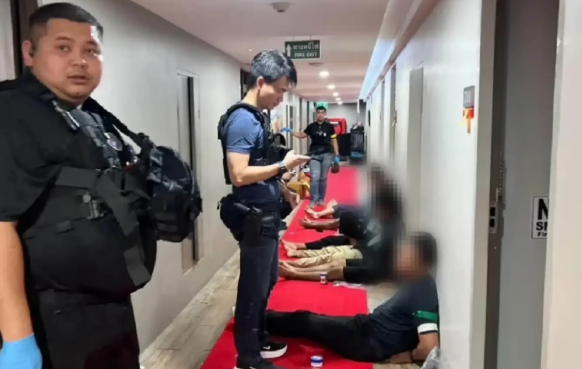
Authorities in Thailand have shut down what police describe as an elaborate underground operation disguised within a luxury hotel in Nonthaburi province, revealing the extent to which transnational criminal networks have infiltrated the hospitality sector in the Bangkok metropolitan region. The Central Investigation Bureau's Crime Suppression Division executed Operation "Dragon Nest" at the property on Ngam Wong Wan Road in Bang Khen subdistrict following weeks of investigation into what officials termed a sophisticated "grey dragon" network. The coordinated enforcement action, involving more than 100 police officers executing a Criminal Court warrant, represents a significant escalation in Thailand's efforts to tackle organised crime involving foreign syndicates and their local enablers.
The hotel raid uncovered an operation that had fundamentally transformed a commercial accommodation facility into what amounted to a clandestine leisure and vice complex. According to police accounts, the establishment's lower floors were repurposed as conventional residential quarters whilst upper levels—specifically the seventh and eighth storeys—functioned as dedicated spaces for prohibited gambling activities, narcotics consumption and arranged sexual services. This vertical compartmentalisation reflects a sophisticated operational security model designed to compartmentalise activities and minimise detection risk. The entire facility had reportedly been secured through an exclusive long-term lease by investors connected to what Thai authorities characterised as a Chinese capital group, effectively converting a legitimate business into a criminal enterprise operating beneath a veneer of legitimacy.
At the heart of the enforcement action was the detention of a 33-year-old Chinese national facing serious drug distribution charges. Police allegations centre on his possession of ketamine in quantities consistent with commercial distribution rather than personal consumption, alongside his purported involvement in facilitating the substance's circulation within the hotel's client network. During preliminary questioning, the suspect maintained his innocence regarding trafficking accusations, instead claiming he functioned merely as an employee executing delivery instructions without broader knowledge of the enterprise's scope. This assertion, whether credible or not, mirrors the defensive posture commonly adopted by intermediaries in transnational drug distribution networks who attempt to minimise their culpability by portraying themselves as expendable operatives rather than decision-makers.
Parallel arrests of three Myanmar nationals illuminate a secondary dimension of the operation—the systematic exploitation of irregular migrant labour to support the criminal infrastructure. All three individuals faced charges related to unlawful border crossing and unauthorised residency within Thai territory. Their admission during questioning that they had entered Thailand illegally specifically to secure employment within this operation indicates deliberate recruitment of undocumented workers, who carry minimal bargaining power and represent reduced prosecution risk compared to Thai nationals. This pattern reflects broader regional dynamics whereby human trafficking and irregular labour migration become intertwined with organised crime, creating vulnerable populations susceptible to coercion and exploitation.
The investigative genesis of the operation began with public complaints highlighting suspicious hotel behaviour inconsistent with standard tourism operations. Community observers noted that the establishment displayed unusual selectivity regarding clientele, apparently refusing conventional tourist bookings whilst maintaining continuous foot traffic involving Chinese nationals at irregular hours. Such inconsistent operational patterns—the hallmark of venues operating beyond legal parameters—eventually triggered official investigation that corroborated concerns and provided sufficient probable cause for law enforcement intervention. This citizen-initiated intelligence demonstrates the continuing value of community vigilance in identifying criminal activity, particularly within the tourism and hospitality sectors where legitimate business operations create convenient cover for illicit enterprises.
Police evidence seizures reveal the operational breadth of the confiscated establishment. Investigators recovered ketamine and "happy water"—colloquial designation for another category of synthetic intoxicant—alongside packaging and distribution apparatus indicating commercial-scale production or repackaging operations. Gambling infrastructure including chips, playing cards, dice, baccarat documentation and hi-lo gaming equipment substantiates allegations of systematic wagering activities operating beyond regulatory oversight. Electronic evidence in the form of mobile communication devices and CCTV system data captures likely proves instrumental to establishing operational timelines, identifying additional participants, and illuminating the broader network extending beyond the hotel's physical confines. Cash reserves and financial documentation will provide investigators insight into profit flows and potential money laundering arrangements.
The sophistication of this operation carries implications extending beyond Thailand's immediate law enforcement concerns. The phenomenon of transnationally-organised Chinese criminal groups establishing dedicated operational bases within Southeast Asian hospitality infrastructure reflects globalised criminal markets and the region's attractiveness as a location for vice tourism and money laundering. Malaysian authorities and regional governments confront comparable vulnerabilities within their own hospitality sectors, particularly in border regions and major tourist destinations where regulatory oversight remains inconsistent. The Nonthaburi case illustrates how legitimate commercial infrastructure can be captured and weaponised by criminal syndicates intent on servicing high-value clientele from their home countries.
The operation also raises questions regarding institutional capacity and coordination among Thai law enforcement agencies in countering sophisticated transnational crime. The involvement of the Central Investigation Bureau—Thailand's premier investigative body—underscores the seriousness with which authorities treated this matter, yet the apparent need for substantial uniformed deployment suggests potential gaps in undercover intelligence gathering or community policing approaches that might have facilitated earlier intervention. Moving forward, sustained pressure against similar operations will likely require enhanced coordination between Thai immigration authorities, narcotics enforcement, financial crime investigators and local police, supported by improved information sharing with regional partners including Malaysia, which faces comparable challenges from Chinese organised crime groups utilising Southeast Asian bases.
From a regional perspective, this enforcement action contributes meaningfully to broader efforts across Southeast Asia to constrain the operational freedom of transnational organised crime. The success in identifying, warrant-securing and executing a raid against a sophisticated clandestine operation demonstrates Thai law enforcement capacity and political will. However, the apparent targeting of this specific establishment raises questions about whether comparable venues continue operating undetected, protected through corruption, insufficient intelligence resources or deliberate enforcement prioritisation favouring high-profile cases. Malaysian authorities monitoring regional trends should note that the attraction of Southeast Asian destinations to Chinese organised crime groups—whether motivated by regulatory gaps, corruption vulnerabilities or geographic proximity to lucrative consumer markets—remains a persistent challenge requiring sustained multilateral cooperation and intelligence sharing.

